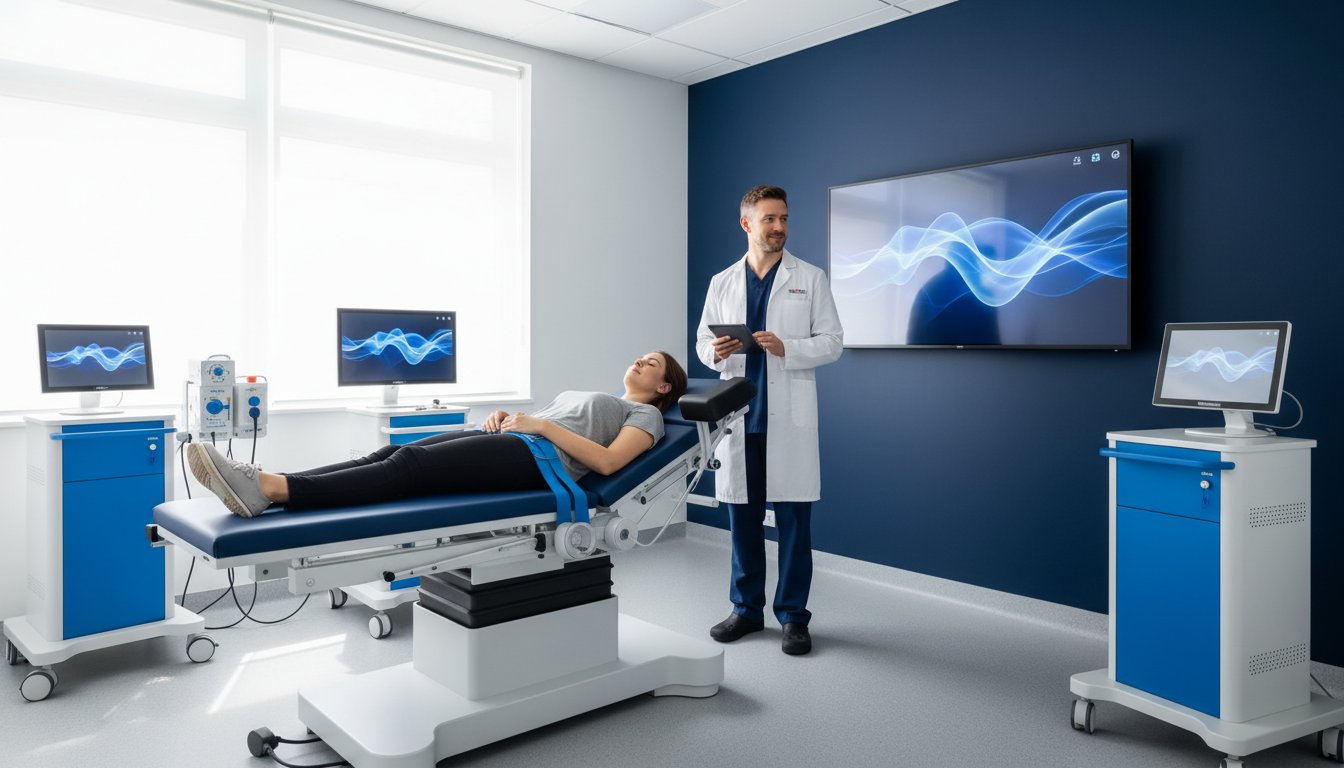
What if your recurring dizziness and racing heart aren't "invisible" medical mysteries, but simply require a different perspective to uncover? For many patients, the frustration of receiving "normal" results from standard heart scans while still feeling profoundly unwell is exhausting. You might feel that your symptoms are being dismissed because they don't appear on a resting ECG; it's also completely natural to feel anxious about a tilt table test, especially if you're worried about the prospect of fainting in a clinical setting.
Dr Ayyaz Sultan, an experienced Consultant Cardiologist, understands that these symptoms are very real and often indicate a complex interaction within your autonomic nervous system. In this guide, you'll discover exactly what happens during the procedure, how it's used to diagnose conditions like Postural Orthostatic Tachycardia Syndrome (PoTS), and why it's a vital tool for those who've found standard cardiac tests inconclusive. We'll also outline the safety protocols in place to ensure you feel supported throughout, providing you with the clarity needed to move forward with a personalised management plan and a clear path toward recovery.
Key Takeaways
- Understand how this diagnostic tool evaluates the autonomic nervous system's ability to regulate your blood pressure and heart rate during postural changes.
- Learn why a tilt table test is considered the gold standard for identifying Postural Orthostatic Tachycardia Syndrome (PoTS) and distinguishing between different types of syncope.
- Discover the essential clinical preparation required, including specific fasting instructions and guidance on managing your current medications safely before the procedure.
- Gain a clear, step-by-step walkthrough of the testing process to help alleviate anxiety regarding what happens during the monitored upright and baseline phases.
- Find out how to interpret your results and how these findings allow Dr Sultan to develop a personalised management plan tailored to your specific symptoms.
Table of Contents
-
What is a Tilt Table Test? Understanding the Gold Standard for Syncope
-
Why This Test is Essential for Diagnosing PoTS and Dysautonomia
-
Preparing for Your Tilt Table Test: Clinical Instructions and Safety
-
Interpreting Your Results and Next Steps in Your Cardiac Journey
What is a Tilt Table Test? Understanding the Gold Standard for Syncope
The tilt table test is a specialised diagnostic procedure used to evaluate how your body adapts to the stresses of gravity. Whilst standard investigations like a Transthoracic Echocardiogram or a resting Electrocardiogram (ECG) provide a vital "snapshot" of the heart’s structure and rhythm at rest, they often fail to capture the transient changes that occur when you move from lying down to standing up. This test effectively acts as a controlled clinical "stress test" for your autonomic nervous system (ANS), which is the intricate control centre responsible for managing your heart rate and blood pressure automatically.
Syncope is the medical term for temporary loss of consciousness caused by a fall in blood pressure. By monitoring your body’s real-time response to being tilted upright, Dr Sultan can identify precisely why your "autopilot" system might be malfunctioning. This approach moves the focus away from the heart's anatomy and towards its functional relationship with the nervous system.
To better understand how this procedure works in practice, watch this helpful video:
The Science of Orthostatic Stress
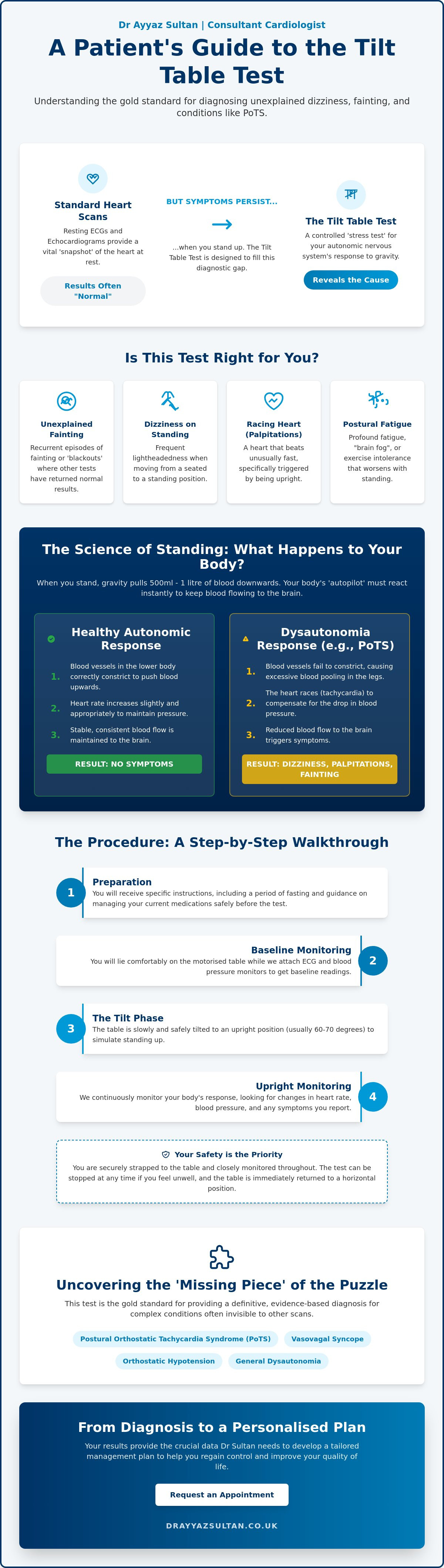
When you stand upright, gravity naturally pulls approximately 500ml to 1 litre of blood towards your lower limbs and abdomen. In a healthy system, your body triggers an immediate reflex: blood vessels constrict and your heart rate increases slightly to ensure the brain receives a constant supply of oxygenated blood. This is known as orthostatic stability. However, for those suffering from dysautonomia, this reflex is either delayed, exaggerated, or absent entirely. This failure can lead to a sudden drop in blood pressure or an inappropriate spike in heart rate, often resulting in the debilitating symptoms patients describe as "brain fog" or near-fainting.
Who Needs a Tilt Table Test?
Dr Sultan often recommends this evaluation for patients who experience recurrent, unexplained episodes of fainting or "blackouts" where standard cardiac screens have returned normal results. It's particularly essential for investigating complex multi-system conditions. You might be a candidate for a tilt table test if you experience:
-
Frequent dizziness or lightheadedness when moving from a seated to a standing position.
-
Palpitations or a racing heart specifically triggered by standing.
-
Chronic fatigue or "exercise intolerance" that seems linked to your posture.
-
Symptoms consistent with Long Covid complications or suspected Postural Orthostatic Tachycardia Syndrome (PoTS).
The goal is to move beyond guesswork and provide a definitive, evidence-based diagnosis that validates your physical experience. By uncovering the underlying cause of your symptoms, we can begin to develop a personalised management plan that addresses the root of the problem.
Why This Test is Essential for Diagnosing PoTS and Dysautonomia
For patients navigating the complexities of dysautonomia, standard cardiac tests often feel like looking for a needle in a haystack. Whilst an ECG can confirm your heart's rhythm is normal at rest, it cannot explain why you feel as though you might collapse the moment you stand. This is where the tilt table test becomes invaluable. It serves as the diagnostic bridge for those with multi-system conditions like Ehlers-Danlos Syndrome (EDS) and Mast Cell Activation Syndrome (MCAS), where the autonomic nervous system's regulation is often compromised. By providing a clear window into how your heart and brain communicate under stress, this test often provides the "missing piece" of the puzzle for those who have spent years seeking answers.
As noted by Johns Hopkins Medicine on Tilt Table Testing, this procedure is vital for unmasking specific triggers of fainting that other tests simply cannot replicate. It allows us to differentiate between a simple vasovagal response and more complex orthostatic intolerance, ensuring your treatment is based on physiological evidence rather than guesswork.
Unmasking Vasovagal Syncope
Vasovagal syncope is essentially an overreaction of the body to certain triggers, causing a sudden drop in heart rate and blood pressure. During the procedure, we aim to carefully induce this "fainting reflex." While the prospect of fainting might feel daunting, it's actually the clinical goal of the evaluation. By triggering these symptoms in a controlled environment, we can observe the characteristic patterns of your blood pressure falling rapidly whilst your heart rate slows. This provides the evidence needed to distinguish a simple fainting reflex from more complex orthostatic issues. You are safe throughout; the medical team is there to immediately return the table to a flat position the moment a reaction occurs.
The PoTS Connection: More Than Just a Fast Heart Rate
Postural Orthostatic Tachycardia Syndrome (PoTS) is frequently misunderstood as a simple anxiety disorder or general deconditioning. However, the diagnostic criteria are very specific: a sustained increase in heart rate of at least 30 beats per minute (or 40bpm in adolescents) within ten minutes of standing, without a significant drop in blood pressure. Standard resting tests miss this because they don't account for the sustained gravitational stress of being upright. Dr Sultan specialises in identifying these subtle autonomic markers, ensuring that patients with Long Covid or EDS receive a diagnosis that accurately reflects their internal physiological struggle. If you are struggling with unexplained dizziness, you may wish to book a specialised consultation to discuss your symptoms and explore whether this evaluation is right for you.
Preparing for Your Tilt Table Test: Clinical Instructions and Safety
Preparing for a clinical investigation often brings a mix of anxiety and relief, especially when you've been searching for answers for a long time. To ensure we gather the most accurate data regarding your autonomic response, specific preparation is required. Most patients are asked to fast for at least four hours for solid food, though you may continue to sip clear fluids like water until two hours before your appointment. This protocol helps to prevent nausea, which can sometimes occur if the tilt table test successfully reproduces your typical symptoms of dizziness or fainting.
Medication management is perhaps the most critical aspect of your preparation. Certain drugs, particularly beta-blockers, calcium channel blockers, or medications used to treat high blood pressure, can "mask" the very autonomic responses we are trying to observe. You should never stop any prescribed medication without a direct instruction from Dr Sultan; however, he will provide a personalised plan during your consultation regarding which treatments to pause temporarily. As the Mayo Clinic explains the tilt table test, these steps are vital for ensuring the results reflect your body's natural physiological state rather than a medicated one.
Whilst the test is designed to provoke symptoms, it is performed under constant specialist supervision. Because the procedure aims to unmask the causes of syncope, you may feel fatigued or slightly lightheaded afterwards. For this reason, you must arrange for someone to drive you home. We strictly advise against driving yourself or using public transport alone immediately following the evaluation, as your blood pressure and heart rate may take some time to return to their baseline levels.
What to Wear and What to Bring
Comfort is essential during your time in the clinic. We recommend wearing loose-fitting, comfortable clothing, ideally a button-down shirt or a top that opens at the front. This allows our clinical team to easily place the ECG leads on your chest without causing you unnecessary discomfort. It's also a good idea to bring a written list of all your current medications and dosages. Once the test is complete, you'll likely feel ready for a light snack and a drink, so feel free to bring something to eat during your recovery. Many patients also find it helpful to bring a friend or family member for emotional support whilst they wait for their results.
Addressing Your Concerns: Is the Test Safe?
It's completely natural to feel apprehensive about a test that might make you faint. However, the tilt table test is conducted in a highly controlled environment equipped with cutting-edge cardiac monitoring technology. Complications are extremely rare because the clinical team is trained to intervene the moment your vitals change. You'll notice safety straps across your waist and knees; these are not restraints, but rather security measures to keep you safely positioned on the table if you do lose consciousness. If symptoms occur, the table is returned to a flat position immediately, which usually resolves the faintness within seconds as blood flow to the brain is restored.
The Procedure Walk-through: What to Expect During the Test
Understanding the chronological steps of a tilt table test can significantly reduce the "fear of the unknown" that many patients feel before their appointment. The procedure is methodical and designed to gather data in stages, ensuring your safety whilst providing Dr Sultan with a clear picture of your autonomic health. You'll be in a quiet, clinical room where the environment is carefully controlled to prevent external factors from influencing your heart rate or blood pressure readings.
The first stage involves the initial monitoring setup. You'll lie flat on a specialised motorised table while a clinical professional attaches ECG leads to your chest to monitor your heart rhythm. A blood pressure cuff is placed on your arm for intermittent readings, and in some cases, a small cannula may be inserted into a vein in your arm if pharmacological provocation or blood sampling is required. Once you're connected to the monitors, we begin the baseline 'flat' period. This resting phase usually lasts 10 to 15 minutes, allowing your body to reach a steady state of relaxation so we can record your "normal" resting data before any gravitational stress is applied.
Next comes the 'Tilt' phase. The motorised table will slowly move you to an upright angle, typically between 60 and 70 degrees. You'll remain in this position for up to 40 minutes. You aren't standing on your own power; your feet rest on a sturdy footboard, and safety straps across your waist and knees provide security without restricting your circulation. During this time, the clinical team observes you closely, looking for changes in your vitals or the onset of your typical symptoms, such as lightheadedness or palpitations.
The Role of GTN (Glyceryl Trinitrate) Spray
If your body doesn't show a significant reaction during the initial tilt phase, we may introduce a provocation stage using Glyceryl Trinitrate (GTN) spray. This is a common clinical tool in the UK used to challenge the autonomic nervous system further. A small dose is administered under the tongue, which works by dilating your blood vessels and briefly stressing your body's ability to maintain blood pressure. It's common to experience a temporary headache, a slight flushing sensation, or a warm feeling in the face after the spray. These effects are short-lived and provide essential data on how your "autopilot" system responds to a sudden drop in vascular resistance.
Carotid Sinus Massage (for Patients Over 40)
For patients over the age of 40, an additional step called a carotid sinus massage is often performed. This helps us investigate carotid sinus hypersensitivity, a condition where the sensors in the neck are overly sensitive to pressure, often causing unexplained falls or faints in older adults. Whilst you are monitored, gentle pressure is applied to the carotid sinus area in the neck for a few seconds. If this causes a significant pause in the heart rate or a drop in blood pressure, it provides a clear diagnosis for previously mysterious "blackouts."
The final stage is recovery. The table is returned to a horizontal position, and you'll remain lying down for a further 10 to 15 minutes to ensure your vitals have stabilised. If you're ready to gain clarity on your symptoms through a professionally monitored evaluation, you can book your tilt table test with Dr Sultan today.
Interpreting Your Results and Next Steps in Your Cardiac Journey
Receiving the results of your tilt table test is often a moment of significant relief for patients who have spent months or even years searching for an explanation for their symptoms. A "positive" result is recorded when the procedure successfully reproduces your typical symptoms, such as lightheadedness or a near-faint, alongside measurable changes in your heart rate or blood pressure. This provides the clinical evidence needed to confirm a diagnosis of vasovagal syncope or Postural Orthostatic Tachycardia Syndrome (PoTS). It transforms an "invisible" struggle into a documented medical reality, allowing Dr Sultan to move forward with a targeted management plan.
A "negative" result, where symptoms do not trigger during the monitored period, does not mean your experiences are invalid. It simply suggests that your autonomic nervous system remained stable under the specific stresses of the test on that day. In these cases, Dr Sultan may recommend further investigations, such as 24-hour Holter Monitoring or a Cardiac MRI, to ensure no other underlying rhythm issues or structural concerns are being missed. The goal is always a comprehensive understanding of your cardiovascular health, ensuring that every potential cause is explored with meticulous care.
Developing a Personalised Treatment Plan
Once a diagnosis is confirmed, the focus shifts from investigation to empowerment through a lifestyle-based strategy. For many patients with dysautonomia, non-pharmacological interventions form the foundation of care. This often involves a structured increase in fluid and salt intake to help expand blood volume, alongside the use of medical-grade compression garments to prevent blood from pooling in the lower limbs. We also provide guidance on "counter-manoeuvres," which are physical techniques like leg crossing or tensing the abdominal muscles. These simple actions can be life-changing, as they help to manually boost blood pressure and prevent fainting during daily activities. If these measures are insufficient, Dr Sultan can discuss specific medication options designed to stabilise heart rate and vascular tone in more resistant cases.
Booking Your Private Consultation
The benefit of a private review is the luxury of time. Complex, multi-system conditions like Long Covid, MCAS, and EDS require a nuanced approach that standard, time-pressured appointments often cannot provide. Dr Sultan’s patient-centred philosophy ensures that your symptoms are heard, your concerns are validated, and your treatment is tailored to the unique rhythms of your life. By accessing a comprehensive cardiac evaluation, you're not just getting a test; you're gaining a partner in your long-term health and recovery.
Book a private consultation with Dr Ayyaz Sultan to discuss your symptoms and tilt table testing.
Taking the Next Step Toward Clarity and Recovery
A tilt table test is more than just a diagnostic procedure; it's a vital bridge between experiencing debilitating, "invisible" symptoms and gaining a clear, evidence-based path forward. By unmasking the specific triggers of your syncope or PoTS, this evaluation allows for the development of a truly personalised management strategy. Whether your journey involves lifestyle adjustments like increased fluid intake or more specific medical interventions, having a definitive diagnosis is the first step toward reclaiming your quality of life.
Dr Ayyaz Sultan has served as a Consultant Cardiologist since 2013, bringing a wealth of expertise to the management of complex autonomic conditions and dysautonomia. His patient-centred, holistic approach ensures that you aren't just another clinical record, but a person deserving of a compassionate and thorough investigation. You don't have to navigate these challenging symptoms alone. If you're ready to find the answers you've been searching for, book your private cardiac assessment with Dr Ayyaz Sultan today. We are here to support you through every stage of your diagnosis and recovery with the highest level of clinical care.
Frequently Asked Questions
How long does a tilt table test take?
A tilt table test typically takes between 60 and 90 minutes to complete from start to finish. This timeframe includes the initial setup of monitoring equipment, a 15-minute resting period to establish baseline data, the active tilt phase which can last up to 40 minutes, and a necessary recovery period. Dr Sultan ensures you aren't rushed through the process, as accurate data collection requires a calm and steady environment.
Will I actually faint during the tilt table test?
Fainting is a possible outcome but it doesn't happen to every patient during the procedure. The clinical objective is to replicate your symptoms in a safe environment so we can observe the physiological cause. If you do lose consciousness, the specialised table is returned to a horizontal position immediately; this usually restores blood flow to the brain and resolves the faint within seconds.
Can I eat before my tilt table test?
You must not eat for at least four hours before your appointment, although you may drink clear water until two hours before the test. This fasting period is a standard safety precaution to prevent nausea or vomiting, which can occasionally occur if the test successfully induces a vasovagal response. Following these instructions ensures your comfort and the clinical integrity of the results.
Is a tilt table test painful?
The procedure is non-invasive and is not considered painful. You might feel a slight pinch if a cannula is required for pharmacological provocation, and the GTN spray can sometimes cause a brief, throbbing headache or facial flushing. However, the tilting movement itself is smooth and painless, with safety straps providing secure support throughout the upright phase without restricting your circulation.
What happens if the tilt table test is negative but I still feel dizzy?
A negative result simply means your symptoms weren't triggered during that specific window of monitoring. It doesn't invalidate your physical experience or mean that nothing is wrong. Dr Sultan will review these findings alongside your clinical history and may suggest alternative investigations, such as a 24-hour Holter monitor or a Cardiac MRI, to uncover the underlying cause of your dizziness.
How soon will I get my tilt table test results?
You'll often receive a preliminary indication of the findings immediately after the test is completed. A comprehensive, formal report is usually finalised within a few working days once Dr Sultan has meticulously reviewed the recorded heart rate and blood pressure data. This detailed analysis is essential for creating an accurate and effective management plan tailored to your specific autonomic response.
Can I drive home after the procedure?
You cannot drive yourself home after the procedure and must arrange for a friend, family member, or taxi to collect you. Because the tilt table test is designed to challenge your autonomic nervous system, many patients feel fatigued or slightly lightheaded for a few hours afterwards. Your safety is our priority, and we advise resting for the remainder of the day following the evaluation.
Is the tilt table test safe for people with high blood pressure?
The procedure is perfectly safe for individuals with high blood pressure, also known as hypertension. Your blood pressure is monitored continuously throughout every stage of the procedure by our clinical team. In fact, the test is often a vital tool for determining whether your symptoms are caused by blood pressure fluctuations or a separate autonomic disorder like PoTS, ensuring you receive the correct treatment.