Get Found & Recommended by ChatGPT, Perplexity AND Google

  • โฐ You're 2.5 years behind competitors who do SEO.
  • ๐Ÿ“š We catch you up with 1 expert article daily + building trust (backlinks).

https://
216% Avg Traffic Increase
527+ Businesses Growing
Zero Technical Skills Needed
We write SEO articles in ๐Ÿ‡ฌ๐Ÿ‡ง English, ๐Ÿ‡ช๐Ÿ‡ธ Spanish, ๐Ÿ‡ซ๐Ÿ‡ท French and 97 other languages
https://yourwebsite.com/blog/article
Deep Research
Daily Articles + Backlinks
More Traffic
Alexandra Truta

"Content-wise the articles are good, with accurate info and nice formatting. Actually very impressive."

Alexandra Truta
MiniCRM.one ยท Copywriter

Read Example Article

Click anywhere to read

Research peptide supplier ยท Peptide Research AU

"Your Money Your Life"-Compliant Content
We're extra careful with health topics. We focus on helping YOUR business get MORE business, NEVER medical self-diagnosis.
Keyword: how to store peptides
2,986 words
Created: Feb 19, 2026

How to Store Peptides: A Researcher's Guide to Preserving Stability

The viability of your research hinges on the stability of your compounds. For researchers, understanding how to store peptides is a fundamental requirement, yet it remains a point of critical uncertainty. The risk of degradation is a significant concern, potentially invalidating results and leading to the loss of a substantial investment in research-grade materials. Confusion over correct temperatures for lyophilized powder versus reconstituted solutions can compromise the integrity of an entire study before it even begins.

This definitive guide eliminates that uncertainty. Here, we provide clear, science-backed protocols for the storage of both peptide forms to ensure maximum efficacy and longevity. By following these precise instructions, you will learn to prevent contamination, avoid common and costly errors, and gain the confidence that your compounds are maintained at optimal quality, preserving the value of your purchase and the integrity of your results.

Key Takeaways

  • Store lyophilized (freeze-dried) peptides in a freezer immediately upon arrival to maximise their long-term stability before reconstitution.
  • Once reconstituted into a liquid state, peptides require specific refrigerated conditions and have a significantly shorter shelf-life.
  • Understanding how to store peptides correctly means avoiding critical errors like repeated freeze-thaw cycles, which can degrade your research compounds.
  • Adhering to precise storage protocols is essential for maintaining peptide integrity and ensuring the accuracy of your research data.
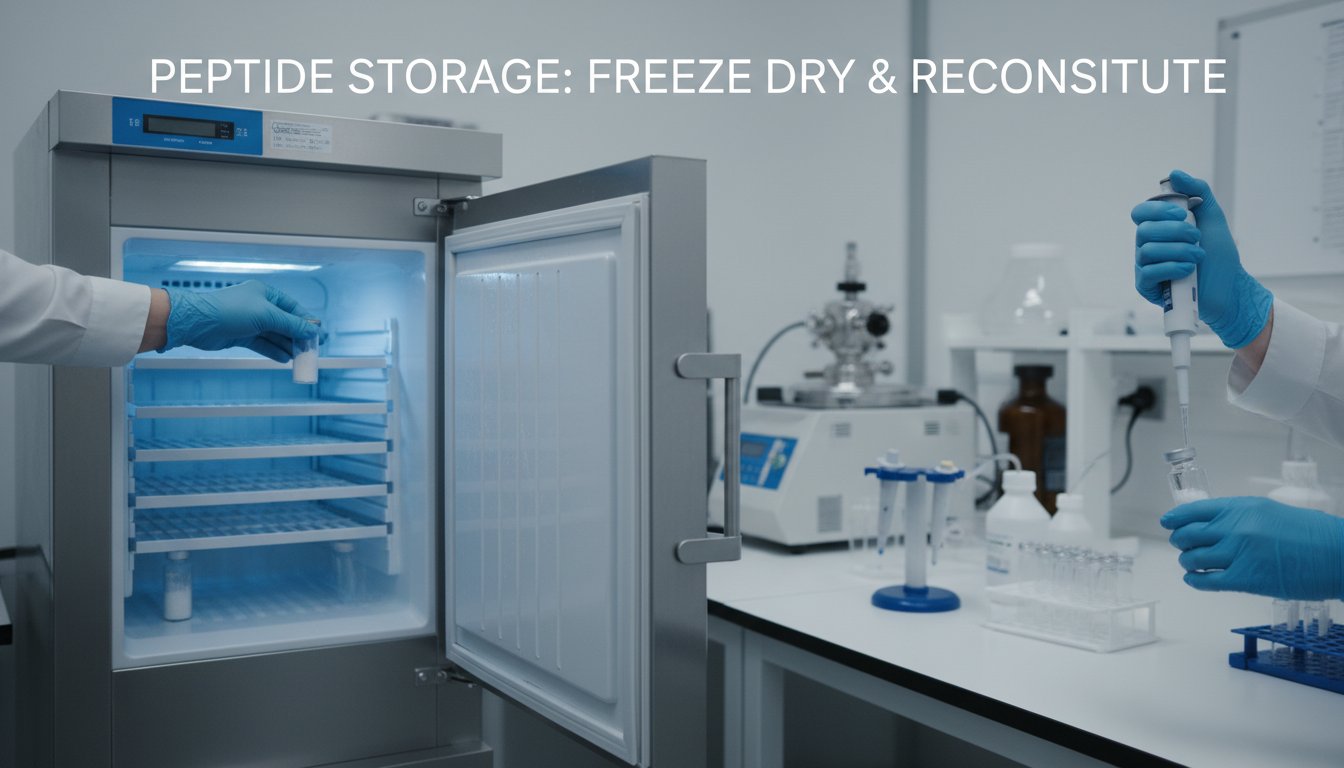
How to Store Peptides: A Researcher's Guide to Preserving Stability

The Two States of Peptides: Lyophilized vs. Reconstituted

To ensure the integrity and efficacy of your research compounds, understanding their physical state is paramount. The specific protocols for how to store peptides are dictated entirely by whether they are in their solid or liquid form. Researchers primarily handle peptides in two distinct states: lyophilized (a dry powder) and reconstituted (a liquid solution). Each state has a different level of stability and, consequently, requires a unique storage strategy to prevent degradation and maintain purity for accurate experimental results.

Understanding Lyophilized (Freeze-Dried) Peptides

Research-grade peptides are almost always shipped and received in a lyophilized, or freeze-dried, state. Lyophilization is a sophisticated dehydration process where water is removed from the peptide compound after it has been frozen and placed under a vacuum. This process sublimates the ice directly into vapour, leaving a stable, dry powder.

The primary purpose of lyophilization is to enhance long-term stability. By removing water, the process significantly reduces the potential for hydrolysis and microbial degradation, which are common pathways for molecular breakdown. This inherent durability is a core principle of peptide stability, making the lyophilized form ideal for shipping and extended storage. When stored correctly, these powders can remain viable for years, providing a reliable stock for ongoing research projects.

Understanding Reconstituted Peptides

A peptide is considered reconstituted once the lyophilized powder has been mixed with a sterile liquid diluent, such as bacteriostatic water or acetic acid solution. This process brings the peptide into a liquid solution, preparing it for administration in a research setting. While reconstitution "activates" the peptide for use, it also marks the beginning of its degradation cycle.

Once in a solution, peptides become far more susceptible to chemical and physical instability. They are vulnerable to proteases, oxidation, and aggregation, which can rapidly diminish their potency and purity. The shelf-life of a reconstituted peptide is drastically shorter than its lyophilized counterpart, often measured in weeks or months rather than years. Therefore, the approach for how to store peptides in their liquid state requires meticulous attention to temperature, light exposure, and handling protocols to preserve their structural integrity for the duration of an experiment.
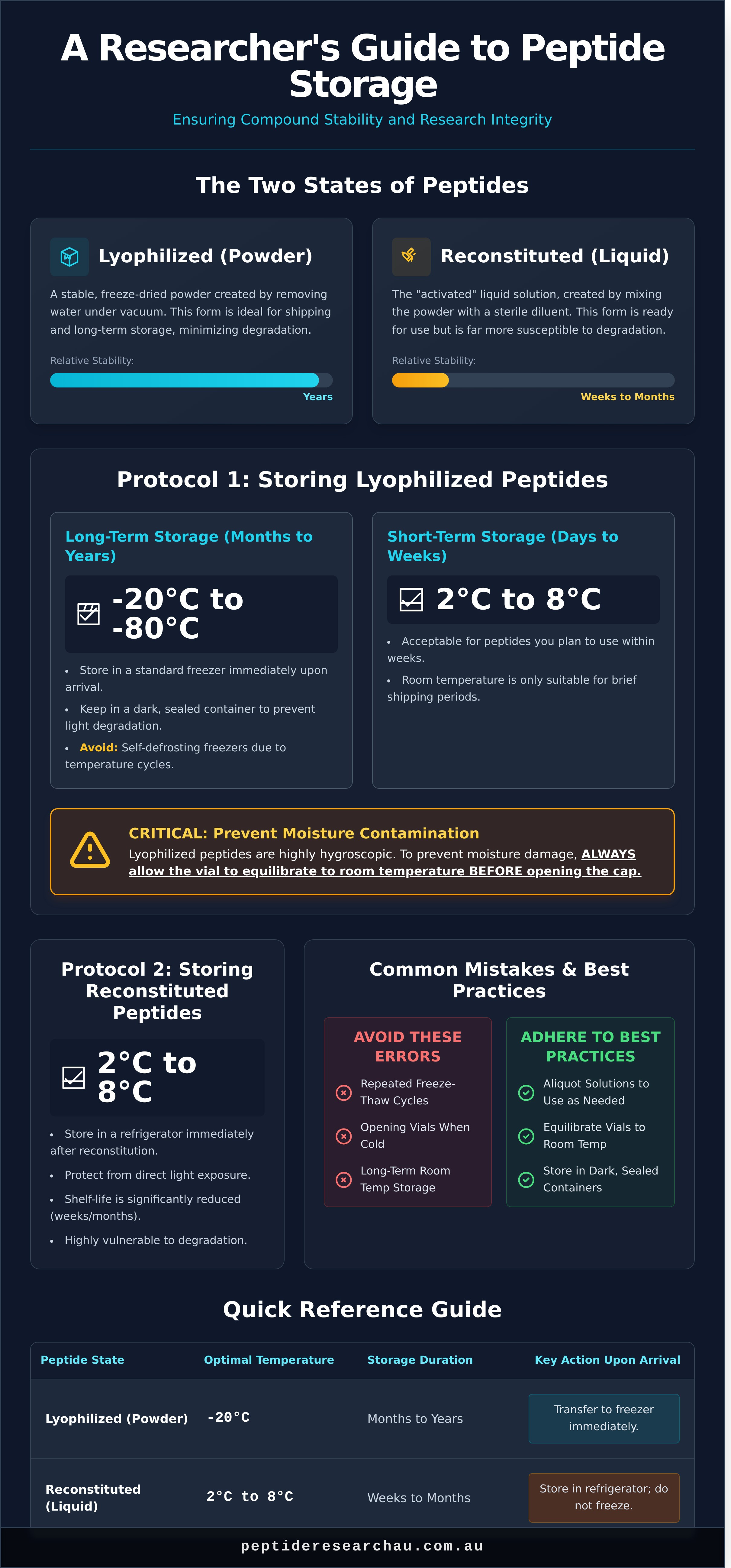
Peptide Storage Infographic

Protocol 1: Storing Lyophilized (Freeze-Dried) Peptides

Upon receiving your order, your first task is to inspect the vials and transfer them to appropriate storage immediately. The stability of lyophilized peptides depends entirely on two primary factors: temperature and moisture control. Understanding how to store peptides in their freeze-dried, pre-reconstituted state is the most critical step to ensure their long-term viability and the integrity of your research data.

Long-Term Storage (Months to Years)

For preserving research peptides for months or even years, the established gold standard is storage in a freezer at a temperature between -20ยฐC and -80ยฐC. For the majority of peptides, a standard domestic freezer, which typically maintains approximately -20ยฐC, is entirely sufficient. It is crucial to keep the vials in a dark, sealed container to protect the delicate compounds from light degradation. For comprehensive guidelines on best practices, including why it is advisable to avoid self-defrosting freezers due to their temperature cycles, the National Institute for Biological Standards and Control offers an authoritative resource on Peptide Handling, dissolution & Storage. When stored under these optimal conditions, lyophilized peptides can maintain their integrity for several years.

Short-Term Storage (Days to Weeks)

If you intend to reconstitute a peptide within a few weeks of receipt, storage in a refrigerator at 2ยฐC to 8ยฐC is an acceptable alternative. This method is suitable for compounds that will be used promptly in your research protocols. While our peptides are stable at ambient temperatures during their transit from our Australian facility to your laboratory, room temperature is not a viable condition for storage beyond this brief shipping window.

Critical Handling: Preventing Moisture Contamination

Lyophilized peptides are highly hygroscopic, meaning they readily absorb moisture from the air. This is their greatest vulnerability prior to reconstitution. When a vial is moved from a cold environment (freezer or refrigerator) to a warmer room, condensation can form on and inside the vial if it is opened prematurely. To prevent this damaging moisture ingress, you must always allow the vial to equilibrate to room temperature before opening the cap. This simple but critical step prevents atmospheric moisture from condensing onto the powder, which would initiate hydrolysis and compromise the peptide's structural integrity.

Protocol 2: Storing Reconstituted (Liquid) Peptides

Once a lyophilized peptide is reconstituted with a sterile diluent like bacteriostatic water, its chemical stability changes significantly. This liquid state is where the potential for degradation increases, making correct storage procedures paramount for preserving the compound's integrity and ensuring reliable research outcomes. The methods for how to store peptides in their liquid form are fundamentally different from storing them as a powder.

In solution, peptides are more susceptible to oxidation, microbial contamination, and degradation from pH or temperature fluctuations. Adhering to a strict storage protocol is not merely a recommendation; it is essential for maintaining the peptide's efficacy for the duration of your study.

The Correct Temperature and Location

The cardinal rule for storing reconstituted peptides is to maintain a constant, refrigerated temperature. The industry standard for research purposes is between 2ยฐC and 8ยฐC. A standard laboratory or domestic refrigerator is suitable for this purpose. Never leave a reconstituted peptide at room temperature for any extended period, as this will accelerate degradation rapidly.

For optimal stability, store vials in an upright position in the main body of the refrigerator, not in the door. The temperature in the refrigerator door fluctuates more frequently, which can compromise the peptide's structure over time.

Expected Shelf Life in Solution

The shelf life of a reconstituted peptide varies widely depending on its specific amino acid sequence. Some robust peptides may remain stable for several months when refrigerated, while others might only be viable for a few weeks. As a general guideline, most common research peptides will maintain their integrity for 4 to 8 weeks under proper refrigeration.

However, this is only an estimate. For precise information, it is critical to consult the Certificate of Analysis (CoA) or technical data sheet provided with your specific peptide, as it will offer stability data relevant to that compound.

Freezing Reconstituted Peptides: A Word of Caution

A common question regarding how to store peptides is whether they can be frozen after reconstitution. While freezing can extend the shelf life of some peptides, it can damage others. The primary risk comes from repeated freeze-thaw cycles, which can fracture the peptide's delicate structure and render it inactive. If you must freeze a solution, it is best to aliquot it into single-use volumes to avoid thawing the entire stock. We recommend avoiding freezing unless the peptide's data sheet explicitly confirms its stability under such conditions. To ensure maximum stability from the moment of reconstitution, always use high-quality diluents. Find research-grade bacteriostatic water for proper reconstitution.

Common Mistakes in Peptide Storage and How to Avoid Them

Ensuring the long-term stability and integrity of research-grade peptides requires meticulous attention to detail. Even minor errors in handling can lead to degradation, compromising the validity of your experimental results. Understanding the correct protocols for how to store peptides involves not just knowing what to do, but also what to avoid. This section outlines the most common storage mistakes and provides clear, actionable solutions to preserve the quality of your compounds.

Mistake #1: Repeated Freeze-Thaw Cycles

Each time a reconstituted peptide solution is frozen and thawed, it undergoes significant physical stress. The formation and melting of ice crystals can shear the delicate peptide structures, leading to denaturation and aggregation. This process irreversibly damages the compound, reducing its potency and purity with every cycle.

Solution: Upon initial reconstitution, divide the master solution into smaller, single-use aliquots. Store these individual vials in the freezer. This allows you to thaw only the amount needed for a single experiment, preserving the integrity of the main stock.

Mistake #2: Opening a Cold Vial

Opening a vial straight from the freezer or refrigerator is a critical error. The cold surface of the vial and its contents will cause moisture from the ambient air to condense inside. This introduction of water can lead to hydrolysis and microbial contamination, significantly shortening the peptide's shelf life.

Solution: Always allow the peptide vial to warm completely to room temperature before opening the cap. This simple, non-negotiable step prevents condensation and is one of the most effective ways to protect your peptide from degradation.

Mistake #3: Exposure to Light and Vibration

Peptides can be sensitive to environmental factors beyond temperature. Exposure to UV light, particularly from direct sunlight or certain laboratory lighting, can degrade photosensitive amino acid residues. Likewise, constant physical agitation or vibration-such as being stored on a freezer door-can promote peptide aggregation.

Solution: Keep peptide vials in a dark place. The original box or a light-blocking container is ideal. Store them in a stable, secure part of your freezer or refrigerator where they will not be subject to frequent movement or vibration.

Mistake #4: Assuming All Peptides Are the Same

While general guidelines are essential, it is a mistake to assume a one-size-fits-all approach. The stability of a peptide is highly dependent on its specific amino acid sequence. Some peptides are inherently robust, while others, particularly those containing cysteine, methionine, or tryptophan, are far more susceptible to oxidation and degradation.

Solution: Treat these protocols as a best-practice foundation. However, always refer to the product-specific data sheet or Certificate of Analysis for any unique storage requirements. Verifying this information is a crucial final step in learning how to store peptides correctly for your specific research application.

Peptide Storage Quick Reference Guide

To ensure the integrity and efficacy of your research compounds, proper storage is a non-negotiable aspect of laboratory protocol. This quick reference guide distills the most critical information from this article, providing an at-a-glance summary for your daily work. Use this guide as a convenient bookmark to reinforce the best practices for how to store peptides and protect your valuable research materials.

Following these clear, evidence-based guidelines will help preserve peptide stability, prevent degradation, and ensure the reproducibility of your experimental results. Incorrect storage can compromise the peptide's structure and function, leading to inaccurate data and wasted resources.

Storage Conditions at a Glance

The stability of a peptide is determined by its state-lyophilized (freeze-dried) or reconstituted (in solution). This table outlines the standard storage guidelines for maintaining peptide viability. For specific peptides, always consult the manufacturer's data sheet for any unique requirements.

Peptide State Temperature Duration Key Tip
Lyophilized (Long-Term) -20ยฐC Years Protect from moisture and light; store in a desiccator if possible.
Lyophilized (Short-Term) 2-8ยฐC Weeks Allow vial to warm to room temperature before opening to prevent condensation.
Reconstituted (In Solution) 2-8ยฐC Weeks Avoid repeated freeze-thaw cycles; use sterile, appropriate solvents.

Essential Storage Checklist

Follow these critical steps from the moment you receive your shipment to daily use. This action-oriented checklist helps maximise peptide viability and ensure consistent experimental outcomes.

  • โœ”๏ธ Received? Upon arrival, immediately transfer your peptides to the appropriate storage condition-typically a freezer (-20ยฐC) for lyophilized powder or a refrigerator for short-term needs.
  • โœ”๏ธ Lyophilized? Before opening a vial of freeze-dried peptide, always allow it to equilibrate to room temperature. This simple step prevents atmospheric moisture from condensing inside the vial, which can degrade the compound.
  • โœ”๏ธ Reconstituted? Once in solution, peptides are far less stable. Store them in a refrigerator at 2-8ยฐC and never at room temperature. Check product-specific data for recommended shelf life after reconstitution.
  • โœ”๏ธ Long-term liquid storage? If you must store a reconstituted peptide for an extended period, consider dividing the solution into single-use aliquots and freezing them. This minimises damage from repeated freeze-thaw cycles.

Mastering how to store peptides correctly is a fundamental aspect of responsible research. The process begins with quality compounds. Source your laboratory-grade peptides from a trusted Australian supplier who understands and implements proper handling and shipping protocols from the very start.

Safeguarding Peptide Integrity Through Correct Storage

Mastering how to store peptides is a non-negotiable skill for any researcher, directly impacting the validity and reproducibility of experimental outcomes. This guide has provided clear protocols, emphasizing the critical distinction between the long-term stability of lyophilized peptides at -20ยฐC and the delicate, short-term requirements of reconstituted solutions. By understanding these differences and diligently avoiding common mistakes-such as repeated freeze-thaw cycles and light exposure-you protect your investment and ensure the integrity of your valuable research materials.

Ultimately, a successful experiment begins long before the first measurement; it starts with sourcing superior compounds. As a trusted source for purity-tested research peptides, Peptide Research AU is committed to empowering scientific discovery by supplying laboratory-grade compounds across Australia. We ensure your work is built on a foundation of uncompromising quality. Ensure your research starts with the highest quality. Browse our laboratory-grade peptides.

Apply these principles with precision, and you can advance your research with full confidence in the stability of your compounds and the reliability of your data.

Frequently Asked Questions About Peptide Storage

How long can lyophilized peptides stay at room temperature during shipping?

Lyophilized peptides are highly stable and can typically withstand ambient temperatures during standard shipping times, often for several days up to a week, without significant degradation. This stability is a key advantage of their freeze-dried state. However, for optimal long-term preservation and to maintain the integrity of your research compounds, it is crucial to transfer them to a freezer, ideally at -20ยฐC, immediately upon receipt. This ensures the peptide remains viable for future reconstitution and use.

What happens if I accidentally leave my reconstituted peptide out overnight?

Leaving a reconstituted peptide at room temperature overnight will likely lead to significant bacterial growth and chemical degradation, compromising its stability and purity. The peptide's specific amino acid sequence and the ambient temperature will influence the rate of decay. To ensure the accuracy and validity of your research results, it is strongly advised to discard the compromised solution. Using a potentially degraded compound introduces unacceptable variables into experimental protocols and can invalidate your findings.

Can I store different reconstituted peptides in the same container?

Storing different reconstituted peptides in the same container is not recommended under any circumstances. This practice introduces a high risk of cross-contamination, which can lead to unpredictable chemical interactions between the compounds and render your experimental data invalid. For accurate and reproducible research, each peptide solution must be stored in its own sterile, clearly labelled vial. Proper segregation is fundamental to maintaining the purity and integrity of each individual research-grade compound in your laboratory.

Does the type of diluent (e.g., bacteriostatic water) affect storage life?

Yes, the choice of diluent significantly impacts the storage life of a reconstituted peptide. Using bacteriostatic water, which contains 0.9% benzyl alcohol, helps inhibit microbial growth and can extend the viable storage period in a refrigerator (2-8ยฐC) to several weeks. In contrast, peptides reconstituted with sterile water lack this preservative and are more susceptible to contamination, limiting their refrigerated storage life to only a few days. Always consult the peptide's specific data sheet for diluent recommendations.

How can I tell if my peptide has degraded?

Visual inspection is often unreliable for detecting peptide degradation. While changes such as cloudiness, discoloration, or particle formation in a reconstituted solution are clear indicators of a problem, degradation can occur without any visible signs. The only definitive method to confirm peptide integrity is through analytical techniques like HPLC. Therefore, the most effective strategy is prevention. Following precise guidelines on how to store peptides correctly is the best way to ensure their stability and the validity of your research.

Is it better to use a frost-free freezer for long-term peptide storage?

A frost-free freezer is not recommended for the long-term storage of peptides. These units undergo regular, brief temperature cycles to prevent ice build-up, and these fluctuations can accelerate peptide degradation over time. For optimal stability, a standard manual-defrost freezer that maintains a constant -20ยฐC or lower is the superior choice. This is a critical detail in understanding how to store peptides to preserve their integrity for the duration of your research project.

AI financial forecasting ยท GrowthGrid

Keyword: financial forecast for startup
2,837 words
Created: Feb 19, 2026

Financial Forecast for Startup: A Step-by-Step Guide for Founders

Does the thought of building a financial forecast for your startup make your head spin? You're not alone. Staring at a blank spreadsheet, trying to predict revenue, costs, and cash flow can feel overwhelming, especially when you're not a finance expert. You know you need a credible financial forecast for startup success-to secure funding, guide your decisions, and prove your business model. But the fear of getting the numbers wrong and looking unprepared for investors is real.

Forget the stress and complexity. This guide is your step-by-step roadmap to building a professional, investor-ready financial forecast without the headaches. We'll break down the entire process into simple, actionable steps. You'll learn exactly what to include, how to base your assumptions in reality, and how to present your numbers with confidence. By the end, you won't just have a spreadsheet; you'll have a powerful tool to drive your startup's growth and understand its true potential. Let's build it together-the smart way.

Key Takeaways

  • Your financial forecast is more than just numbers-it's the strategic roadmap for your growth and the proof investors need to see.
  • Master the three core financial statements (Income, Cash Flow, Balance Sheet) to get a complete, 360-degree view of your business health.
  • Learn the bottom-up method to build a credible financial forecast for startup success based on specific, defensible assumptions investors trust.
  • Sidestep the 4 most common forecasting mistakes to save time and create a more accurate financial model from day one.
Financial Forecast for Startup: A Step-by-Step Guide for Founders

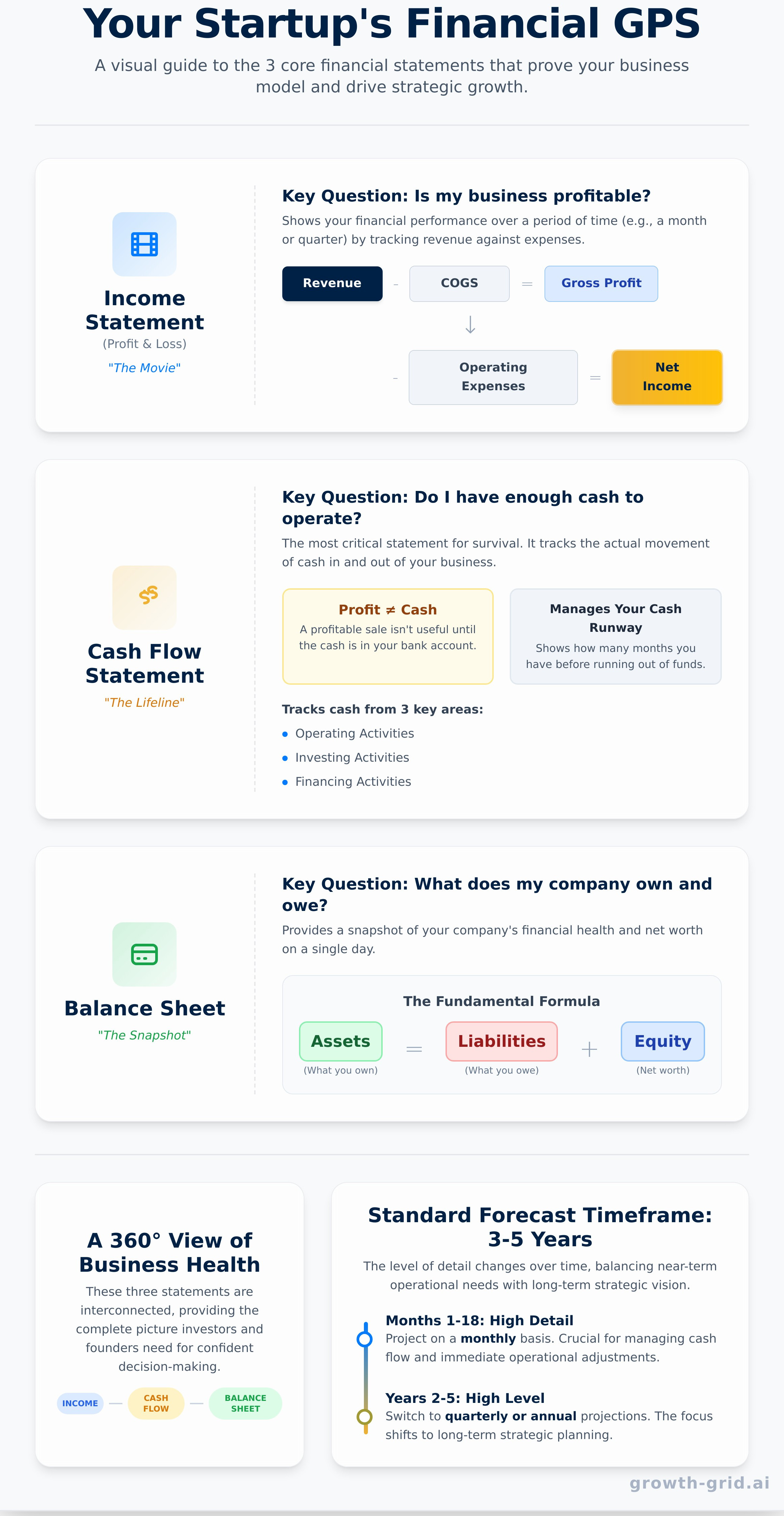
What is a Financial Forecast? (And Why It's Your Startup's GPS)

Think of a financial forecast as your startup's GPS. It shows you where you are now, where you're headed, and the resources you'll need to get there. In simple terms, it's your business's story, told in numbers-a detailed prediction of your future revenues, expenses, and cash flow. It's not a wild guess; it's an educated estimate based on data, market research, and your strategic assumptions.

Your forecast serves two critical roles. Internally, it's your strategic roadmap. Externally, it's the proof investors and lenders need to see. A solid financial forecast for startup founders is non-negotiable; it's the first thing a potential backer will ask for to validate your business model's viability. And don't confuse it with a budget. A budget is a plan for what you intend to spend, while a forecast is a prediction of what you expect to happen.

More Than Just a Fundraising Tool

While essential for securing capital, a forecast's real power is in day-to-day decision-making. It transforms your goals from abstract ideas into concrete financial targets. It's the tool that helps you:

  • Guide strategic decisions: Can we afford that new hire? Is now the right time to double our marketing spend? Your forecast has the answers.
  • Manage your cash runway: Know exactly how many months of operation you have left and when you need to act to avoid running out of funds.
  • Set clear KPIs: Track your progress against your projections to see if you're on target, celebrating wins and quickly correcting course when needed.

Key Timeframes: Your First 3-5 Years

The industry standard is a 3-5 year financial forecast. This timeframe is long enough to showcase your long-term vision but short enough to remain grounded in reality. However, the level of detail changes over time. Your model should use various forecasting methods to project with different levels of granularity:

  • Months 1-18: Project on a monthly basis. This high-detail view is crucial for managing cash flow and making immediate operational adjustments.
  • Years 2-5: Switch to quarterly or even annual projections. As you look further into the future, the focus shifts from tactical management to high-level strategic planning.
Financial Forecast Infographic

The 3 Core Statements of Your Financial Forecast

Diving into financial statements can feel overwhelming. But don't worry-you don't need an accounting degree to get this right. Think of your financial forecast for a startup as three different camera angles on your business's health. Together, they create the full picture investors and lenders need to see.

Here's a simple way to remember the two most important statements:

  • The Income Statement is like a movie, showing your performance over a period of time (e.g., a month or a quarter).
  • The Balance Sheet is a snapshot, showing your financial position on a single day.

Let's break down the "big three" so you can build them instantly.

The Income Statement (Profit & Loss)

This statement answers one critical question: Is my business profitable? It tracks your financial performance over time by subtracting costs and expenses from your revenue. Focus on these key lines:

  • Revenue: All the money your business earns from sales.
  • Cost of Goods Sold (COGS): The direct costs of creating your product or service.
  • Gross Profit: Your Revenue minus COGS.
  • Operating Expenses: Costs to run the business, like rent, marketing, and salaries.

What's left after all expenses are paid is your Net Income-the famous "bottom line."

The Cash Flow Statement

This is the most critical statement for survival. It answers: Do I have enough cash to operate? Profit doesn't equal cash in the bank. You might have made a $10,000 sale (profit!), but if the invoice isn't paid for 60 days, you don't have the cash. This statement tracks the actual movement of cash through three areas: operating, investing, and financing activities. A healthy cash flow keeps the lights on.

The Balance Sheet

This statement provides a snapshot of your company's net worth at a specific point in time. It answers: What does my company own and owe? It's all based on a simple, powerful formula:

Assets = Liabilities + Equity

These three statements are the foundation of all solid financial projections for your business plan, providing the clarity needed for smart decisions. Here's what each part means:

  • Assets: What your company owns (e.g., your work laptop, cash in the bank).
  • Liabilities: What your company owes (e.g., a small business loan, credit card debt).
  • Equity: The value left over for the owners (Assets - Liabilities).

How to Build Your Forecast: A 5-Step Bottom-Up Method

Forget vague, top-down guesses like "we'll capture 1% of the market." Investors see right through them. The most practical and credible way to build a financial forecast for a startup is with a bottom-up approach. Why? Because it's built on specific, defensible assumptions about your actual operations.

This method forces you to think like an operator, not a dreamer. You'll connect your marketing activities to sales, your sales to costs, and your growth to your hiring plan. It's the only way to create a forecast that tells a believable story. Let's build it step-by-step.

Step 1: Forecast Your Sales & Revenue

Start with the drivers you can actually control. Instead of guessing a revenue number, calculate it. For an e-commerce or SaaS business, a simple formula is your foundation:

Website Traffic x Conversion Rate x Average Purchase Price = Revenue

Build your model based on realistic marketing plans and conversion data. It's smart to create three scenarios: worst-case, realistic, and best-case. This shows investors you've considered risk and opportunity.

Step 2: Project Your Cost of Goods Sold (COGS)

COGS are the direct costs tied to producing or delivering your product. For a physical product, this includes raw materials and direct labor. For software, it might be server hosting fees, data APIs, or transaction fees. Calculating your COGS is critical because it determines your Gross Margin-a key indicator of your business's profitability and scalability.

Step 3: Detail Your Operating Expenses (OpEx)

OpEx are the costs required to run your business, outside of COGS. These are your everyday expenses to keep the lights on and the business growing. They typically fall into two main buckets:

  • SG&A (Sales, General & Administrative): This includes marketing spend, salaries for non-product staff, rent, software subscriptions, and legal fees.
  • R&D (Research & Development): These are the costs to develop and improve your product, including salaries for your engineering team.

Step 4: Create a Headcount & Salary Plan

For most startups, payroll is the single largest expense, so it deserves its own step. Map out your hiring plan by role, projected start date, and base salary. Don't forget to include the "fully-loaded" cost-add an extra 20-30% on top of salary to cover payroll taxes, insurance, and benefits. This is a common oversight that can wreck a forecast.

Step 5: Consolidate and Generate Your Statements

Finally, bring all your assumptions together. Your revenue forecast, COGS, OpEx, and hiring plan are the inputs that feed your three core financial statements. Manually connecting these moving parts in a spreadsheet is slow and full of risk. One broken formula can invalidate the entire model.

This is where your assumptions become a professional financial forecast for your startup. A smart tool can handle the complex connections instantly, ensuring accuracy and saving you days of frustration. Let AI build your financial statements in minutes.

Top-Down vs. Bottom-Up Forecasting: What Investors Want to See

When crafting your financial projections, you'll face two main approaches: top-down and bottom-up. It's not about choosing one over the other. Think of them as two essential tools that serve different, complementary purposes.

A winning business plan uses a detailed bottom-up forecast as its foundation, then uses a top-down analysis as a high-level "sanity check." This powerful combination shows investors you are both ambitious and grounded in reality-a founder who dreams big but has a concrete plan to get there.

The Top-Down 'Sanity Check'

The top-down approach starts with the largest possible number-your Total Addressable Market (TAM)-and works its way down. You estimate the percentage of that massive market you can realistically capture over time. This method is incredibly useful for one key thing: showing investors the sheer scale of the opportunity. It answers the question, "How big can this possibly get?"

Warning: Never use this as your primary forecasting method. Simply stating "we'll capture 1% of a $20 billion market" is a huge red flag for any serious investor. It shows a lack of tactical planning.

The Bottom-Up 'Credibility Builder'

This is where you earn your credibility. The bottom-up method is the core of a believable financial forecast for startup success. It starts with your actual, real-world operational capacity and builds your revenue forecast from the ground up. It's based on tangible business drivers you can control and measure.

  • โœ“ Example (SaaS): "Our two sales reps can each make 50 calls a day, and our historical conversion rate is 2%. That means we can close two new deals per day."
  • โœ“ Example (E-commerce): "Our marketing budget will drive 10,000 website visitors per month. With a 3% conversion rate and a $50 average order value, we project $15,000 in monthly revenue."

This is the forecast you will be judged on. It proves you have a realistic, data-driven plan to achieve your goals.

Ultimately, your top-down numbers show the size of the prize, while your bottom-up forecast provides the step-by-step map to win it. Getting this balance right is critical for securing funding. Need to build a professional, investor-ready forecast fast? The tools at GrowthGrid can generate your complete financial plan in minutes, saving you weeks of work.

Avoid These 4 Common Forecasting Mistakes (The Smart Way)

Every founder makes assumptions that turn out to be wrong. That's part of the journey. But some mistakes are entirely avoidable-unforced errors that can damage your credibility with investors. A solid financial forecast for startup success is about anticipating these pitfalls and building a plan grounded in reality.

Learn from others so you can focus on what matters: growing your business.

Mistake 1: The Unrealistic 'Hockey Stick' Growth

Investors have seen thousands of 'hockey stick' graphs promising explosive, overnight growth. It's a red flag. Instead of just showing a steep curve, tie your growth to tangible drivers. For example: "We will hire 3 new salespeople in Q3, each expected to close 5 deals per month, which drives our revenue growth." Show your work; don't just state the result.

Mistake 2: Forgetting That Cash is King

Profitability on paper means nothing if you don't have cash in the bank to pay your bills. This is a classic startup trap. Late-paying customers (accounts receivable), inventory costs, and loan repayments can drain your cash reserves even when you're 'profitable'. Your cash flow forecast isn't an afterthought; it's your early warning system.

Mistake 3: Underestimating Costs

Optimism is a founder's superpower, but it can be a liability when it comes to expenses. It's easy to forget the 'hidden' costs that add up fast: payroll taxes, employee benefits, software subscriptions, and professional fees. A smart move? Add a 10-15% contingency buffer to your expense forecast for the inevitable surprises.

The Old Way vs. The Smart Way

Building your financial forecast for startup capital doesn't have to be a nightmare. You have a choice.

  • The Old Way: Wasting hours fighting with broken Excel formulas and guessing at the right structure, only to miss key sections investors expect to see.
  • The Smart Way: Answering simple questions and letting AI generate a professional, comprehensive forecast in minutes, using a proven, investor-ready structure.

Ready to skip the spreadsheet stress and focus on strategy? Stop stressing over spreadsheets. Generate your forecast now.

From Complex to Confident: Your Next Steps

Building a robust financial forecast for your startup is no small task, but it's the most critical step in turning your vision into a fundable reality. Remember, your forecast isn't just a spreadsheet-it's your strategic GPS. By adopting a detailed, bottom-up approach and avoiding common pitfalls, you create a credible narrative that investors will trust and respect.

The old way means wrestling with complex formulas for weeks. The smart way means getting it done in minutes. Why spend 40+ hours on something you can automate? Trusted by thousands of startups, GrowthGrid gives you the power to create a professional, accurate forecast instantly. It's fast, efficient, and backed by our 100% Satisfaction Guarantee.

Generate Your Investor-Ready Financial Forecast in Minutes โ†’

You have the big idea. Now, get the numbers to prove it.

Frequently Asked Questions

How far out should a startup forecast its financials?

Most investors expect a three-to-five-year financial forecast. Your first year should be detailed month-by-month to manage cash flow effectively. For years two through five, you can switch to quarterly or annual projections. This approach provides the granular detail needed for immediate operations while still showing a clear, long-term vision for growth. It's the smart way to balance precision with strategic planning and meet investor expectations without getting lost in hypotheticals.

What's the difference between a financial forecast and a financial model?

Think of it this way: a financial model is the engine, and the forecast is the destination. The model is your spreadsheet, filled with all the assumptions, formulas, and variables that drive your business. The forecast is the output-the polished Profit & Loss, Balance Sheet, and Cash Flow statements you present. Your model lets you test different scenarios instantly, while the forecast is your official prediction based on your chosen strategy.

How do I create a forecast if my startup is pre-revenue?

A pre-revenue forecast focuses on two things: expenses and drivers. First, meticulously detail your startup costs and monthly burn rate to calculate your cash runway. For revenue, use a bottom-up approach. Instead of a vague market share guess, base your numbers on specific actions, like 'we will contact 100 leads per month with a 2% conversion rate.' This makes your financial forecast for startup grounded and believable to investors.

What are the best tools for creating a financial forecast?

For speed and flexibility, spreadsheets like Google Sheets or Excel are excellent go-to tools, offering complete control. However, to save weeks of work and avoid common formula errors, investing in dedicated financial forecasting software can be a smart move. These specialized platforms often provide professional templates and automate complex calculations, helping you produce an investor-ready forecast in a fraction of the time and with significantly less stress.

How often should I update my financial forecast?

You should update your financial forecast monthly, or quarterly at a minimum. The goal is to compare your projections to your actual performance. This isn't just an accounting exercise; it's a vital strategic tool that helps you spot problems early, manage cash efficiently, and make faster, data-driven decisions. If you're actively fundraising or in a high-growth phase, monthly updates are non-negotiable to stay on track.

What are 'assumptions' in a financial forecast and how do I make good ones?

Assumptions are the educated guesses that form the foundation of your forecast-metrics like customer conversion rates, pricing, or monthly churn. To make good ones, use real data: industry benchmarks, competitor analysis, or early test results. Avoid pulling numbers out of thin air. Document every assumption clearly. This transparency shows investors you've done your homework and built a credible plan for your business.

AI brand monitoring ยท TrackMyBusiness

Keyword: track website mentions in chatgpt
2,858 words
Created: Feb 19, 2026

How to Track Website Mentions in ChatGPT: A Complete Guide

I notice a growing concern among business owners in Saudi Arabia: what is ChatGPT telling potential customers about my brand? You might be wondering if your website is being recommended, if the sentiment is positive, or if a competitor is being suggested instead. Manually prompting the AI can feel like a guessing game, a time-consuming process that yields unreliable results. This uncertainty can be a significant disadvantage in a competitive digital landscape where every customer interaction, even with an AI, counts.

There is, however, a more precise approach. This guide is designed to provide a clear, systematic process to track website mentions in ChatGPT. We will explore both manual techniques and powerful automated tools that can alert you to new mentions. You will learn not just how to find these conversations, but how to interpret them and use that insight to influence AI perception, turning this new channel into a measurable competitive advantage for your business in the Saudi market.

Key Takeaways

  • Learn why Generative AI is the new search and how it's shaping customer perceptions, making brand monitoring a non-negotiable for businesses today.
  • Discover both simple, manual prompting techniques you can use immediately and the scalable, automated solutions needed for comprehensive monitoring.
  • Master specific, iterative questioning techniques to manually track website mentions in ChatGPT and uncover how the AI perceives your brand.
  • Move beyond simple tracking by learning the fundamentals of AI Optimization (AIO) to proactively influence how ChatGPT represents your business.
How to Track Website Mentions in ChatGPT: A Complete Guide

Why Tracking ChatGPT Mentions is a Non-Negotiable for Your Business

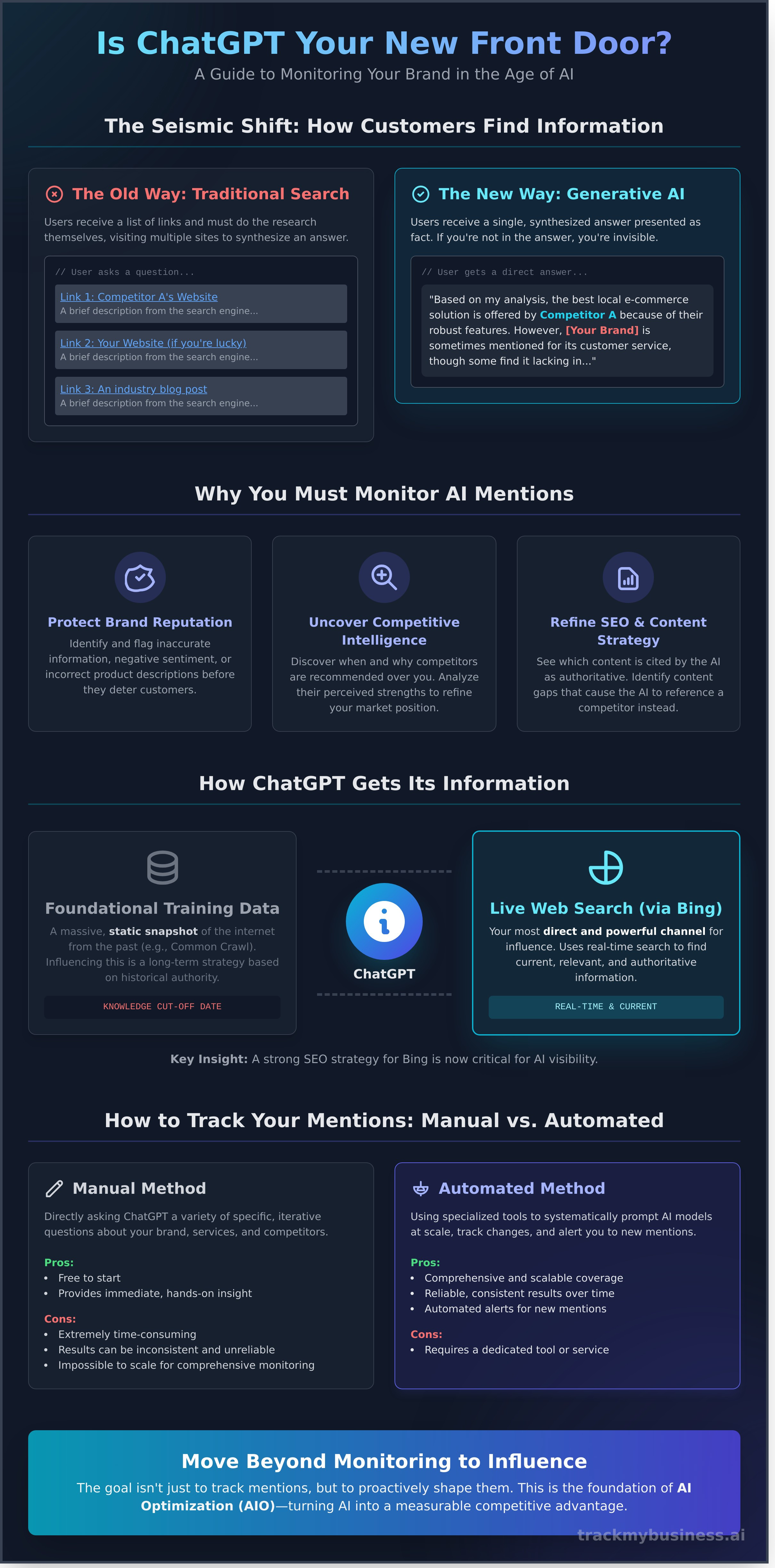
The way customers in Saudi Arabia find information is undergoing a seismic shift. Generative AI is rapidly becoming the new search box, moving beyond a simple tool to a primary source for answers. Instead of browsing a list of links, users now receive a single, synthesized answer. This fundamental change means that if your brand is misrepresented-or worse, absent-from that answer, you've already lost a critical touchpoint with a potential customer.

These platforms, powered by complex large language models, digest vast amounts of web data to form their responses. They directly influence brand perception and purchase decisions by presenting information as fact. Failing to monitor this channel means you are blind to a massive and growing conversation about your business. This is why learning how to track website mentions in ChatGPT is no longer just an option; it's essential for survival and growth.

Protect Your Brand Reputation

In the AI-driven answer economy, perception is reality. A single incorrect statement from ChatGPT about your services in Riyadh or your product specifications can deter customers. Proactive monitoring allows you to safeguard your brand's image by ensuring the AI presents your business accurately. This involves:

  • Identifying and flagging inaccurate information or negative sentiment for correction.
  • Verifying that your products and services are described correctly and with the right benefits.
  • Understanding how the AI positions your brand against key competitors in the Saudi market.

Uncover Competitive Intelligence

What happens when a potential customer in Jeddah asks ChatGPT for "the best local e-commerce solution"? If your competitor is recommended, you need to know why. Tracking these mentions is a powerful way to gather actionable intelligence. You can analyze the context of competitor mentions to understand their perceived strengths and weaknesses, helping you to strategically position your own offerings and capture market share.

Refine Your Content and SEO Strategy

The content that ChatGPT chooses to cite is a strong indicator of authority and relevance. By seeing which of your articles, blog posts, or studies are used as sources, you gain direct insight into what's working. More importantly, you can identify content gaps that cause the AI to reference a competitor instead. Using a tool to track website mentions in ChatGPT provides a direct feedback loop to create more authoritative content that answers the specific questions your audience is asking.

ChatGPT Mention Tracking Infographic

How ChatGPT Finds Information (And How Your Website Gets Mentioned)

To effectively track website mentions in ChatGPT, you first need to understand that it is not a traditional search engine like Google or Bing. It doesn't just "look up" answers and present a list of links. Instead, ChatGPT is a generative AI that synthesizes information from two primary sources to construct its responses. Your ability to appear in its answers depends entirely on your visibility within these two distinct information streams.

The AI pulls from:

  • Its foundational training data: A massive, static snapshot of the internet from the past.
  • Live web searches: Real-time information retrieved to answer questions about recent events or specific topics.

Understanding how to become a trusted, citable source in both of these areas is the key to getting your website mentioned and recommended by the AI.

The Role of Training Data

At its core, ChatGPT's knowledge comes from the immense dataset it was built on. Models like this are trained on large volumes of data, including massive web archives like the Common Crawl dataset. This data has a "knowledge cut-off" date, meaning it represents the internet up to a certain point in time. Mentions that originate from this source depend on your website's historical authority and presence. Influencing this is a long-term strategy, as it relies on content you published months or years ago.

The Power of Live Web Search (via Bing)

To overcome the limitations of static training data, newer versions of ChatGPT can browse the internet in real-time. This capability is powered primarily by Microsoft Bing's search index. This is your most direct and powerful channel for influencing ChatGPT's current responses. If your website has strong SEO fundamentals and ranks well on Bing for relevant queries, ChatGPT is significantly more likely to discover, use, and cite your content as a source in its answers. For any business in Saudi Arabia, optimising for Bing is now critical for AI visibility.

Ultimately, your strategy must address both fronts. Build long-term authority so your brand becomes part of the AI's foundational knowledge, and execute a strong Bing SEO strategy to ensure you are the go-to source for real-time queries. Mastering this dual approach is essential if you want to successfully track website mentions in ChatGPT and see your brand recommended.

Manual Methods: How to Check for Mentions Today

While automated tools provide the most comprehensive data, you can manually track website mentions in ChatGPT with a few strategic techniques. This approach is excellent for spot-checking, initial research, and understanding the AI's current perception of your brand. The key is iterative questioning. To do this effectively, we recommend documenting your prompts and ChatGPT's responses in a simple spreadsheet to monitor changes over time.

Basic Brand Name and URL Queries

Start with the most direct questions to establish a baseline. This helps you see if ChatGPT has foundational knowledge of your business. For clean, unbiased results, remember to start a new chat for each session to clear the conversation history.

  • Simple Prompts: Ask direct questions like, "What is [Your Brand Name]?" or "What can you tell me about [yourwebsite.com]?"
  • Check Variations: Test common misspellings or alternative names for your brand to see what information surfaces.

Contextual and Competitor-Based Queries

Move beyond your brand to understand where you fit in the broader market. These prompts reveal if ChatGPT recommends you alongside or over your competitors when users in Saudi Arabia are looking for solutions.

  • Category Questions: Use prompts such as, "What are the best digital marketing agencies in Riyadh?"
  • Comparative Analysis: Ask directly, "Compare [Your Brand] with [Competitor Brand]."
  • Role-Playing Scenarios: Frame a question like, "As a Saudi-based e-commerce manager, recommend a solution for improving customer logistics."

Product and Service-Level Queries

Drill down to the specific solutions you offer. This method helps you understand if ChatGPT is aware of your core products and associates them with solving specific customer problems. This is a crucial part of how you can track website mentions in ChatGPT for specific offerings.

  • Product Names: Check for specific products with, "Tell me about [Your Product Name]."
  • Problem-Based Questions: Ask about the pain points your services solve, for example, "How can a business in Saudi Arabia reduce its shipping costs?"

Manually tracking these mentions provides valuable insights, but it can be time-consuming. It's a great start, but for consistent and scalable monitoring, automation is the next logical step. See how automation can save you time.

Automated Tracking: The Smart Way to Monitor AI Mentions

While manually checking ChatGPT for mentions of your brand is a good starting point, it's not a sustainable strategy for any serious business in Saudi Arabia. The digital landscape, driven by initiatives like Vision 2030, moves too quickly. To truly understand and manage your brand's presence in AI conversations, you need a systematic, automated approach. This is the professional standard for modern reputation management.

Automated platforms use APIs to query large language models like ChatGPT at scale, providing consistent and comprehensive data that manual checks simply cannot match. This is how you effectively track website mentions in ChatGPT without dedicating countless hours to the task.

Limitations of Manual Tracking

Relying on manual searches is inefficient and unreliable. The process is incredibly time-consuming, and results can vary wildly based on your chat history or the specific phrasing of your query. It's impossible to monitor mentions across different AI models or regions consistently. Most importantly, you can't get real-time alerts, meaning you're always reacting to old information instead of proactively managing your brand's narrative as it happens.

Key Features of an LLM Mention Tracker

A dedicated tool for monitoring AI mentions offers a suite of powerful features designed for businesses. Instead of just seeing a mention, you gain actionable intelligence. Look for platforms that provide:

  • Real-time Alerts: Get instant notifications whenever your brand, products, or key executives are mentioned.
  • Sentiment Analysis: Automatically determine if the context of a mention is positive, negative, or neutral.
  • Competitor Tracking: Benchmark your AI visibility against competitors in the Saudi market to identify opportunities and threats.
  • Source Identification: See if the AI cites sources for its information, helping you trace the origin of the mention.

Introducing TrackMyBusiness

Guesswork is no longer an option when it comes to your AI reputation. Our platform, TrackMyBusiness, is built specifically to monitor your brand's presence in ChatGPT and other leading AI models. We provide a clear, intuitive dashboard that shows you exactly how your business is being portrayed. Stop wondering what AI says about you and start managing it with precise data. Take control of your brand's digital future today.

Start your free trial and see who's talking about you.

How to Influence ChatGPT and Increase Your Mentions

Monitoring your brand's presence is the essential first step. Once you know how to track website mentions in ChatGPT, the next frontier is influencing those results. This emerging field is known as AI Optimization (AIO), and it focuses on making your brand an authoritative and indispensable source for large language models.

The core strategy is to build such a strong, clear, and trustworthy online presence that AI models prefer your information over others. This involves a combination of on-page and off-page tactics that signal credibility.

Build Your Entity Authority

An AI model understands your brand as an "entity." To strengthen this entity, you must ensure consistency everywhere your brand appears online. This means having the same name, address, and business details across all platforms. Key actions include:

  • Getting listed in authoritative knowledge bases like Wikipedia, Wikidata, and industry-specific directories.
  • Using structured data (Schema.org) on your website to explicitly tell AI models who you are, what you do, and how you relate to other entities.

Create AI-Friendly Content

Large language models are trained on vast amounts of text. They prioritize content that is clear, factual, and easy to parse. To make your content more appealing to AI, focus on clarity and structure. Write in simple language, use descriptive headings (H2, H3), and break down complex topics. Including easily citable elements like FAQs, glossaries, and data-driven statistics makes your content a prime candidate for AI-generated answers. Regularly updating your content ensures its accuracy and relevance.

Earn High-Quality Citations and Links

Just as in traditional SEO, who talks about you matters. For AIO, citations and links from highly trusted sources are powerful signals of authority. A mention in a major publication or a link from a leading industry blog in the KSA region demonstrates your credibility. Focus on digital PR and guest posting on reputable websites. Remember, what is good for your SEO is almost always good for your AIO, as both systems are designed to reward authority and trustworthiness.

By combining these strategies, you can move from passively observing your brand's presence to actively shaping it. A robust monitoring system, like the one offered at TrackMyBusiness.ai, is crucial for measuring the impact of your AIO efforts.

Master Your AI Narrative: The Future of Brand Monitoring

The digital landscape is evolving, and your brand's reputation is now being shaped in AI conversations. As we've explored, manually checking for mentions is no longer a viable strategy. The key takeaways are clear: understanding your visibility within large language models is critical, and automation is the only way to do it effectively. To truly protect your brand and capitalize on new opportunities in the Saudi market, you must be proactive, not reactive. Learning how to track website mentions in ChatGPT is the first step toward mastering this new frontier.

Don't let this crucial conversation happen without you. It's time to move beyond guesswork and embrace a data-driven approach. TrackMyBusiness is the essential tool designed for marketers, SEOs, and brand managers who need to stay ahead. Get real-time alerts on new mentions and gain a crucial edge by tracking your competitors' AI visibility. Stop flying blind. Start tracking your AI mentions today with TrackMyBusiness.

Take control of your brand's story in the age of AI and secure your digital future.

Frequently Asked Questions

Can I find out which users were shown a mention of my website?

No, you cannot identify specific users. ChatGPT conversations are private and protected by OpenAI's privacy policy. There is no mechanism to see who was shown a mention of your website or brand. The focus of monitoring should be on the content and context of the mention itself, not the individual user who prompted it, as this information is not accessible.

How often should I check for ChatGPT mentions?

For most businesses in Saudi Arabia, a monthly check is a reasonable frequency. However, if you are in a dynamic sector like e-commerce or have recently launched a major marketing campaign, checking every two weeks is advisable. Consistent monitoring allows you to quickly spot and address any new narratives or misinformation about your brand as they appear in the AI's responses.

What's the difference between tracking mentions in ChatGPT vs. Google SGE?

The key difference is the source and presentation. ChatGPT generates conversational answers from its vast training data without always citing live sources. Google's Search Generative Experience (SGE) creates an AI summary at the top of search results, but it prominently links to the web pages it used for information. Mentions in SGE are more directly tied to your current website content and traditional SEO efforts.

If ChatGPT says something wrong about my brand, can I get it removed?

You cannot directly remove a statement, but you can report it as incorrect using ChatGPT's feedback feature. A more effective long-term solution is to publish clear, authoritative information on your own website and other reputable platforms. This helps correct the data the model learns from over time.

Does getting mentioned by ChatGPT improve my Google search ranking?

No, a mention within a ChatGPT conversation has no direct impact on your Google search ranking. Google's algorithm relies on public web signals like backlinks, content quality, and site authority. Since ChatGPT conversations are not public or indexed by Google's crawlers, they do not act as a ranking signal. The primary benefit of a mention is brand awareness, not direct SEO value.

Are the results in ChatGPT the same for every user?

No, the results can differ significantly. Responses are influenced by the user's previous conversation, the specific wording of the prompt, and ongoing updates to the AI model. Two users in Saudi Arabia asking the same question might receive different answers. This variability is why it's crucial to use multiple prompts when you track website mentions in ChatGPT to get a broader understanding.

How can I track mentions in other AI models like Google Gemini?

The method is very similar. You must manually query each AI model using various prompts related to your brand, products, and industry. For instance, you could ask, "What are the best digital marketing agencies in Jeddah?" or "Review the services of [Your Brand Name]." Document the responses from each platform, such as Gemini or Claude, as their unique training data will yield different results.

Works with
WordPress
Shopify
Webflow
WIX
BigCommerce
Lovable
RSS
1 article/day + backlinks
216% avg traffic boost
527+ businesses growing
Start Growing »

While You Read This, AI is Recommending Your Competitors

ChatGPT
AI Assistant

What's the best roofing company in Dallas?

Based on customer reviews and industry reputation, here are the top roofing companies in Dallas:

1. CompetitorRoof Pro

Highly rated, 20+ years experience

2. RivalRoofing Solutions

Excellent warranty options

3. OtherCompany Roofing

Fast response times

WITHOUT AutoSEO

Your business: Not mentioned

AI doesn't know you exist

Lost customer to competitor

They click on someone else

ChatGPT
AI Assistant

What's the best roofing company in Dallas?

Based on customer reviews and industry reputation, here are the top roofing companies in Dallas:

1. YOUR BUSINESS

Top-rated service, expert team

2. CompetitorRoof Pro

Also well reviewed

3. RivalRoofing Solutions

Good local option

WITH AutoSEO

Your business: Top recommendation

AI knows you're the expert

Customer clicks to YOUR site

They trust AI's top pick

67%
of people now start with AI search
Source: Gartner Research 2024
3x
more clicks than position #2 on Google
AI recommendations convert better
319%+
traffic gains for first movers
Early adopters winning big
Start Getting AI Traffic โ†’

Every day you wait, your competitors get further ahead.

Real Businesses. Real Growth. Real Fast.

We used to grow enterprises like Vodafone (+62% conversion).
Big wins. Honestly? They were just numbers in spreadsheets.

Now we help small businesses grow. Same /month expertise for 400 .

The difference? Every extra customer we bring you is money you can spend on your family. Dinner out. Kids' college fund. That vacation you've been putting off.

That's real impact.

Vodafone
MiniCRM
Pepita Group
Voltie
Avian Care
Deraland
Mike
@MikeRoofingDFW ยท Roofing Company Owner
Oct 28, 2025

Honestly thought "another SEO tool that won't deliver." Started in June anyway. Impressions up 180%, clicks up 90% in 3 months. Now I sell it to my own clients as a managed service. If you run a local service biz, try this. You'll stop wasting time on content.

David
@davidmakees ยท SaaS Founder
Sep 15, 2025

I'm bootstrapping, so it's nice knowing the blog and SEO aren't neglected. The articles are great and totally in context!

Amanda
@AmandaEcomLife ยท Online Store Owner
Aug 3, 2025

Was scared AI content would tank my rankings. Opposite happened. Went from page 3 to page 1 for 12+ keywords in 8 weeks. The keyword research is genuinely smart - finds gaps competitors miss. Any e-commerce owner: this beats hiring writers. Your SEO will thank you.

Ryan
@RyanGrowthCo ยท Agency Owner
Jul 12, 2025

Burned through $1,200/mo on Jasper + Surfer + SEMrush. Results were meh. Tried this expecting nothing. Canceled all 3 tools, now paying $29/week and getting better rankings. Saved $13,800 this year.

Jessica
@JessicaWrites_ ยท Blogger
Jun 21, 2025

Went from 0 to 24 DA in just 3 months. Absolutely amazing results! โšก

Tom
@TomLocalBiz ยท Local Business Owner
May 17, 2025

Set it up once with the WordPress plugin, and now articles just appear on my site every day. Like having a full-time content team for $29/week.

Join 527+ businesses growing on autopilot

Your Growth Engine: From Research to Revenue in 4 Simple Steps

1

Deep Research on YOUR Business

Our AI studies your business, customers, and competitors

For 'Dallas Electrician': We discover people search 'smart thermostat installation' NOT just 'electrician near me'

Analyzes 500+ competitor keywords
Get keyword research for your business โ†’
2

Write 1 Expert Article Daily

High-quality content that solves real customer problems

Not fluff. Articles like '5 Signs Your Circuit Breaker is Dangerous' that build trust

1,500-2,500 words avg
Start publishing expert articles on autopilot โ†’
3

Get 100 Domain Authority worth of Backlinks Monthly (Autopilot)

Other trusted sites mention and link to your articles

Like getting public votes of confidence

Strict ZERO spam policy
Build high-quality backlinks automatically โ†’
4

Watch Traffic Explode

AI chatbots recommend you. Google ranks you higher.

More customers find you organically = $0 ad spend

216% avg traffic increase
Start growing your business today โ†’

Writing Examples: deep researched content that your customers love to read.

https://yourwebsite.com/blog/article

Research peptide supplier ยท Peptide Research AU

"Your Money Your Life"-Compliant Content
We're extra careful with health topics. We focus on helping YOUR business get MORE business, NEVER medical self-diagnosis.
Keyword: how to store peptides
2,986 words
Created: Feb 19, 2026

How to Store Peptides: A Researcher's Guide to Preserving Stability

The viability of your research hinges on the stability of your compounds. For researchers, understanding how to store peptides is a fundamental requirement, yet it remains a point of critical uncertainty. The risk of degradation is a significant concern, potentially invalidating results and leading to the loss of a substantial investment in research-grade materials. Confusion over correct temperatures for lyophilized powder versus reconstituted solutions can compromise the integrity of an entire study before it even begins.

This definitive guide eliminates that uncertainty. Here, we provide clear, science-backed protocols for the storage of both peptide forms to ensure maximum efficacy and longevity. By following these precise instructions, you will learn to prevent contamination, avoid common and costly errors, and gain the confidence that your compounds are maintained at optimal quality, preserving the value of your purchase and the integrity of your results.

Key Takeaways

  • Store lyophilized (freeze-dried) peptides in a freezer immediately upon arrival to maximise their long-term stability before reconstitution.
  • Once reconstituted into a liquid state, peptides require specific refrigerated conditions and have a significantly shorter shelf-life.
  • Understanding how to store peptides correctly means avoiding critical errors like repeated freeze-thaw cycles, which can degrade your research compounds.
  • Adhering to precise storage protocols is essential for maintaining peptide integrity and ensuring the accuracy of your research data.
How to Store Peptides: A Researcher's Guide to Preserving Stability

The Two States of Peptides: Lyophilized vs. Reconstituted

To ensure the integrity and efficacy of your research compounds, understanding their physical state is paramount. The specific protocols for how to store peptides are dictated entirely by whether they are in their solid or liquid form. Researchers primarily handle peptides in two distinct states: lyophilized (a dry powder) and reconstituted (a liquid solution). Each state has a different level of stability and, consequently, requires a unique storage strategy to prevent degradation and maintain purity for accurate experimental results.

Understanding Lyophilized (Freeze-Dried) Peptides

Research-grade peptides are almost always shipped and received in a lyophilized, or freeze-dried, state. Lyophilization is a sophisticated dehydration process where water is removed from the peptide compound after it has been frozen and placed under a vacuum. This process sublimates the ice directly into vapour, leaving a stable, dry powder.

The primary purpose of lyophilization is to enhance long-term stability. By removing water, the process significantly reduces the potential for hydrolysis and microbial degradation, which are common pathways for molecular breakdown. This inherent durability is a core principle of peptide stability, making the lyophilized form ideal for shipping and extended storage. When stored correctly, these powders can remain viable for years, providing a reliable stock for ongoing research projects.

Understanding Reconstituted Peptides

A peptide is considered reconstituted once the lyophilized powder has been mixed with a sterile liquid diluent, such as bacteriostatic water or acetic acid solution. This process brings the peptide into a liquid solution, preparing it for administration in a research setting. While reconstitution "activates" the peptide for use, it also marks the beginning of its degradation cycle.

Once in a solution, peptides become far more susceptible to chemical and physical instability. They are vulnerable to proteases, oxidation, and aggregation, which can rapidly diminish their potency and purity. The shelf-life of a reconstituted peptide is drastically shorter than its lyophilized counterpart, often measured in weeks or months rather than years. Therefore, the approach for how to store peptides in their liquid state requires meticulous attention to temperature, light exposure, and handling protocols to preserve their structural integrity for the duration of an experiment.

Peptide Storage Infographic

Protocol 1: Storing Lyophilized (Freeze-Dried) Peptides

Upon receiving your order, your first task is to inspect the vials and transfer them to appropriate storage immediately. The stability of lyophilized peptides depends entirely on two primary factors: temperature and moisture control. Understanding how to store peptides in their freeze-dried, pre-reconstituted state is the most critical step to ensure their long-term viability and the integrity of your research data.

Long-Term Storage (Months to Years)

For preserving research peptides for months or even years, the established gold standard is storage in a freezer at a temperature between -20ยฐC and -80ยฐC. For the majority of peptides, a standard domestic freezer, which typically maintains approximately -20ยฐC, is entirely sufficient. It is crucial to keep the vials in a dark, sealed container to protect the delicate compounds from light degradation. For comprehensive guidelines on best practices, including why it is advisable to avoid self-defrosting freezers due to their temperature cycles, the National Institute for Biological Standards and Control offers an authoritative resource on Peptide Handling, dissolution & Storage. When stored under these optimal conditions, lyophilized peptides can maintain their integrity for several years.

Short-Term Storage (Days to Weeks)

If you intend to reconstitute a peptide within a few weeks of receipt, storage in a refrigerator at 2ยฐC to 8ยฐC is an acceptable alternative. This method is suitable for compounds that will be used promptly in your research protocols. While our peptides are stable at ambient temperatures during their transit from our Australian facility to your laboratory, room temperature is not a viable condition for storage beyond this brief shipping window.

Critical Handling: Preventing Moisture Contamination

Lyophilized peptides are highly hygroscopic, meaning they readily absorb moisture from the air. This is their greatest vulnerability prior to reconstitution. When a vial is moved from a cold environment (freezer or refrigerator) to a warmer room, condensation can form on and inside the vial if it is opened prematurely. To prevent this damaging moisture ingress, you must always allow the vial to equilibrate to room temperature before opening the cap. This simple but critical step prevents atmospheric moisture from condensing onto the powder, which would initiate hydrolysis and compromise the peptide's structural integrity.

Protocol 2: Storing Reconstituted (Liquid) Peptides

Once a lyophilized peptide is reconstituted with a sterile diluent like bacteriostatic water, its chemical stability changes significantly. This liquid state is where the potential for degradation increases, making correct storage procedures paramount for preserving the compound's integrity and ensuring reliable research outcomes. The methods for how to store peptides in their liquid form are fundamentally different from storing them as a powder.

In solution, peptides are more susceptible to oxidation, microbial contamination, and degradation from pH or temperature fluctuations. Adhering to a strict storage protocol is not merely a recommendation; it is essential for maintaining the peptide's efficacy for the duration of your study.

The Correct Temperature and Location

The cardinal rule for storing reconstituted peptides is to maintain a constant, refrigerated temperature. The industry standard for research purposes is between 2ยฐC and 8ยฐC. A standard laboratory or domestic refrigerator is suitable for this purpose. Never leave a reconstituted peptide at room temperature for any extended period, as this will accelerate degradation rapidly.

For optimal stability, store vials in an upright position in the main body of the refrigerator, not in the door. The temperature in the refrigerator door fluctuates more frequently, which can compromise the peptide's structure over time.

Expected Shelf Life in Solution

The shelf life of a reconstituted peptide varies widely depending on its specific amino acid sequence. Some robust peptides may remain stable for several months when refrigerated, while others might only be viable for a few weeks. As a general guideline, most common research peptides will maintain their integrity for 4 to 8 weeks under proper refrigeration.

However, this is only an estimate. For precise information, it is critical to consult the Certificate of Analysis (CoA) or technical data sheet provided with your specific peptide, as it will offer stability data relevant to that compound.

Freezing Reconstituted Peptides: A Word of Caution

A common question regarding how to store peptides is whether they can be frozen after reconstitution. While freezing can extend the shelf life of some peptides, it can damage others. The primary risk comes from repeated freeze-thaw cycles, which can fracture the peptide's delicate structure and render it inactive. If you must freeze a solution, it is best to aliquot it into single-use volumes to avoid thawing the entire stock. We recommend avoiding freezing unless the peptide's data sheet explicitly confirms its stability under such conditions. To ensure maximum stability from the moment of reconstitution, always use high-quality diluents. Find research-grade bacteriostatic water for proper reconstitution.

Common Mistakes in Peptide Storage and How to Avoid Them

Ensuring the long-term stability and integrity of research-grade peptides requires meticulous attention to detail. Even minor errors in handling can lead to degradation, compromising the validity of your experimental results. Understanding the correct protocols for how to store peptides involves not just knowing what to do, but also what to avoid. This section outlines the most common storage mistakes and provides clear, actionable solutions to preserve the quality of your compounds.

Mistake #1: Repeated Freeze-Thaw Cycles

Each time a reconstituted peptide solution is frozen and thawed, it undergoes significant physical stress. The formation and melting of ice crystals can shear the delicate peptide structures, leading to denaturation and aggregation. This process irreversibly damages the compound, reducing its potency and purity with every cycle.

Solution: Upon initial reconstitution, divide the master solution into smaller, single-use aliquots. Store these individual vials in the freezer. This allows you to thaw only the amount needed for a single experiment, preserving the integrity of the main stock.

Mistake #2: Opening a Cold Vial

Opening a vial straight from the freezer or refrigerator is a critical error. The cold surface of the vial and its contents will cause moisture from the ambient air to condense inside. This introduction of water can lead to hydrolysis and microbial contamination, significantly shortening the peptide's shelf life.

Solution: Always allow the peptide vial to warm completely to room temperature before opening the cap. This simple, non-negotiable step prevents condensation and is one of the most effective ways to protect your peptide from degradation.

Mistake #3: Exposure to Light and Vibration

Peptides can be sensitive to environmental factors beyond temperature. Exposure to UV light, particularly from direct sunlight or certain laboratory lighting, can degrade photosensitive amino acid residues. Likewise, constant physical agitation or vibration-such as being stored on a freezer door-can promote peptide aggregation.

Solution: Keep peptide vials in a dark place. The original box or a light-blocking container is ideal. Store them in a stable, secure part of your freezer or refrigerator where they will not be subject to frequent movement or vibration.

Mistake #4: Assuming All Peptides Are the Same

While general guidelines are essential, it is a mistake to assume a one-size-fits-all approach. The stability of a peptide is highly dependent on its specific amino acid sequence. Some peptides are inherently robust, while others, particularly those containing cysteine, methionine, or tryptophan, are far more susceptible to oxidation and degradation.

Solution: Treat these protocols as a best-practice foundation. However, always refer to the product-specific data sheet or Certificate of Analysis for any unique storage requirements. Verifying this information is a crucial final step in learning how to store peptides correctly for your specific research application.

Peptide Storage Quick Reference Guide

To ensure the integrity and efficacy of your research compounds, proper storage is a non-negotiable aspect of laboratory protocol. This quick reference guide distills the most critical information from this article, providing an at-a-glance summary for your daily work. Use this guide as a convenient bookmark to reinforce the best practices for how to store peptides and protect your valuable research materials.

Following these clear, evidence-based guidelines will help preserve peptide stability, prevent degradation, and ensure the reproducibility of your experimental results. Incorrect storage can compromise the peptide's structure and function, leading to inaccurate data and wasted resources.

Storage Conditions at a Glance

The stability of a peptide is determined by its state-lyophilized (freeze-dried) or reconstituted (in solution). This table outlines the standard storage guidelines for maintaining peptide viability. For specific peptides, always consult the manufacturer's data sheet for any unique requirements.

Peptide State Temperature Duration Key Tip
Lyophilized (Long-Term) -20ยฐC Years Protect from moisture and light; store in a desiccator if possible.
Lyophilized (Short-Term) 2-8ยฐC Weeks Allow vial to warm to room temperature before opening to prevent condensation.
Reconstituted (In Solution) 2-8ยฐC Weeks Avoid repeated freeze-thaw cycles; use sterile, appropriate solvents.

Essential Storage Checklist

Follow these critical steps from the moment you receive your shipment to daily use. This action-oriented checklist helps maximise peptide viability and ensure consistent experimental outcomes.

  • โœ”๏ธ Received? Upon arrival, immediately transfer your peptides to the appropriate storage condition-typically a freezer (-20ยฐC) for lyophilized powder or a refrigerator for short-term needs.
  • โœ”๏ธ Lyophilized? Before opening a vial of freeze-dried peptide, always allow it to equilibrate to room temperature. This simple step prevents atmospheric moisture from condensing inside the vial, which can degrade the compound.
  • โœ”๏ธ Reconstituted? Once in solution, peptides are far less stable. Store them in a refrigerator at 2-8ยฐC and never at room temperature. Check product-specific data for recommended shelf life after reconstitution.
  • โœ”๏ธ Long-term liquid storage? If you must store a reconstituted peptide for an extended period, consider dividing the solution into single-use aliquots and freezing them. This minimises damage from repeated freeze-thaw cycles.

Mastering how to store peptides correctly is a fundamental aspect of responsible research. The process begins with quality compounds. Source your laboratory-grade peptides from a trusted Australian supplier who understands and implements proper handling and shipping protocols from the very start.

Safeguarding Peptide Integrity Through Correct Storage

Mastering how to store peptides is a non-negotiable skill for any researcher, directly impacting the validity and reproducibility of experimental outcomes. This guide has provided clear protocols, emphasizing the critical distinction between the long-term stability of lyophilized peptides at -20ยฐC and the delicate, short-term requirements of reconstituted solutions. By understanding these differences and diligently avoiding common mistakes-such as repeated freeze-thaw cycles and light exposure-you protect your investment and ensure the integrity of your valuable research materials.

Ultimately, a successful experiment begins long before the first measurement; it starts with sourcing superior compounds. As a trusted source for purity-tested research peptides, Peptide Research AU is committed to empowering scientific discovery by supplying laboratory-grade compounds across Australia. We ensure your work is built on a foundation of uncompromising quality. Ensure your research starts with the highest quality. Browse our laboratory-grade peptides.

Apply these principles with precision, and you can advance your research with full confidence in the stability of your compounds and the reliability of your data.

Frequently Asked Questions About Peptide Storage

How long can lyophilized peptides stay at room temperature during shipping?

Lyophilized peptides are highly stable and can typically withstand ambient temperatures during standard shipping times, often for several days up to a week, without significant degradation. This stability is a key advantage of their freeze-dried state. However, for optimal long-term preservation and to maintain the integrity of your research compounds, it is crucial to transfer them to a freezer, ideally at -20ยฐC, immediately upon receipt. This ensures the peptide remains viable for future reconstitution and use.

What happens if I accidentally leave my reconstituted peptide out overnight?

Leaving a reconstituted peptide at room temperature overnight will likely lead to significant bacterial growth and chemical degradation, compromising its stability and purity. The peptide's specific amino acid sequence and the ambient temperature will influence the rate of decay. To ensure the accuracy and validity of your research results, it is strongly advised to discard the compromised solution. Using a potentially degraded compound introduces unacceptable variables into experimental protocols and can invalidate your findings.

Can I store different reconstituted peptides in the same container?

Storing different reconstituted peptides in the same container is not recommended under any circumstances. This practice introduces a high risk of cross-contamination, which can lead to unpredictable chemical interactions between the compounds and render your experimental data invalid. For accurate and reproducible research, each peptide solution must be stored in its own sterile, clearly labelled vial. Proper segregation is fundamental to maintaining the purity and integrity of each individual research-grade compound in your laboratory.

Does the type of diluent (e.g., bacteriostatic water) affect storage life?

Yes, the choice of diluent significantly impacts the storage life of a reconstituted peptide. Using bacteriostatic water, which contains 0.9% benzyl alcohol, helps inhibit microbial growth and can extend the viable storage period in a refrigerator (2-8ยฐC) to several weeks. In contrast, peptides reconstituted with sterile water lack this preservative and are more susceptible to contamination, limiting their refrigerated storage life to only a few days. Always consult the peptide's specific data sheet for diluent recommendations.

How can I tell if my peptide has degraded?

Visual inspection is often unreliable for detecting peptide degradation. While changes such as cloudiness, discoloration, or particle formation in a reconstituted solution are clear indicators of a problem, degradation can occur without any visible signs. The only definitive method to confirm peptide integrity is through analytical techniques like HPLC. Therefore, the most effective strategy is prevention. Following precise guidelines on how to store peptides correctly is the best way to ensure their stability and the validity of your research.

Is it better to use a frost-free freezer for long-term peptide storage?

A frost-free freezer is not recommended for the long-term storage of peptides. These units undergo regular, brief temperature cycles to prevent ice build-up, and these fluctuations can accelerate peptide degradation over time. For optimal stability, a standard manual-defrost freezer that maintains a constant -20ยฐC or lower is the superior choice. This is a critical detail in understanding how to store peptides to preserve their integrity for the duration of your research project.

AI financial forecasting ยท GrowthGrid

Keyword: financial forecast for startup
2,837 words
Created: Feb 19, 2026

Financial Forecast for Startup: A Step-by-Step Guide for Founders

Does the thought of building a financial forecast for your startup make your head spin? You're not alone. Staring at a blank spreadsheet, trying to predict revenue, costs, and cash flow can feel overwhelming, especially when you're not a finance expert. You know you need a credible financial forecast for startup success-to secure funding, guide your decisions, and prove your business model. But the fear of getting the numbers wrong and looking unprepared for investors is real.

Forget the stress and complexity. This guide is your step-by-step roadmap to building a professional, investor-ready financial forecast without the headaches. We'll break down the entire process into simple, actionable steps. You'll learn exactly what to include, how to base your assumptions in reality, and how to present your numbers with confidence. By the end, you won't just have a spreadsheet; you'll have a powerful tool to drive your startup's growth and understand its true potential. Let's build it together-the smart way.

Key Takeaways

  • Your financial forecast is more than just numbers-it's the strategic roadmap for your growth and the proof investors need to see.
  • Master the three core financial statements (Income, Cash Flow, Balance Sheet) to get a complete, 360-degree view of your business health.
  • Learn the bottom-up method to build a credible financial forecast for startup success based on specific, defensible assumptions investors trust.
  • Sidestep the 4 most common forecasting mistakes to save time and create a more accurate financial model from day one.
Financial Forecast for Startup: A Step-by-Step Guide for Founders

What is a Financial Forecast? (And Why It's Your Startup's GPS)

Think of a financial forecast as your startup's GPS. It shows you where you are now, where you're headed, and the resources you'll need to get there. In simple terms, it's your business's story, told in numbers-a detailed prediction of your future revenues, expenses, and cash flow. It's not a wild guess; it's an educated estimate based on data, market research, and your strategic assumptions.

Your forecast serves two critical roles. Internally, it's your strategic roadmap. Externally, it's the proof investors and lenders need to see. A solid financial forecast for startup founders is non-negotiable; it's the first thing a potential backer will ask for to validate your business model's viability. And don't confuse it with a budget. A budget is a plan for what you intend to spend, while a forecast is a prediction of what you expect to happen.

More Than Just a Fundraising Tool

While essential for securing capital, a forecast's real power is in day-to-day decision-making. It transforms your goals from abstract ideas into concrete financial targets. It's the tool that helps you:

  • Guide strategic decisions: Can we afford that new hire? Is now the right time to double our marketing spend? Your forecast has the answers.
  • Manage your cash runway: Know exactly how many months of operation you have left and when you need to act to avoid running out of funds.
  • Set clear KPIs: Track your progress against your projections to see if you're on target, celebrating wins and quickly correcting course when needed.

Key Timeframes: Your First 3-5 Years

The industry standard is a 3-5 year financial forecast. This timeframe is long enough to showcase your long-term vision but short enough to remain grounded in reality. However, the level of detail changes over time. Your model should use various forecasting methods to project with different levels of granularity:

  • Months 1-18: Project on a monthly basis. This high-detail view is crucial for managing cash flow and making immediate operational adjustments.
  • Years 2-5: Switch to quarterly or even annual projections. As you look further into the future, the focus shifts from tactical management to high-level strategic planning.
Financial Forecast Infographic

The 3 Core Statements of Your Financial Forecast

Diving into financial statements can feel overwhelming. But don't worry-you don't need an accounting degree to get this right. Think of your financial forecast for a startup as three different camera angles on your business's health. Together, they create the full picture investors and lenders need to see.

Here's a simple way to remember the two most important statements:

  • The Income Statement is like a movie, showing your performance over a period of time (e.g., a month or a quarter).
  • The Balance Sheet is a snapshot, showing your financial position on a single day.

Let's break down the "big three" so you can build them instantly.

The Income Statement (Profit & Loss)

This statement answers one critical question: Is my business profitable? It tracks your financial performance over time by subtracting costs and expenses from your revenue. Focus on these key lines:

  • Revenue: All the money your business earns from sales.
  • Cost of Goods Sold (COGS): The direct costs of creating your product or service.
  • Gross Profit: Your Revenue minus COGS.
  • Operating Expenses: Costs to run the business, like rent, marketing, and salaries.

What's left after all expenses are paid is your Net Income-the famous "bottom line."

The Cash Flow Statement

This is the most critical statement for survival. It answers: Do I have enough cash to operate? Profit doesn't equal cash in the bank. You might have made a $10,000 sale (profit!), but if the invoice isn't paid for 60 days, you don't have the cash. This statement tracks the actual movement of cash through three areas: operating, investing, and financing activities. A healthy cash flow keeps the lights on.

The Balance Sheet

This statement provides a snapshot of your company's net worth at a specific point in time. It answers: What does my company own and owe? It's all based on a simple, powerful formula:

Assets = Liabilities + Equity

These three statements are the foundation of all solid financial projections for your business plan, providing the clarity needed for smart decisions. Here's what each part means:

  • Assets: What your company owns (e.g., your work laptop, cash in the bank).
  • Liabilities: What your company owes (e.g., a small business loan, credit card debt).
  • Equity: The value left over for the owners (Assets - Liabilities).

How to Build Your Forecast: A 5-Step Bottom-Up Method

Forget vague, top-down guesses like "we'll capture 1% of the market." Investors see right through them. The most practical and credible way to build a financial forecast for a startup is with a bottom-up approach. Why? Because it's built on specific, defensible assumptions about your actual operations.

This method forces you to think like an operator, not a dreamer. You'll connect your marketing activities to sales, your sales to costs, and your growth to your hiring plan. It's the only way to create a forecast that tells a believable story. Let's build it step-by-step.

Step 1: Forecast Your Sales & Revenue

Start with the drivers you can actually control. Instead of guessing a revenue number, calculate it. For an e-commerce or SaaS business, a simple formula is your foundation:

Website Traffic x Conversion Rate x Average Purchase Price = Revenue

Build your model based on realistic marketing plans and conversion data. It's smart to create three scenarios: worst-case, realistic, and best-case. This shows investors you've considered risk and opportunity.

Step 2: Project Your Cost of Goods Sold (COGS)

COGS are the direct costs tied to producing or delivering your product. For a physical product, this includes raw materials and direct labor. For software, it might be server hosting fees, data APIs, or transaction fees. Calculating your COGS is critical because it determines your Gross Margin-a key indicator of your business's profitability and scalability.

Step 3: Detail Your Operating Expenses (OpEx)

OpEx are the costs required to run your business, outside of COGS. These are your everyday expenses to keep the lights on and the business growing. They typically fall into two main buckets:

  • SG&A (Sales, General & Administrative): This includes marketing spend, salaries for non-product staff, rent, software subscriptions, and legal fees.
  • R&D (Research & Development): These are the costs to develop and improve your product, including salaries for your engineering team.

Step 4: Create a Headcount & Salary Plan

For most startups, payroll is the single largest expense, so it deserves its own step. Map out your hiring plan by role, projected start date, and base salary. Don't forget to include the "fully-loaded" cost-add an extra 20-30% on top of salary to cover payroll taxes, insurance, and benefits. This is a common oversight that can wreck a forecast.

Step 5: Consolidate and Generate Your Statements

Finally, bring all your assumptions together. Your revenue forecast, COGS, OpEx, and hiring plan are the inputs that feed your three core financial statements. Manually connecting these moving parts in a spreadsheet is slow and full of risk. One broken formula can invalidate the entire model.

This is where your assumptions become a professional financial forecast for your startup. A smart tool can handle the complex connections instantly, ensuring accuracy and saving you days of frustration. Let AI build your financial statements in minutes.

Top-Down vs. Bottom-Up Forecasting: What Investors Want to See

When crafting your financial projections, you'll face two main approaches: top-down and bottom-up. It's not about choosing one over the other. Think of them as two essential tools that serve different, complementary purposes.

A winning business plan uses a detailed bottom-up forecast as its foundation, then uses a top-down analysis as a high-level "sanity check." This powerful combination shows investors you are both ambitious and grounded in reality-a founder who dreams big but has a concrete plan to get there.

The Top-Down 'Sanity Check'

The top-down approach starts with the largest possible number-your Total Addressable Market (TAM)-and works its way down. You estimate the percentage of that massive market you can realistically capture over time. This method is incredibly useful for one key thing: showing investors the sheer scale of the opportunity. It answers the question, "How big can this possibly get?"

Warning: Never use this as your primary forecasting method. Simply stating "we'll capture 1% of a $20 billion market" is a huge red flag for any serious investor. It shows a lack of tactical planning.

The Bottom-Up 'Credibility Builder'

This is where you earn your credibility. The bottom-up method is the core of a believable financial forecast for startup success. It starts with your actual, real-world operational capacity and builds your revenue forecast from the ground up. It's based on tangible business drivers you can control and measure.

  • โœ“ Example (SaaS): "Our two sales reps can each make 50 calls a day, and our historical conversion rate is 2%. That means we can close two new deals per day."
  • โœ“ Example (E-commerce): "Our marketing budget will drive 10,000 website visitors per month. With a 3% conversion rate and a $50 average order value, we project $15,000 in monthly revenue."

This is the forecast you will be judged on. It proves you have a realistic, data-driven plan to achieve your goals.

Ultimately, your top-down numbers show the size of the prize, while your bottom-up forecast provides the step-by-step map to win it. Getting this balance right is critical for securing funding. Need to build a professional, investor-ready forecast fast? The tools at GrowthGrid can generate your complete financial plan in minutes, saving you weeks of work.

Avoid These 4 Common Forecasting Mistakes (The Smart Way)

Every founder makes assumptions that turn out to be wrong. That's part of the journey. But some mistakes are entirely avoidable-unforced errors that can damage your credibility with investors. A solid financial forecast for startup success is about anticipating these pitfalls and building a plan grounded in reality.

Learn from others so you can focus on what matters: growing your business.

Mistake 1: The Unrealistic 'Hockey Stick' Growth

Investors have seen thousands of 'hockey stick' graphs promising explosive, overnight growth. It's a red flag. Instead of just showing a steep curve, tie your growth to tangible drivers. For example: "We will hire 3 new salespeople in Q3, each expected to close 5 deals per month, which drives our revenue growth." Show your work; don't just state the result.

Mistake 2: Forgetting That Cash is King

Profitability on paper means nothing if you don't have cash in the bank to pay your bills. This is a classic startup trap. Late-paying customers (accounts receivable), inventory costs, and loan repayments can drain your cash reserves even when you're 'profitable'. Your cash flow forecast isn't an afterthought; it's your early warning system.

Mistake 3: Underestimating Costs

Optimism is a founder's superpower, but it can be a liability when it comes to expenses. It's easy to forget the 'hidden' costs that add up fast: payroll taxes, employee benefits, software subscriptions, and professional fees. A smart move? Add a 10-15% contingency buffer to your expense forecast for the inevitable surprises.

The Old Way vs. The Smart Way

Building your financial forecast for startup capital doesn't have to be a nightmare. You have a choice.

  • The Old Way: Wasting hours fighting with broken Excel formulas and guessing at the right structure, only to miss key sections investors expect to see.
  • The Smart Way: Answering simple questions and letting AI generate a professional, comprehensive forecast in minutes, using a proven, investor-ready structure.

Ready to skip the spreadsheet stress and focus on strategy? Stop stressing over spreadsheets. Generate your forecast now.

From Complex to Confident: Your Next Steps

Building a robust financial forecast for your startup is no small task, but it's the most critical step in turning your vision into a fundable reality. Remember, your forecast isn't just a spreadsheet-it's your strategic GPS. By adopting a detailed, bottom-up approach and avoiding common pitfalls, you create a credible narrative that investors will trust and respect.

The old way means wrestling with complex formulas for weeks. The smart way means getting it done in minutes. Why spend 40+ hours on something you can automate? Trusted by thousands of startups, GrowthGrid gives you the power to create a professional, accurate forecast instantly. It's fast, efficient, and backed by our 100% Satisfaction Guarantee.

Generate Your Investor-Ready Financial Forecast in Minutes โ†’

You have the big idea. Now, get the numbers to prove it.

Frequently Asked Questions

How far out should a startup forecast its financials?

Most investors expect a three-to-five-year financial forecast. Your first year should be detailed month-by-month to manage cash flow effectively. For years two through five, you can switch to quarterly or annual projections. This approach provides the granular detail needed for immediate operations while still showing a clear, long-term vision for growth. It's the smart way to balance precision with strategic planning and meet investor expectations without getting lost in hypotheticals.

What's the difference between a financial forecast and a financial model?

Think of it this way: a financial model is the engine, and the forecast is the destination. The model is your spreadsheet, filled with all the assumptions, formulas, and variables that drive your business. The forecast is the output-the polished Profit & Loss, Balance Sheet, and Cash Flow statements you present. Your model lets you test different scenarios instantly, while the forecast is your official prediction based on your chosen strategy.

How do I create a forecast if my startup is pre-revenue?

A pre-revenue forecast focuses on two things: expenses and drivers. First, meticulously detail your startup costs and monthly burn rate to calculate your cash runway. For revenue, use a bottom-up approach. Instead of a vague market share guess, base your numbers on specific actions, like 'we will contact 100 leads per month with a 2% conversion rate.' This makes your financial forecast for startup grounded and believable to investors.

What are the best tools for creating a financial forecast?

For speed and flexibility, spreadsheets like Google Sheets or Excel are excellent go-to tools, offering complete control. However, to save weeks of work and avoid common formula errors, investing in dedicated financial forecasting software can be a smart move. These specialized platforms often provide professional templates and automate complex calculations, helping you produce an investor-ready forecast in a fraction of the time and with significantly less stress.

How often should I update my financial forecast?

You should update your financial forecast monthly, or quarterly at a minimum. The goal is to compare your projections to your actual performance. This isn't just an accounting exercise; it's a vital strategic tool that helps you spot problems early, manage cash efficiently, and make faster, data-driven decisions. If you're actively fundraising or in a high-growth phase, monthly updates are non-negotiable to stay on track.

What are 'assumptions' in a financial forecast and how do I make good ones?

Assumptions are the educated guesses that form the foundation of your forecast-metrics like customer conversion rates, pricing, or monthly churn. To make good ones, use real data: industry benchmarks, competitor analysis, or early test results. Avoid pulling numbers out of thin air. Document every assumption clearly. This transparency shows investors you've done your homework and built a credible plan for your business.

AI brand monitoring ยท TrackMyBusiness

Keyword: track website mentions in chatgpt
2,858 words
Created: Feb 19, 2026

How to Track Website Mentions in ChatGPT: A Complete Guide

I notice a growing concern among business owners in Saudi Arabia: what is ChatGPT telling potential customers about my brand? You might be wondering if your website is being recommended, if the sentiment is positive, or if a competitor is being suggested instead. Manually prompting the AI can feel like a guessing game, a time-consuming process that yields unreliable results. This uncertainty can be a significant disadvantage in a competitive digital landscape where every customer interaction, even with an AI, counts.

There is, however, a more precise approach. This guide is designed to provide a clear, systematic process to track website mentions in ChatGPT. We will explore both manual techniques and powerful automated tools that can alert you to new mentions. You will learn not just how to find these conversations, but how to interpret them and use that insight to influence AI perception, turning this new channel into a measurable competitive advantage for your business in the Saudi market.

Key Takeaways

  • Learn why Generative AI is the new search and how it's shaping customer perceptions, making brand monitoring a non-negotiable for businesses today.
  • Discover both simple, manual prompting techniques you can use immediately and the scalable, automated solutions needed for comprehensive monitoring.
  • Master specific, iterative questioning techniques to manually track website mentions in ChatGPT and uncover how the AI perceives your brand.
  • Move beyond simple tracking by learning the fundamentals of AI Optimization (AIO) to proactively influence how ChatGPT represents your business.
How to Track Website Mentions in ChatGPT: A Complete Guide

Why Tracking ChatGPT Mentions is a Non-Negotiable for Your Business

The way customers in Saudi Arabia find information is undergoing a seismic shift. Generative AI is rapidly becoming the new search box, moving beyond a simple tool to a primary source for answers. Instead of browsing a list of links, users now receive a single, synthesized answer. This fundamental change means that if your brand is misrepresented-or worse, absent-from that answer, you've already lost a critical touchpoint with a potential customer.

These platforms, powered by complex large language models, digest vast amounts of web data to form their responses. They directly influence brand perception and purchase decisions by presenting information as fact. Failing to monitor this channel means you are blind to a massive and growing conversation about your business. This is why learning how to track website mentions in ChatGPT is no longer just an option; it's essential for survival and growth.

Protect Your Brand Reputation

In the AI-driven answer economy, perception is reality. A single incorrect statement from ChatGPT about your services in Riyadh or your product specifications can deter customers. Proactive monitoring allows you to safeguard your brand's image by ensuring the AI presents your business accurately. This involves:

  • Identifying and flagging inaccurate information or negative sentiment for correction.
  • Verifying that your products and services are described correctly and with the right benefits.
  • Understanding how the AI positions your brand against key competitors in the Saudi market.

Uncover Competitive Intelligence

What happens when a potential customer in Jeddah asks ChatGPT for "the best local e-commerce solution"? If your competitor is recommended, you need to know why. Tracking these mentions is a powerful way to gather actionable intelligence. You can analyze the context of competitor mentions to understand their perceived strengths and weaknesses, helping you to strategically position your own offerings and capture market share.

Refine Your Content and SEO Strategy

The content that ChatGPT chooses to cite is a strong indicator of authority and relevance. By seeing which of your articles, blog posts, or studies are used as sources, you gain direct insight into what's working. More importantly, you can identify content gaps that cause the AI to reference a competitor instead. Using a tool to track website mentions in ChatGPT provides a direct feedback loop to create more authoritative content that answers the specific questions your audience is asking.

ChatGPT Mention Tracking Infographic

How ChatGPT Finds Information (And How Your Website Gets Mentioned)

To effectively track website mentions in ChatGPT, you first need to understand that it is not a traditional search engine like Google or Bing. It doesn't just "look up" answers and present a list of links. Instead, ChatGPT is a generative AI that synthesizes information from two primary sources to construct its responses. Your ability to appear in its answers depends entirely on your visibility within these two distinct information streams.

The AI pulls from:

  • Its foundational training data: A massive, static snapshot of the internet from the past.
  • Live web searches: Real-time information retrieved to answer questions about recent events or specific topics.

Understanding how to become a trusted, citable source in both of these areas is the key to getting your website mentioned and recommended by the AI.

The Role of Training Data

At its core, ChatGPT's knowledge comes from the immense dataset it was built on. Models like this are trained on large volumes of data, including massive web archives like the Common Crawl dataset. This data has a "knowledge cut-off" date, meaning it represents the internet up to a certain point in time. Mentions that originate from this source depend on your website's historical authority and presence. Influencing this is a long-term strategy, as it relies on content you published months or years ago.

The Power of Live Web Search (via Bing)

To overcome the limitations of static training data, newer versions of ChatGPT can browse the internet in real-time. This capability is powered primarily by Microsoft Bing's search index. This is your most direct and powerful channel for influencing ChatGPT's current responses. If your website has strong SEO fundamentals and ranks well on Bing for relevant queries, ChatGPT is significantly more likely to discover, use, and cite your content as a source in its answers. For any business in Saudi Arabia, optimising for Bing is now critical for AI visibility.

Ultimately, your strategy must address both fronts. Build long-term authority so your brand becomes part of the AI's foundational knowledge, and execute a strong Bing SEO strategy to ensure you are the go-to source for real-time queries. Mastering this dual approach is essential if you want to successfully track website mentions in ChatGPT and see your brand recommended.

Manual Methods: How to Check for Mentions Today

While automated tools provide the most comprehensive data, you can manually track website mentions in ChatGPT with a few strategic techniques. This approach is excellent for spot-checking, initial research, and understanding the AI's current perception of your brand. The key is iterative questioning. To do this effectively, we recommend documenting your prompts and ChatGPT's responses in a simple spreadsheet to monitor changes over time.

Basic Brand Name and URL Queries

Start with the most direct questions to establish a baseline. This helps you see if ChatGPT has foundational knowledge of your business. For clean, unbiased results, remember to start a new chat for each session to clear the conversation history.

  • Simple Prompts: Ask direct questions like, "What is [Your Brand Name]?" or "What can you tell me about [yourwebsite.com]?"
  • Check Variations: Test common misspellings or alternative names for your brand to see what information surfaces.

Contextual and Competitor-Based Queries

Move beyond your brand to understand where you fit in the broader market. These prompts reveal if ChatGPT recommends you alongside or over your competitors when users in Saudi Arabia are looking for solutions.

  • Category Questions: Use prompts such as, "What are the best digital marketing agencies in Riyadh?"
  • Comparative Analysis: Ask directly, "Compare [Your Brand] with [Competitor Brand]."
  • Role-Playing Scenarios: Frame a question like, "As a Saudi-based e-commerce manager, recommend a solution for improving customer logistics."

Product and Service-Level Queries

Drill down to the specific solutions you offer. This method helps you understand if ChatGPT is aware of your core products and associates them with solving specific customer problems. This is a crucial part of how you can track website mentions in ChatGPT for specific offerings.

  • Product Names: Check for specific products with, "Tell me about [Your Product Name]."
  • Problem-Based Questions: Ask about the pain points your services solve, for example, "How can a business in Saudi Arabia reduce its shipping costs?"

Manually tracking these mentions provides valuable insights, but it can be time-consuming. It's a great start, but for consistent and scalable monitoring, automation is the next logical step. See how automation can save you time.

Automated Tracking: The Smart Way to Monitor AI Mentions

While manually checking ChatGPT for mentions of your brand is a good starting point, it's not a sustainable strategy for any serious business in Saudi Arabia. The digital landscape, driven by initiatives like Vision 2030, moves too quickly. To truly understand and manage your brand's presence in AI conversations, you need a systematic, automated approach. This is the professional standard for modern reputation management.

Automated platforms use APIs to query large language models like ChatGPT at scale, providing consistent and comprehensive data that manual checks simply cannot match. This is how you effectively track website mentions in ChatGPT without dedicating countless hours to the task.

Limitations of Manual Tracking

Relying on manual searches is inefficient and unreliable. The process is incredibly time-consuming, and results can vary wildly based on your chat history or the specific phrasing of your query. It's impossible to monitor mentions across different AI models or regions consistently. Most importantly, you can't get real-time alerts, meaning you're always reacting to old information instead of proactively managing your brand's narrative as it happens.

Key Features of an LLM Mention Tracker

A dedicated tool for monitoring AI mentions offers a suite of powerful features designed for businesses. Instead of just seeing a mention, you gain actionable intelligence. Look for platforms that provide:

  • Real-time Alerts: Get instant notifications whenever your brand, products, or key executives are mentioned.
  • Sentiment Analysis: Automatically determine if the context of a mention is positive, negative, or neutral.
  • Competitor Tracking: Benchmark your AI visibility against competitors in the Saudi market to identify opportunities and threats.
  • Source Identification: See if the AI cites sources for its information, helping you trace the origin of the mention.

Introducing TrackMyBusiness

Guesswork is no longer an option when it comes to your AI reputation. Our platform, TrackMyBusiness, is built specifically to monitor your brand's presence in ChatGPT and other leading AI models. We provide a clear, intuitive dashboard that shows you exactly how your business is being portrayed. Stop wondering what AI says about you and start managing it with precise data. Take control of your brand's digital future today.

Start your free trial and see who's talking about you.

How to Influence ChatGPT and Increase Your Mentions

Monitoring your brand's presence is the essential first step. Once you know how to track website mentions in ChatGPT, the next frontier is influencing those results. This emerging field is known as AI Optimization (AIO), and it focuses on making your brand an authoritative and indispensable source for large language models.

The core strategy is to build such a strong, clear, and trustworthy online presence that AI models prefer your information over others. This involves a combination of on-page and off-page tactics that signal credibility.

Build Your Entity Authority

An AI model understands your brand as an "entity." To strengthen this entity, you must ensure consistency everywhere your brand appears online. This means having the same name, address, and business details across all platforms. Key actions include:

  • Getting listed in authoritative knowledge bases like Wikipedia, Wikidata, and industry-specific directories.
  • Using structured data (Schema.org) on your website to explicitly tell AI models who you are, what you do, and how you relate to other entities.

Create AI-Friendly Content

Large language models are trained on vast amounts of text. They prioritize content that is clear, factual, and easy to parse. To make your content more appealing to AI, focus on clarity and structure. Write in simple language, use descriptive headings (H2, H3), and break down complex topics. Including easily citable elements like FAQs, glossaries, and data-driven statistics makes your content a prime candidate for AI-generated answers. Regularly updating your content ensures its accuracy and relevance.

Earn High-Quality Citations and Links

Just as in traditional SEO, who talks about you matters. For AIO, citations and links from highly trusted sources are powerful signals of authority. A mention in a major publication or a link from a leading industry blog in the KSA region demonstrates your credibility. Focus on digital PR and guest posting on reputable websites. Remember, what is good for your SEO is almost always good for your AIO, as both systems are designed to reward authority and trustworthiness.

By combining these strategies, you can move from passively observing your brand's presence to actively shaping it. A robust monitoring system, like the one offered at TrackMyBusiness.ai, is crucial for measuring the impact of your AIO efforts.

Master Your AI Narrative: The Future of Brand Monitoring

The digital landscape is evolving, and your brand's reputation is now being shaped in AI conversations. As we've explored, manually checking for mentions is no longer a viable strategy. The key takeaways are clear: understanding your visibility within large language models is critical, and automation is the only way to do it effectively. To truly protect your brand and capitalize on new opportunities in the Saudi market, you must be proactive, not reactive. Learning how to track website mentions in ChatGPT is the first step toward mastering this new frontier.

Don't let this crucial conversation happen without you. It's time to move beyond guesswork and embrace a data-driven approach. TrackMyBusiness is the essential tool designed for marketers, SEOs, and brand managers who need to stay ahead. Get real-time alerts on new mentions and gain a crucial edge by tracking your competitors' AI visibility. Stop flying blind. Start tracking your AI mentions today with TrackMyBusiness.

Take control of your brand's story in the age of AI and secure your digital future.

Frequently Asked Questions

Can I find out which users were shown a mention of my website?

No, you cannot identify specific users. ChatGPT conversations are private and protected by OpenAI's privacy policy. There is no mechanism to see who was shown a mention of your website or brand. The focus of monitoring should be on the content and context of the mention itself, not the individual user who prompted it, as this information is not accessible.

How often should I check for ChatGPT mentions?

For most businesses in Saudi Arabia, a monthly check is a reasonable frequency. However, if you are in a dynamic sector like e-commerce or have recently launched a major marketing campaign, checking every two weeks is advisable. Consistent monitoring allows you to quickly spot and address any new narratives or misinformation about your brand as they appear in the AI's responses.

What's the difference between tracking mentions in ChatGPT vs. Google SGE?

The key difference is the source and presentation. ChatGPT generates conversational answers from its vast training data without always citing live sources. Google's Search Generative Experience (SGE) creates an AI summary at the top of search results, but it prominently links to the web pages it used for information. Mentions in SGE are more directly tied to your current website content and traditional SEO efforts.

If ChatGPT says something wrong about my brand, can I get it removed?

You cannot directly remove a statement, but you can report it as incorrect using ChatGPT's feedback feature. A more effective long-term solution is to publish clear, authoritative information on your own website and other reputable platforms. This helps correct the data the model learns from over time.

Does getting mentioned by ChatGPT improve my Google search ranking?

No, a mention within a ChatGPT conversation has no direct impact on your Google search ranking. Google's algorithm relies on public web signals like backlinks, content quality, and site authority. Since ChatGPT conversations are not public or indexed by Google's crawlers, they do not act as a ranking signal. The primary benefit of a mention is brand awareness, not direct SEO value.

Are the results in ChatGPT the same for every user?

No, the results can differ significantly. Responses are influenced by the user's previous conversation, the specific wording of the prompt, and ongoing updates to the AI model. Two users in Saudi Arabia asking the same question might receive different answers. This variability is why it's crucial to use multiple prompts when you track website mentions in ChatGPT to get a broader understanding.

How can I track mentions in other AI models like Google Gemini?

The method is very similar. You must manually query each AI model using various prompts related to your brand, products, and industry. For instance, you could ask, "What are the best digital marketing agencies in Jeddah?" or "Review the services of [Your Brand Name]." Document the responses from each platform, such as Gemini or Claude, as their unique training data will yield different results.

Unlike agencies that keep you in the dark:

See every article before it publishes
Track every backlink we build
Dashboard updates in real-time
You're in control, we do the work

Agency-Quality SEO. Without the /Month bill.

Traditional SEO Agency

Huge upfront investment

3-month minimum contract

Locked in, no flexibility

Black box reporting

No idea what they're doing

Maybe 4-8 articles/month

Inconsistent delivery

You hope they're working

Trust but can't verify

Average Agency Annual Cost:

AutoSEO

Affordable for any business

Cancel anytime with 1 click

Zero risk, full control

Full transparency dashboard

See exactly what we do

30 articles/month guaranteed

Consistent, reliable output

You see everything we do

Complete visibility

AutoSEO Monthly Cost:

Only

Most Popular Choice

Your Savings Breakdown

Traditional SEO Cost: $5,000/mo ร— 12 = $60,000/year
AutoSEO Cost: ร— 12 = /year
You Save:

$58,812/year

98% cost reduction

What You Get for

30 SEO-optimized articles
$3,000 value
100 Domain Authority worth of high-authority backlinks
$1,500 value
Keyword research & competitor analysis
$800 value
WordPress auto-publishing
$300 value
Custom images & infographics
$600 value
Total Monthly Value: $6,200
You Pay:

That's 98% off the market value

Lock in - Start Growing โ†’

โš ๏ธ Price increases to for new customers soon

Choose Your Growth Plan

Start with . See results in 3 days. Cancel anytime.

๐Ÿ’ฐ Best Value

Annual

Save 2 months

  • 365 SEO articles/year
  • 1,200 DA worth of backlinks/year
  • Competitor analysis
  • VIP support
  • Early access to features
Start Growing »

๐Ÿ›ก๏ธ 30-day money-back guarantee

โญ Most Popular

Monthly

Best for serious growth

  • 30 SEO articles/month
  • 100 Domain Authority worth of backlinks/month
  • Competitor analysis
  • Advanced keyword research
  • Priority support
  • Cancel with 1 click
Start Growing »

๐Ÿ›ก๏ธ 7-day money-back guarantee

Your Trial Includes:

3 days for just
Full access to all features
Cancel anytime with 1 click (no questions asked)
If you don't love it, just cancel before day 4

Our Promise:

If we don't write 30 articles for you in the first month, you get the next month free.

Can I really cancel anytime?

Yes, 1-click cancellation.

Do I need technical skills?

No, we handle everything.

Will this work for my industry?

Yes, proven in 50+ industries.

Still on the Fence? Let's Clear That Up.

We're anti-robot. Our motto: "If you wouldn't share it on LinkedIn, it's not good enough."

Every article: 1,500+ words, expert-level, with sources and infographics

The Choice is Yours

Keep Struggling

Keep paying $500+/month for SEO tools

Spend hours writing content yourself

Watch competitors dominate AI search

Miss out on the AI traffic revolution

Start Growing Today

Pay just (start with )

Get 30 expert articles published automatically

Be recommended by ChatGPT & Perplexity

Join the AI search revolution NOW

๐Ÿ”ฅ Early adopters are already winning. Don't be left behind.

Start Now โ†’

3 days to test everything. Cancel anytime.

Questions? Chat with us
100% SSL Security
Powered by Stripe
527+ Happy Customers