LEED, BREEAM, WELL, ENERGY STAR… The world of green building certification can feel like a sea of acronyms. As a forward-thinking developer or builder, you understand that sustainable construction is no longer a niche trend but a market expectation. Yet the path to certification often seems complex, costly, and clouded with questions. Which system offers the best ROI beyond a marketing plaque? How do you navigate the process without draining your team’s bandwidth? You have an unwavering dedication to building a greener future, but you need a clear, practical roadmap to get there.
This guide was created to provide that clarity. We will cut through the jargon to demystify the world’s leading green building certifications, comparing their goals, benefits, and requirements in a straightforward way. You will gain a firm grasp of the process, understand the tangible financial and environmental advantages, and feel equipped to confidently select the ideal certification for your project. Consider this your definitive resource for turning sustainability goals into certified, high-performing assets that benefit your business and the planet.
What is Green Building Certification and Why Does It Matter?
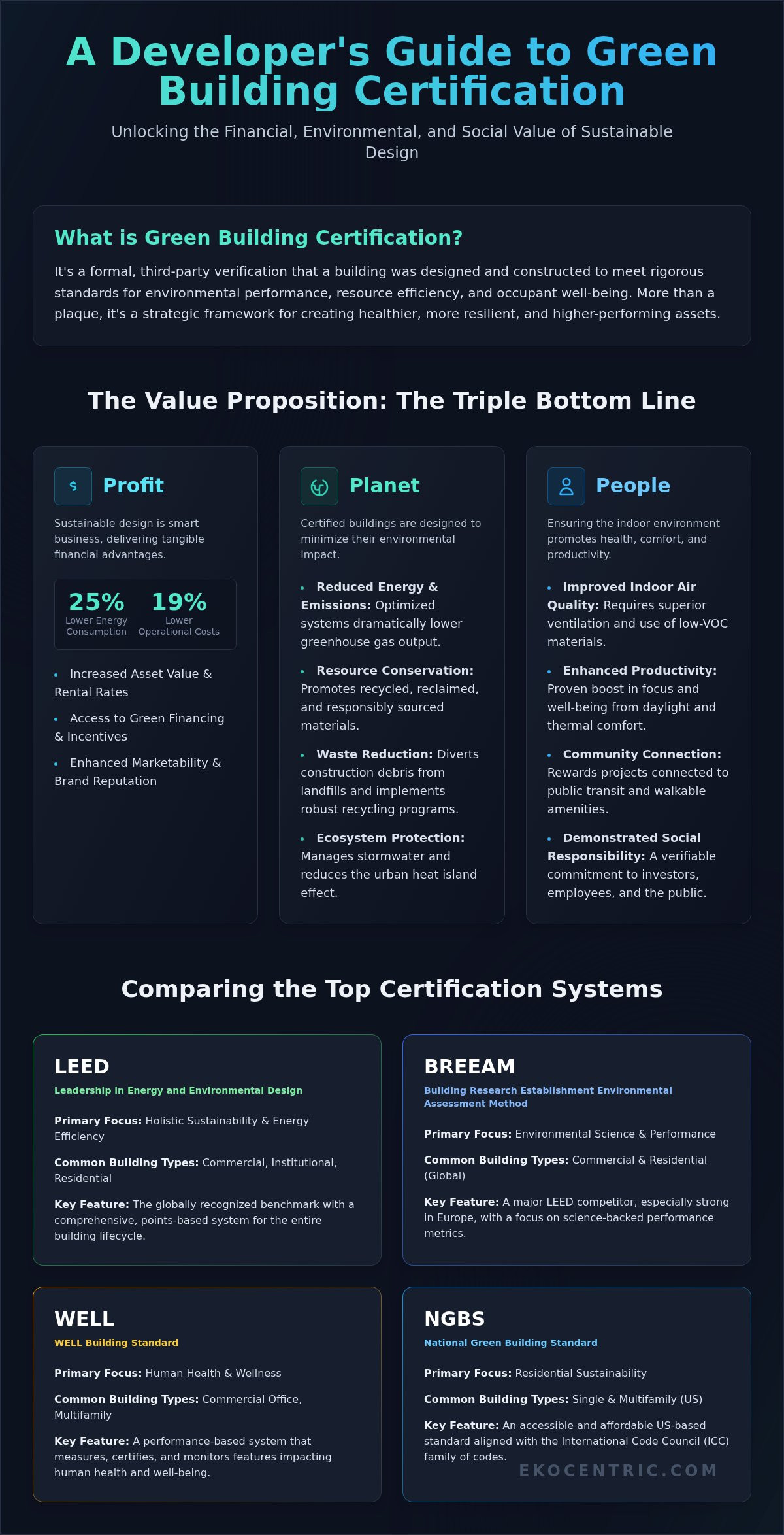
At its core, a green building certification is a formal, third-party verification that a building was designed and constructed to meet specific standards for environmental performance, resource efficiency, and occupant well-being. Far more than a plaque on the wall, it provides a rigorous framework for creating healthier, more resilient, and higher-performing assets. Numerous Green building certification systems exist globally, but they all share a common goal: to transform the built environment for the better.
For developers and architects, pursuing certification is a strategic decision that delivers value across the "triple bottom line"-achieving measurable success for your finances (Profit), the environment (Planet), and the building's occupants (People).
The Financial Benefits: ROI and Operational Savings
Sustainable design is smart business. By integrating green principles from the start, projects unlock significant, long-term financial advantages that directly impact profitability and market position.
- Lower Operating Costs: Certified buildings consistently use less energy and water. Studies by the U.S. General Services Administration (GSA) have found these properties can have 25% lower energy consumption and 19% lower operational costs.
- Increased Asset Value: Green-certified buildings often command higher rental rates, attract and retain quality tenants, and sell faster and at a premium compared to conventional properties.
- Access to Incentives: Many jurisdictions offer tax credits, grants, expedited permitting, and other incentives. Certification can also be a prerequisite for securing green financing and bonds.
- Enhanced Marketability: A certification like LEED acts as a powerful differentiator, strengthening brand reputation and demonstrating a clear commitment to quality and sustainability.
The Environmental Benefits: A Lighter Footprint
Every certified project represents an unwavering dedication to environmental stewardship. These buildings are designed to minimize their impact on the planet by fundamentally changing how we use resources.
- Reduced Energy & Emissions: Optimized building envelopes, efficient HVAC systems, and renewable energy integration dramatically lower energy consumption and associated greenhouse gas emissions.
- Resource Conservation: Certification promotes the use of recycled, reclaimed, and responsibly sourced materials, while advanced plumbing fixtures significantly reduce water usage.
- Ecosystem Protection: Thoughtful site selection and landscape design help protect local habitats, manage stormwater runoff, and reduce the heat island effect.
The Social & Health Benefits: People-Centric Buildings
Ultimately, buildings are for people. A green building certification ensures the indoor environment is designed to promote the health, comfort, and productivity of every occupant.
- Improved Indoor Air Quality: Strict requirements for ventilation, air filtration, and the use of low-VOC (volatile organic compound) materials create healthier indoor spaces.
- Enhanced Occupant Productivity: Access to natural daylight, exterior views, and superior thermal and acoustic comfort have been proven to boost focus, creativity, and overall well-being.
- Connection to Community: Many systems reward projects that are walkable, connected to public transit, and provide amenities that foster a sense of community.
- Demonstrated Social Responsibility: Certification is a tangible and verifiable way to showcase your commitment to corporate social responsibility (CSR) to investors, employees, and the public.
Comparing the Top Green Building Certification Systems
While LEED is a global benchmark, the world of sustainable design is supported by a diverse array of Green Building Standards and Certification Systems. The best green building certification for your project depends entirely on its unique goals, whether you are prioritizing holistic environmental performance, occupant wellness, or resilience to regional climate challenges. Understanding the key players is the first step in making a strategic decision.
Here is a quick comparison of the leading systems developers and architects encounter most frequently:
| System | Primary Focus | Common Building Type | Key Feature |
|---|---|---|---|
| LEED | Holistic Sustainability & Energy | Commercial, Institutional, Residential | Globally recognized, points-based system |
| BREEAM | Environmental Science & Performance | Commercial & Residential (Global) | Major LEED competitor, strong in Europe |
| WELL | Human Health & Wellness | Commercial Office, Multifamily | Performance-based, focuses on occupants |
| NGBS | Residential Sustainability | Single & Multifamily (US) | Accessible, ICC code-aligned |
LEED (Leadership in Energy and Environmental Design)
Managed by the U.S. Green Building Council (USGBC), LEED is the most widely used system in the world. Its comprehensive framework addresses the entire building lifecycle, with specific rating systems like Building Design + Construction (BD+C), Operations + Maintenance (O+M), and Interior Design + Construction (ID+C). Projects earn points across multiple sustainability categories to achieve one of four certification levels: Certified, Silver, Gold, or Platinum, making it the global standard for holistic green building.
WELL Building Standard
The WELL Building Standard shifts the focus from the building to the people inside it. It is a performance-based system that measures, certifies, and monitors building features that impact human health and well-being. WELL evaluates projects across ten core concepts, including Air, Water, Nourishment, Light, and Movement, with verification requiring on-site testing. It is frequently pursued in conjunction with LEED to deliver a building that is both environmentally responsible and optimized for occupant health.
NGBS (National Green Building Standard)
Specifically for residential construction in the United States, the National Green Building Standard (ICC-700) offers a practical and accessible path to certification for single-family and multifamily homes. Known for its flexibility and clear alignment with the residential construction industry, NGBS provides a rigorous framework for verifying sustainable practices. It features four certification levels-Bronze, Silver, Gold, and Emerald-making it a pragmatic choice for home builders nationwide.
Regional and Other Notable Systems (BREEAM, FGBC)
Beyond the major US-based systems, it is crucial to recognize global and regional standards. BREEAM is a primary international competitor to LEED, particularly dominant in the UK and Europe. More locally, standards like the Florida Green Building Coalition (FGBC) are tailored to specific climates. FGBC addresses Florida’s unique challenges, such as hurricane resistance, humidity control, and native landscaping. For projects in specific regions, these tailored standards can offer a more practical and relevant path to building a truly resilient and sustainable structure.
The Green Building Certification Process: A Step-by-Step Overview
Achieving a prestigious credential like LEED BD+C is not an afterthought; it’s a strategic journey that aligns directly with your project timeline. Approaching the process as a clear, four-phase roadmap ensures that sustainability goals are integrated seamlessly from concept to completion. Success hinges on early planning and the commitment of an integrated design team dedicated to a shared vision of performance and resilience.
Phase 1: Pre-Design & Goal Setting
This foundational phase sets the entire project up for success. It begins with selecting the right rating system (e.g., LEED BD+C, NGBS) for your project’s scope. The next critical step is conducting a charrette, or kickoff meeting, with all stakeholders-architects, engineers, developers, and a green building consultant. Together, you will establish clear sustainability targets, define a target certification level (e.g., LEED Gold), and create a preliminary scorecard to guide the design.
Phase 2: Design & Documentation
During this phase, the team translates sustainability goals into actionable architectural and engineering plans. Strategies for energy efficiency, water conservation, and material selection are woven into the core design. Meticulous documentation is paramount; every decision contributing to a credit must be tracked and recorded. We recommend using tools like LEED Online to manage documentation, assign tasks, and monitor progress toward your green building certification goal before submitting for a preliminary design review.
Phase 3: Construction & Verification
This is where design intent meets reality. It involves implementing sustainable construction practices, from advanced waste management to protecting indoor air quality. It is essential to ensure that all specified green materials and high-performance systems are installed correctly. A third-party verifier, such as a LEED Green Rater or NGBS Green Verifier, plays a crucial role here, conducting on-site inspections and performance tests (like blower door tests) to confirm compliance with the program’s rigorous standards.
Phase 4: Final Certification & Post-Occupancy
Once construction is complete, the project team compiles and submits all final documentation to the certifying body, like the Green Business Certification Inc. (GBCI), for a comprehensive review. Upon successful verification, you receive the official certification award-a powerful testament to your project's quality and environmental commitment. This final step validates your efforts and provides a compelling marketing tool. True success, however, is also measured in long-term performance, making post-occupancy monitoring essential to ensure your building operates as sustainably as it was designed.
How to Choose the Right Certification for Your Project
Moving beyond the fundamentals of LEED BD+C, the crucial next step is determining the right path for your specific development. Selecting the ideal green building certification isn't about finding a single best answer; it's about a strategic alignment of your project's unique goals, budget, and location. This decision-making framework will help you navigate the options with clarity and purpose, ensuring your choice delivers maximum value.
Factor 1: Project Type and Scope
The first consideration is the nature of your build. While LEED BD+C is tailored for new construction and major renovations, the world of green building offers specific pathways for nearly every project type. Different rating systems prioritize sustainability metrics relevant to a building's intended use, such as:
- Commercial Offices: Systems like LEED for Core & Shell (LEED CS) are ideal for speculative developments where the developer controls the base building.
- Residential Buildings: Standards such as LEED for Homes or the National Green Building Standard (NGBS) focus on occupant health, comfort, and residential energy use.
- Specialized Facilities: Healthcare, schools, and data centers each have dedicated LEED rating systems that address their unique operational and environmental challenges.
Factor 2: Location and Climate
Geography plays a pivotal role in sustainable design. A successful certification strategy acknowledges regional priorities. For instance, a project in an arid climate should prioritize water conservation credits, making them high-impact points to pursue. Similarly, a regional standard like the Florida Green Building Coalition (FGBC) is optimized for Florida’s unique challenges with humidity and hurricane resilience. Understanding how local building codes intersect with a chosen green building certification is essential for a streamlined and effective process.
Factor 3: Budget and Project Goals
Ultimately, your choice must align with your financial and strategic objectives. Are you targeting significant long-term energy savings, aiming for market differentiation, or prioritizing occupant wellness? Each goal may point to a different certification or level (e.g., LEED Certified vs. Platinum). It is essential to understand both the 'hard' costs, such as registration and consulting fees, and the 'soft' costs of internal management to accurately forecast your return on investment.
Need help analyzing the costs versus the long-term benefits for your specific project? Talk to our experts. We provide the clarity needed to make a confident, impactful decision.
The Role of a Green Building Consultant: Your Partner in Success
Pursuing a LEED BD+C credential is a rewarding but demanding endeavor. The rigorous documentation, complex credit requirements, and strict deadlines can overwhelm even the most experienced project teams. Many developers and builders simply do not have the specialized bandwidth to manage the sustainability side of a project effectively. This is where a green building consultant becomes an indispensable part of your team-not as an added cost, but as a strategic partner dedicated to maximizing your project's success.
Think of them as your project’s dedicated sustainability manager, an expert guide whose sole focus is to ensure your vision for a high-performing, sustainable building becomes a reality, efficiently and cost-effectively.
Navigating Complexity and Streamlining the Process
A consultant’s primary role is to translate complex LEED requirements into a clear, actionable roadmap. They provide an essential layer of management that keeps the project on track, reduces risk, and frees your team to focus on their core responsibilities. Their support includes:
- Expert interpretation of technical credit requirements and documentation needs.
- Proactive project management to avoid common pitfalls and costly mistakes.
- Serving as the single point of contact with the Green Business Certification Inc. (GBCI).
- Managing all submission deadlines to ensure a smooth and timely review process.
Maximizing ROI and Certification Level
A skilled consultant does more than just check boxes; they unlock value. By analyzing the unique aspects of your project, they identify the most cost-effective strategies to earn points. Through services like energy modeling and life-cycle assessments, they help optimize building performance for long-term operational savings. Their expertise can elevate your project, often helping you achieve a higher level of green building certification-such as Gold or Platinum-without inflating the budget, ensuring the final building performs as brilliantly as it was designed.
When to Hire a Green Building Consultant
The ideal time to engage a consultant is at the very beginning of a project, preferably during the pre-design or schematic design phase. Early involvement allows them to integrate sustainability goals seamlessly with the architectural vision and engineering systems from day one. If your team lacks in-house LEED expertise or the capacity to manage the certification process, a consultant is your solution. They integrate with architects, engineers, and contractors to create a cohesive, goal-oriented team driven by an unwavering passion for sustainability.
Ready to ensure your next project achieves its green building certification goals with confidence? Let's discuss how Ekocentric can guide your next project. Get in touch.
From Blueprint to Benchmark: Your Path to Certification Success
As we've explored, pursuing green building certification is a powerful, strategic decision. It goes beyond a simple plaque to deliver tangible returns: enhanced marketability, lower operating costs, and healthier environments for occupants. The key to unlocking these benefits lies in selecting the right framework for your goals-whether it's the global recognition of LEED or the regional specificity of FGBC-and meticulously navigating the verification process.
We understand that developers and builders often lack the dedicated bandwidth to manage the sustainability side of a project. At Ekocentric, we are your pragmatic partner, transforming this complexity into a clear, achievable roadmap. Our proven track record is built on specialized expertise in critical standards, including LEED BD+C and LEED Green Rater services, as well as deep knowledge of the Florida Green Building Coalition (FGBC) standards. We guide you every step of the way.
Let’s build a more sustainable and resilient future, one certified project at a time.
Frequently Asked Questions
How much does green building certification cost?
The cost of green building certification varies based on project size, complexity, and the desired certification level (e.g., Silver, Gold, or Platinum). Fees typically include registration, documentation review, and consulting support. While there can be an initial premium for high-performance materials and systems, these are often offset by significant long-term operational savings. A strategic approach focuses on integrating sustainable design early to manage costs effectively and maximize your return on investment.
How long does the green building certification process take?
The certification timeline aligns directly with your project's design and construction schedule. The process begins during the initial design phase and concludes after construction is complete and all performance data has been submitted and approved. Integrating certification goals from the very beginning is crucial for a smooth process. Partnering with an experienced consultant like Ekocentric ensures milestones are met efficiently, preventing delays and streamlining the path to a successful and sustainable outcome.
What is the difference between LEED and FGBC certification?
LEED is a globally recognized benchmark for green building, offering a comprehensive framework for nearly any project type, anywhere in the world. The Florida Green Building Coalition (FGBC) standard is tailored specifically to Florida's unique subtropical climate and environmental challenges. It often places a greater emphasis on issues like water conservation, hurricane resilience, and local ecology. The best choice depends on your project’s location, market, and specific sustainability goals.
Can existing buildings become certified?
Absolutely. Certifying existing buildings is a powerful way to enhance asset value and contribute to a healthier future. The LEED for Building Operations and Maintenance (O+M) rating system is designed specifically for this purpose. It provides a framework for improving energy efficiency, reducing waste, and enhancing indoor environmental quality in existing structures without a major renovation. This process validates high performance and demonstrates a commitment to sustainable operations.
What is the typical ROI on a certified green building?
The return on investment for a certified green building is multifaceted and compelling. Financially, these buildings benefit from lower energy and water utility costs, higher occupancy rates, and increased asset valuation. Studies consistently show they command higher rental and sale prices. Beyond the balance sheet, the ROI includes improved occupant health, well-being, and productivity-invaluable benefits that create healthier, more desirable spaces for people to live and work.
Do I need a special 'certified green builder' to construct my project?
While not an official requirement, hiring a general contractor with proven experience in sustainable construction is highly recommended. A builder familiar with the rigorous documentation, material sourcing, and on-site practices required for a green building certification can prevent costly errors and delays. Their expertise is a pragmatic investment that ensures your project’s design integrity is realized and its sustainability goals are successfully achieved through construction.