
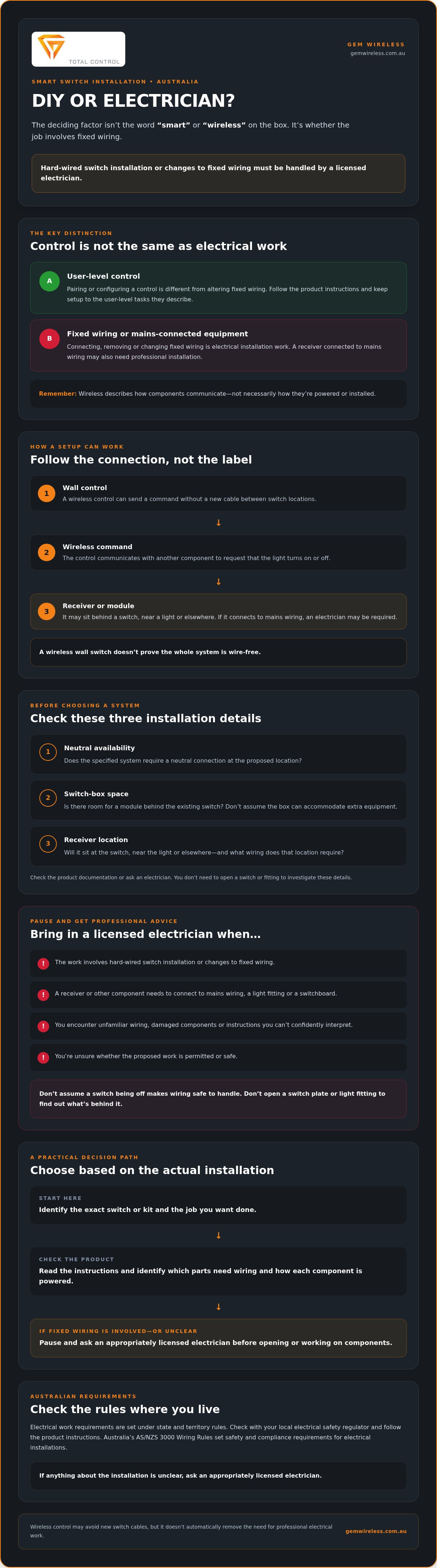
The smart switch that looks easiest to fit may still involve electrical work. If you’re weighing DIY vs electrician for smart switch installation, the deciding factor isn’t the word “smart” on the box. It’s whether the job involves fixed wiring. In Australia, hard-wired switch installation or changes to fixed wiring must be handled by a licensed electrician.
It’s understandable to want a simpler upgrade, especially if you’re concerned about safety, compliance or unexpected work behind the wall. Adding smart control doesn’t always mean running new switch cables. Wireless switching can provide another option, although a receiver connected to mains wiring may still need an electrician.
This guide explains which setup tasks may be suitable for DIY, when to bring in a licensed professional and what to check under your state or territory’s requirements. It also compares wired and wireless approaches, so you can choose a practical route without assuming every smart switch is a DIY job. Always check the product instructions and ask an appropriately licensed electrician about installation questions.
Key Takeaways
- Start with the job you want done and the exact switch or kit, not just its “smart” label.
- Separate user-level pairing and configuration from work that changes fixed wiring.
- Check practical installation details, including neutral availability, switch-box space and where a receiver would sit.
- Use a decision process to identify when to pause and ask an appropriately licensed electrician.
- Wireless switching may add control without new switch wiring, but some mains-connected components may still need professional installation.
DIY vs electrician for a smart switch: first identify the electrical work
Pairing or configuring a control is different from altering fixed wiring. That distinction is the starting point for DIY vs electrician for smart switch decisions. Some tasks involve settings and wireless communication; others mean working on the home’s electrical installation. The term “smart switch” alone doesn’t tell you which type of job is involved.
Wireless control sends a command; electrical installation connects, changes or works on wiring or equipment in the electrical system. In Australia, electrical work requirements are set under state and territory rules, so check with your local electrical safety regulator. Hard-wired switch installation or changes to fixed wiring need a licensed electrician. Formal electrical codes, including Australia’s AS/NZS 3000 Wiring Rules, set safety and compliance requirements for electrical installations.
What counts as a smart switch installation?
A setup might include a wall switch, a separate wireless control and, in some systems, a receiver that tells the light to turn on or off. A wireless wall control can communicate with another component without new cables between switch locations. This may let you add a control point without opening walls to run switch wiring.
The receiver’s connection still matters. If it connects to mains wiring, fitting it can become electrical installation work, even if the wall control itself is wireless. The arrangement depends on the product and existing installation, so don’t assume the same DIY boundary applies to every kit.
Why the word “wireless” does not automatically mean DIY
“Wireless” describes how components communicate, not necessarily how they’re powered or installed. A control may operate without being wired to the light, while a receiver or mains-powered component may still need a connection to the electrical circuit. Packaging alone may not make that distinction clear.
Before handling anything, read the specific product instructions and identify which parts require wiring. If they involve connecting, removing or altering fixed wiring, stop and consult an appropriately licensed electrician. Don’t assume removing a switch plate or accessing a light fitting is harmless. Wiring may be present behind the plate or at the fitting, and the switch being off doesn’t establish that it’s safe to handle.
Check the product’s installation requirements, then verify relevant rules with your state or territory regulator. If anything is unclear, get advice from a licensed electrician before opening or working on components. Base your decision on the actual installation, not just the smart-switch label.
Smart switch wiring explained: what may need an electrician
The key question is how each component connects, not whether the control communicates wirelessly. A wireless wall switch can send a command without a new cable running between switch locations. Another part of the system may still connect to mains wiring, turning a simple control upgrade into electrical installation work.
Wireless control, switch modules and mains wiring
A wireless wall switch is a control interface. It doesn’t prove the whole setup is wire-free. Depending on the system, a switching module or receiver may sit behind an existing switch or near a light. Its location and power source affect the installation work required.
A receiver may change the installation requirements because connecting it to mains wiring can turn a wireless-control upgrade into electrical work. Check the product documentation for the power and wiring requirements of every component. Don’t infer them from the switch’s appearance or the word “wireless”.
Before choosing a setup, check these three practical details in the product instructions or with an electrician:
- Neutral availability: Does the specified system require a neutral connection at the proposed location?
- Switch-box space: Is there room for a module behind the existing switch? Don’t assume the box can accommodate extra equipment.
- Receiver location: Does the system place a receiver at the switch, near the light or elsewhere?
You don’t need to open a switch or fitting to investigate these points. If the documentation doesn’t answer them, ask an appropriately licensed electrician to assess the installation.
When to stop and get professional advice
Use an electrician for work involving fixed wiring, a light fitting or a switchboard. Stop if you encounter unfamiliar wiring, damaged components or instructions you can’t confidently interpret. Don’t experiment or treat switching a control off as permission to handle electrical components.
For the DIY vs electrician for smart switch decision, separate user-level tasks, such as pairing or configuring an already installed control, from work that connects or changes electrical equipment. Requirements can depend on your state or territory. Check current rules and applicable standards with the relevant electrical safety regulator, and confirm installation questions with a licensed professional.
If avoiding new switch cables is the goal, wireless switching hardware designed to work with existing switches and lights may be worth investigating. It doesn’t necessarily remove the need for electrical installation: check whether a receiver or mains-powered component needs wiring. Reviewing wireless switching options can help you compare the types of systems available before discussing a setup with an electrician.
DIY smart switch vs electrician: compare safety, scope and effort
The practical DIY vs electrician for smart switch comparison comes down to the task. Pairing a control after installation isn’t the same as fitting equipment that connects to fixed wiring. A wireless setup may avoid running new switch cables, but that doesn’t automatically remove the need for an electrician.
| Task type | Wiring involvement | Skills and safety | When to seek advice |
|---|---|---|---|
| Pairing or configuring an installed control | Typically no access to fixed wiring, if the product instructions describe a user setup | Follow the specific instructions and keep electrical enclosures closed | Ask the supplier or an appropriately licensed professional if setup requires opening equipment |
| Installing a wireless wall control | May not need new cables between control locations, but check how every component is powered | Product-specific; wireless communication alone doesn’t establish that installation is safe for DIY | Check the instructions, especially if a receiver or mains-powered component is included |
| Fitting a module or changing a switch connection | May involve fixed wiring or a light fitting | Requires an assessment of the actual installation, not just general DIY confidence | Consult a licensed electrician and verify current state or territory requirements |
Which smart-switch tasks might be user-level setup?
Depending on the product, user-level tasks may include pairing a control with an already installed system or changing settings through its prescribed interface. Do these only where the product instructions allow it. They’re separate from the electrical work needed to install the equipment. These examples don’t authorise opening an electrical enclosure, removing a fitting or handling wiring.
Which jobs should be assessed by a licensed electrician?
Have fixed-wiring connections and receiver installation assessed professionally, particularly if a component connects to mains wiring, a switch or a light fitting. Don’t follow online steps for replacing a switch or making wiring connections. Requirements can differ between Australian states and territories, so check current rules with your local electrical safety regulator rather than relying on a broad national assumption.
A setup can involve more work than expected because both the product and existing installation matter. DIY isn’t automatically cheaper or quicker, and involving an electrician doesn’t mean walls must be cut or new cables run. Wireless switching may avoid new switch wiring, while a receiver still needs professional installation if its connection involves fixed wiring. Check the product documentation and ask an appropriately licensed electrician about the specific arrangement before deciding. If you need licensed professionals to assist with your home wiring or switch installations, check out Aether Electrical.
How to decide: a safe smart-switch checklist for Australian homes
A clear plan makes the DIY vs electrician for smart switch decision easier. Work through these checks before buying equipment or starting an installation. You can gather useful information without removing covers or inspecting wiring.
- Define the outcome. Do you want to control an existing light from another spot, replace a wall control or add smart functions? A wireless control may suit a different goal from a hard-wired switch.
- Identify the exact product. Note the product name and model, then read its current instructions. Check compatibility with your switch and light arrangement, and find out how each component is powered and installed.
- Record what’s already there. Note the number and location of the switches and the light or lights they operate. Don’t remove a switch plate or fitting to gather details. If you’re unsure what controls what, write down the question for an electrician.
- Clarify the installation scope. Does the plan only configure a control that’s already installed, or does it add a receiver, create a new switch location or change wiring? Treat any unclear connection as a reason to pause, not guess.
- Check local requirements. Before work begins, verify current electrical work rules for your state or territory with its electrical safety regulator. Check the product instructions too, including what they allow a user to set up and what needs professional installation.
- Ask for an assessment if needed. If the job involves fixed wiring or mains-powered equipment, or the wiring scope isn’t clear, ask an appropriately licensed electrician to assess it before proceeding.
Before making arrangements, ask who is responsible for installing each component and whether the proposed work involves fixed wiring. If an electrician is assessing the job, share the product documentation and your notes on the existing setup. For property owners seeking trade support, providers like Banner Power deliver specialised electrical services across residential systems to ensure work meets Australian standards. Ask about safety, compliance and site-specific constraints, such as whether the proposed receiver location is suitable. Don’t rely on a general product description to answer questions about your home.
If avoiding new switch wiring is part of your goal, compare wireless switching options and check each product’s instructions for receiver or mains-powered components. Explore wireless switching hardware and confirm installation questions with an appropriately licensed professional.
Could wireless switching avoid rewiring for your smart-switch upgrade?
If your goal is to add a control point without running new switch cables or changing walls, wireless switching is worth investigating. A wireless control can communicate with an existing system without a new cable between switch locations. This may suit a retrofit where reaching a second control location with wiring would be disruptive.
But “no new switch wiring” doesn’t mean “no electrical work”. Some systems use a receiver or another mains-powered component connected to the circuit. Whether installation needs an electrician depends on the specific product and the work required at your property. Check the current instructions, and ask an appropriately licensed electrician if any part of the installation involves fixed wiring or the requirements aren’t clear.
When a wireless approach may suit the project
Wireless switching may be relevant when you want another way to operate an existing light but would prefer not to run new switch wiring. Compare your goal with the components and installation requirements of the system you’re considering. The wireless light switch kit guide offers kit-selection context, while the wireless switching modules guide explains the role modules can play in a retrofit setup.
Gem Wireless sells wireless switching hardware and kits designed to work with existing switches and lights without rewiring. That describes the intended approach, not a promise that every setup needs no electrical work. Check the documentation for the exact kit, including whether a receiver or mains-powered component needs installation, before deciding if it suits your home.
Choose the next step with confidence
Compare the product instructions with the work needed at your property. Is the plan only to add a wireless control, or does it also require fitting a receiver or changing a connection? If the wiring scope is uncertain, pause and ask a licensed electrician to assess it. For more retrofit context, read about no-rewire lighting control options.
The DIY vs electrician for smart switch choice is clearer once you know which parts are user setup and which involve electrical installation. To compare hardware options, you can explore Gem Wireless switching solutions, then check the product instructions and discuss wiring questions with an appropriately licensed professional. Gem Wireless sells switching products, not electrical installation services.
Choose a smart-switch upgrade that fits your home
The safest DIY vs electrician for smart switch decision starts with the work involved. Pairing or configuring an installed control is different from connecting a receiver or changing fixed wiring. Check the exact product instructions, ask an appropriately licensed electrician about wiring or installation questions, and verify current requirements with your state or territory regulator.
If your goal is to add control without running new switch cables, wireless switching may be an option to explore. Gem Wireless products are designed to work with existing switches and lights without rewiring, though some receiver or mains-powered components may still need a licensed electrician. Customers can purchase products directly or find them through stockists.
Explore wireless switching options from Gem Wireless and compare the product requirements with the work your home needs. With the right information and professional advice where required, you can make a considered upgrade.
Frequently Asked Questions
Can I install a smart switch myself in Australia?
You can usually handle user-level setup, such as pairing or configuring a control, if the product instructions allow it and you don’t access electrical wiring. Installing a hard-wired smart switch involves fixed wiring and must be done by a licensed electrician in Australia. The DIY vs electrician for smart switch decision depends on the actual task, not the product label. Check your state or territory’s current requirements if you’re unsure.
Do I need an electrician to install a wireless light switch?
Not necessarily for a wireless control that only pairs or communicates wirelessly, but a receiver or other component may need to connect to mains wiring. That part may require a licensed electrician. “Wireless” describes how components communicate, not how every component is powered or installed. Check the exact product instructions before handling anything, and ask an appropriately licensed electrician if the installation involves fixed wiring or the requirements aren’t clear.
Can I replace a light switch without an electrician?
No. Replacing a light switch involves working on fixed wiring, so in Australia it must be carried out by a licensed electrician. This applies even if the replacement appears straightforward or the new switch is labelled smart. Don’t remove the switch plate or attempt to connect wires yourself. If you want smart control, compare the product instructions with your goal and ask an electrician to assess work involving the existing switch or circuit.
What happens if a smart switch needs a neutral wire?
If the product requires a neutral wire, an electrician needs to determine whether the required connection is available and suitable at the intended location. Don’t remove a switch plate or inspect wiring to check for one. Switch and circuit arrangements vary, and product compatibility depends on the actual installation. Share the product instructions with an appropriately licensed electrician, who can assess the wiring and advise whether the switch is suitable or another approach should be considered.
Can a wireless switch work without rewiring?
Yes, some wireless switching systems can add a control point without running new switch cables between locations. Gem Wireless products are designed to work with existing switches and lights without rewiring. However, a receiver or mains-powered component may still need to be connected to the electrical circuit. Check the specific product instructions to understand what installation involves, and consult a licensed electrician if fixed wiring is required.
Is it cheaper to install a smart switch yourself?
Not always, and it’s not safe or lawful to do fixed-wiring work yourself in Australia. The overall cost depends on the specific product and what the existing installation requires, including whether an electrician needs to fit a receiver or make wiring changes. Don’t assume a wireless product means there’s no installation work. Compare the product requirements with your intended setup, then ask an electrician to clarify the work involved before deciding.
How do I know whether my smart switch installation is safe?
Check the current product instructions, confirm the switch is intended for your setup and identify whether installation involves fixed wiring, a fitting or a receiver connected to mains power. Have a licensed electrician handle fixed-wiring work, and verify current requirements with your state or territory electrical safety regulator. Stop if wiring is unfamiliar, components appear damaged or instructions are unclear. Don’t open enclosures or rely on the switch being off as proof it’s safe.