That sinking feeling in your gut is real. You launched your website, but the only visitor is you. Your competitors are pulling ahead, and you’re left with a digital ghost town, constantly asking the one question that matters: why is my website not getting traffic? Every second you spend guessing is another customer you lose to a rival who figured this out years ago. The game has changed, and the stakes are higher. If you’re invisible on Google, you’re completely nonexistent to the new wave of AI search engines like ChatGPT and Perplexity.
Ensuring your site’s foundation is solid is crucial. For those who want to avoid these technical headaches from the start, it’s helpful to learn more about SaaS Website Builder platforms designed for performance and user experience.
Stop the guesswork. Forget the overwhelming jargon. This isn’t another useless list of “tips”-this is your battle plan. We are exposing the 5 core reasons your site is failing and handing you the exact, actionable blueprint to fix it. By the end of this guide, you will have a clear checklist to diagnose your traffic problem and finally unlock the visitors you deserve. It’s time to get found, get clicks, and watch your traffic explode.
Key Takeaways
- Your website might be live but completely invisible to search engines. Learn the critical first step to diagnose if you even exist in Google’s index.
- Stop guessing what to write. Discover how to find high-demand topics that answer specific customer questions and drive a flood of targeted traffic.
- The answer to “why is my website not getting traffic” is often a “bad first impression.” Uncover the technical errors and UX flaws that are actively scaring Google away.
- A site with zero authority is a ghost. This guide reveals the blueprint for building the trust signals and backlinks that Google demands before it will ever rank you.
- The search game has changed. Find out how to get your business found and recommended by the new wave of AI search engines like ChatGPT and Perplexity.
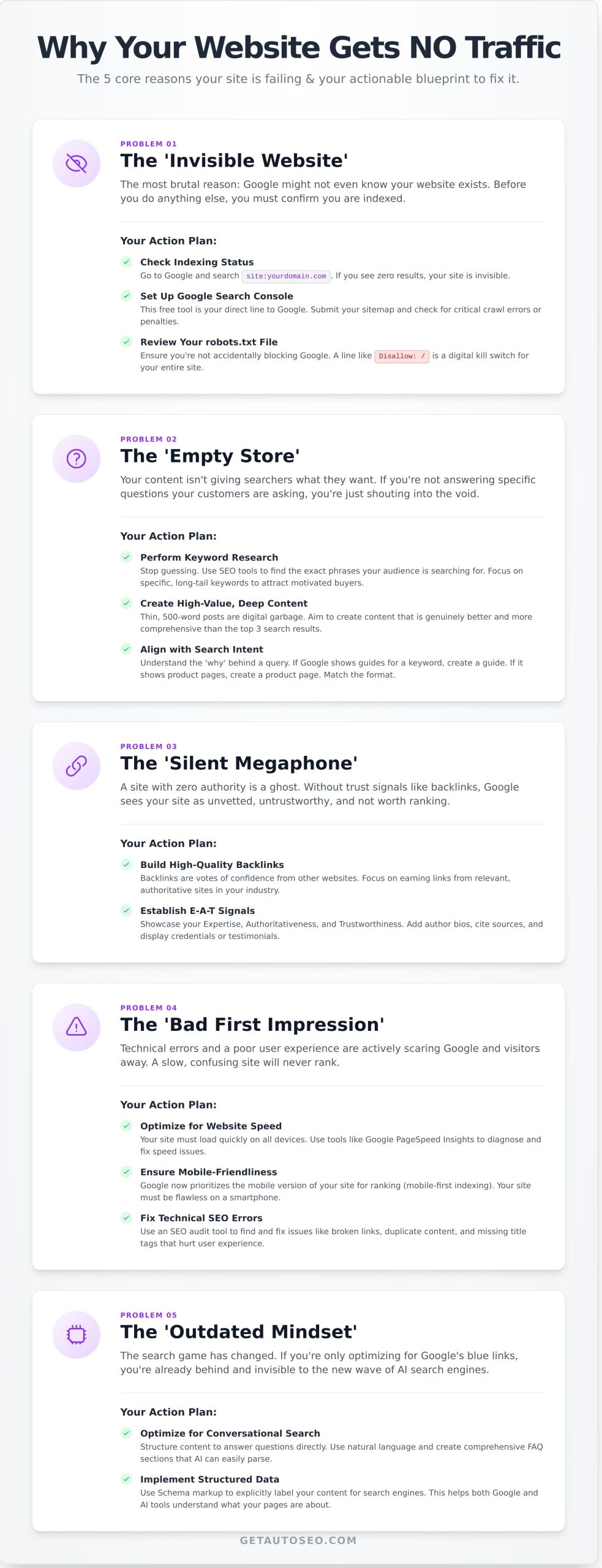
Problem #1: The ‘Invisible Website’ – Is Google Even Aware You Exist?
You launched your site. You waited. And… nothing. No visitors, no sales, just digital silence. The most common answer to “why is my website not getting traffic” is also the most brutal: Google might not even know you exist. Your site is live, but it’s a ghost. Before you waste a single dollar on ads or content, you must fix this. Without getting indexed by search engines, all your other efforts are completely useless. Let’s diagnose this in under five minutes.
Check Your Indexing Status
This is the 60-second test that reveals everything. Go to Google and type this exact command into the search bar: site:yourdomain.com (replace “yourdomain.com” with your actual URL). If you see your homepage, about page, and other key pages listed, you’re on the map. If you see zero results? Alarm bells. This means your site is invisible, and you have a critical indexing problem to solve immediately.
Set Up Google Search Console (GSC)
Stop guessing and get data straight from the source. Google Search Console is a free, non-negotiable tool for any website owner. It’s your direct line to Google, showing you exactly how it sees your site. Setting it up is your command center for all Search Engine Optimization (SEO). Submit your sitemap to hand Google a roadmap of all your pages, and check the reports for crawl errors or manual penalties that are holding you back.
Review Your Robots.txt File
Think of your robots.txt file as a bouncer for your website. Its job is to tell search engine crawlers which doors are open and which are locked. A single wrong command can accidentally tell Google, “Don’t come in.” Look for this line: Disallow: /. This is a digital kill switch, blocking your entire site. You need to ensure this file isn’t preventing your most important pages from being seen and indexed by search engines.
Problem #2: The ‘Empty Store’ – Is Your Content Targeting the Wrong People (or Nobody)?
Imagine building a beautiful retail store but stocking it with products nobody wants. That’s what most business websites do. You have a blog, you publish articles, but the traffic meter is stuck at zero and you’re left wondering, why is my website not getting traffic?
Traffic isn’t magic. It’s a direct result of giving searchers exactly what they’re looking for. If your content doesn’t solve a specific problem or answer a specific question your customers are typing into Google, you’re just shouting into the void. This is where most businesses fail before they even start.
You’re Ignoring Keyword Research
Stop guessing what people want to read. Your gut feeling is costing you customers. You need to target the exact phrases your audience is searching for, right now. Using SEO tools to uncover these keywords isn’t optional-it’s the blueprint for your entire content strategy. Focus on specific, long-tail keywords (like “emergency plumber for leaking pipe in brooklyn”) to attract highly motivated buyers and sidestep the crushing competition.
Your Content Lacks Value and Depth
Let’s be blunt: Is your article genuinely better than the top 3 results for your target keyword? Today, thin, 500-word blog posts are digital garbage. Google’s algorithm rewards depth, expertise, and authority (E-A-T). It doesn’t just read your text; it evaluates the entire visitor journey. This includes judging your expertise and how factors like Website speed and user experience contribute to the overall value you provide. Go deeper, offer unique data, and solve the user’s problem so completely they don’t need to click back to Google.
You’re Misaligned with Search Intent
Search intent is the ‘why’ behind a query. If someone searches “how to fix a leaky faucet,” they want a step-by-step guide with images or a video-not your plumbing service sales page. Serving the wrong content type is like showing up to a gunfight with a knife. Analyze the search results page (SERP) before you write a single word. Does Google show blog posts, product pages, or videos? Match that format. Giving the wrong answer to the right question is a guaranteed way to stay invisible.
Problem #3: The ‘Silent Megaphone’ – Do You Have Zero Authority or Trust?
You’ve published amazing articles and polished your website until it shines. You’re shouting into a megaphone, but the world is silent. Why? Because a new website is like a new business with no reputation. It has zero trust signals, and in Google’s eyes, you’re an unknown risk.
Content alone is not enough to get traffic. You can have the best advice in the world, but without authority, you’re invisible. This is one of the most common and frustrating answers to the question, “why is my website not getting traffic?” You need other websites to vouch for you.
Understanding Domain Authority (DA)
Think of Domain Authority (DA) as a credit score for your website. It’s a metric from 1-100 that predicts your ability to rank in search results. Every new site starts at the bottom with a DA near 1. The only way to increase this score and prove your credibility is by earning high-quality backlinks-links from other established, trustworthy websites. A single link from an industry leader is worth more than a hundred from irrelevant blogs.
Why You Have No Backlinks
Here’s the brutal truth most agencies won’t tell you: great content doesn’t just attract links on its own. The “if you build it, they will come” mindset is a myth that keeps businesses stuck with zero traffic. Building backlinks requires a relentless, proactive strategy. Manual outreach-begging other sites for links-is a soul-crushing grind with an abysmal success rate. For a small business owner, it’s an impossible time-sink.
The Solution: Consistent Content & Link Building
The engine that drives explosive SEO growth has two critical parts working together:
- Consistent Content Creation: A steady flow of new articles creates “linkable assets”-valuable pages that other sites actually want to link to.
- Consistent Backlink Acquisition: A strategic, ongoing effort to acquire new backlinks builds your DA and signals to Google that you are a rising authority.
This two-part system is what separates sites that dominate search from those that remain invisible. But it’s incredibly time-consuming and the reason traditional SEO costs a fortune. It’s a full-time job you don’t have time for. See how AutoSEO builds content and backlinks on autopilot.
Problem #4: The ‘Bad First Impression’ – Are You Scaring Away Google and Visitors?
You can have the best content in the world, but if your digital storefront is slow, broken, or confusing, you’re losing customers. Instantly. Google’s entire business model depends on sending users to sites that solve their problems, not create new ones. If your site offers a frustrating experience, Google will simply stop sending you traffic. Period.
This isn’t a vague concept; it’s measured in cold, hard data. Technical problems and a poor user experience (UX) directly impact critical metrics like your bounce rate (people leaving immediately) and dwell time (how long they stay). When these numbers are bad, they send a powerful negative signal to Google, which is a major reason why is my website not getting traffic. Fixing these foundational issues can unlock a faster and more significant traffic boost than almost any other strategy.
Your Website is Too Slow
Stop waiting. Your customers won’t. Users expect a page to load in under three seconds. Any longer, and they’re gone-likely to a competitor. Slow speed isn’t just an annoyance; it’s a direct negative ranking factor. Don’t let a few oversized images sabotage your growth. Use Google’s free PageSpeed Insights tool to see where you stand. The fixes are often straightforward: compress your images and leverage browser caching to deliver a lightning-fast experience.
Your Site Isn’t Mobile-Friendly
Here’s a brutal truth: over 60% of all searches happen on a mobile device. Because of this, Google uses mobile-first indexing. This means your mobile site is your main site in Google’s eyes. If it’s a clunky, broken mess on a phone, you’re essentially invisible to the majority of your potential audience. Can users read your text without pinching to zoom? Are your buttons easy to tap? A poor mobile experience is one of the most common and damaging traffic killers today.
Your Design is Confusing or Outdated
If a user lands on your site and can’t figure out where to go in five seconds, they will leave. A confusing layout, chaotic navigation, or an outdated design from 2010 doesn’t just look bad; it screams “untrustworthy” and sends your bounce rate through the roof. This tells Google your page failed to help the user. Ensure your site has a logical structure and dead-simple navigation that guides both humans and search engine crawlers effortlessly to the right information.
Problem #5: The ‘2023 Mindset’ – Are You Invisible to the New AI Search Engines?
If you’re still thinking only about Google, you’re already obsolete. The internet’s front door has changed. Millions of your potential customers now bypass traditional search entirely, asking questions directly to AI like ChatGPT and Perplexity. They get instant, synthesized answers. And if your website isn’t one of the sources, you simply don’t exist to them.
How AI Search Finds Information
Forget just matching keywords. AI Answer Engines don’t just “rank” pages; they consume them. They scan the web for the most authoritative, comprehensive, and well-structured content on a topic. To be considered a credible source, an AI needs to see a deep library of expert articles from your site, not just a handful of sporadic blog posts. It’s looking for overwhelming proof that you are a master of your domain.
Why Your Site is Invisible to AI
This is the real answer to “why is my website not getting traffic” in today’s world. Your site is invisible because it lacks the sheer volume and authority AI demands. AI engines trust consistency. They prioritize sites that publish expert-level content daily and have a strong backlink profile to validate their claims. Trying to produce this level of content manually is impossible. Your competitors using automation are burying you.
The Autopilot Fix: Dominate Google and AI
You can’t fight this new reality with old tools. The only way to win is to meet AI on its terms-at scale. Automated SEO platforms work 24/7 to build your topical authority, publishing expert articles and building high-quality backlinks every single day. This relentless consistency signals to both Google and AI engines like ChatGPT that your site is a dominant authority. Your traffic doesn’t just grow; it explodes across all search platforms.
Stop wondering why your website is not getting traffic and start getting seen everywhere. It’s time to put your growth on autopilot. Start getting found on ChatGPT and Google. Try AutoSEO for $1.
Stop Diagnosing Your Traffic Problem. Obliterate It.
The silence from your website is deafening. You now understand that being invisible to Google, lacking trustworthy content, and being ignored by new AI search is the brutal answer to the question, “why is my website not getting traffic?” Every day you wait, your competitors pull further ahead, leaving you in the digital dust.
Forget the slow, expensive SEO agencies that promise the world and deliver invoices. There is a faster, smarter way. Imagine solving all five problems automatically. With AutoSEO, you get Automated Daily Expert Articles to build authority and Consistent Backlink Building to skyrocket your visibility. It’s the ultimate unfair advantage, built for businesses that demand results.
Stop waiting for traffic. Put your SEO on autopilot for just $1.
Your future customers are out there. Let’s make sure they find you, not your competition.
Frequently Asked Questions
How long does it take for a new website to get traffic?
Forget waiting around. Traditional SEO can take 6-12 months to show a trickle of traffic, while your competitors dominate search and steal your customers. You can’t afford to wait. The only way to accelerate this is with a relentless strategy of daily content and backlink creation from day one. You must build authority fast to get Google and new AI search engines like ChatGPT to finally notice you.
Can I do SEO myself or do I need to hire someone?
You can try DIY SEO, but prepare to burn hundreds of hours on a steep learning curve with costly mistakes. The alternative is hiring a “traditional agency” for $3,000+ a month for slow, opaque results. The smart move is to automate it. Put your growth on autopilot with a system that handles the research, content, and backlinks for you, so you can focus on what you do best: running your business.
How much does it cost to fix my website’s traffic problems?
The old way costs a fortune. Traditional SEO agencies will quote you $2,500-$5,000+ per month, trapping you in long-term contracts with no real guarantees. They gatekeep the strategies that actually work. We believe in explosive results, not bloated retainers. You can get a complete, automated SEO system that skyrockets your traffic for a tiny fraction of that cost, putting enterprise-level power in your hands.
Is paid advertising (PPC) a better option than SEO for getting traffic?
Paid ads get you instant traffic, but it’s rented. The second you stop paying, your traffic vanishes. It’s a constant cash bonfire. SEO is an asset you own. Every article and backlink built is a permanent piece of digital real estate that works for you 24/7, compounding its value over time. It’s the only way to build sustainable, long-term traffic that doesn’t disappear when your ad budget does.
What is more important for traffic: content or backlinks?
This is a false choice and exactly why most businesses fail. It’s like asking what’s more important for a rocket: the engine or the fuel? Great content is the engine, but backlinks are the high-octane fuel that creates liftoff. One without the other is a guaranteed way to stay invisible. You need a system that produces both high-quality content and powerful backlinks simultaneously to dominate the search results.
Why is my competitor getting traffic when my website looks better?
Because search engines don’t care about your beautiful design. They care about authority. Your competitor’s site is likely packed with targeted content and powerful backlinks that signal their expertise to Google. If you keep asking, “why is my website not getting traffic” despite looking great, it’s because you’re losing the invisible SEO war. It’s what’s under the hood that drives traffic, not the paint job.