
Your competitors across the UAE are capturing customers on Google right now. The secret? They aren’t guessing. They’ve mastered keyword research, and every day you wait, they pull further ahead, leaving you invisible.
Feeling overwhelmed by complex SEO advice from agencies charging tens of thousands of dirhams? You know your customers are searching, but you’re tired of the frustrating guesswork that costs you time and sales. The old way is too slow, too technical, and too expensive.
It’s time to stop guessing and start dominating. This is not another complicated manual. This is a simple, 5-step blueprint to find the exact, high-value phrases your customers are typing into Google and AI search every single day. Forget the jargon. You are about to unlock a clear, fast process to find profitable customers your competition is completely missing and turn your website into a traffic-exploding engine.
Why Keyword Research Is the Engine of Your Business Growth
Let’s be clear: old-school keyword stuffing is dead. But the strategy behind it? It’s the engine that powers every successful business in the UAE. This isn’t about tricking Google. It’s about decoding your customer’s mind. Every search on Google.ae is a question, a need, or a problem. Your business must be the answer.
Without this blueprint, you’re just guessing-burning cash on ads and content that nobody is looking for. Your competitors in Dubai and Abu Dhabi aren’t guessing. They’re using this data to win your customers. Every day you wait, you fall further behind.
Translate Customer Needs into Search Terms
Stop thinking about what you sell. Start thinking about what your customer needs. What problem are they trying to solve right now? At its core, keyword research is the process of translating those pain points, goals, and questions into the exact language your audience uses. These aren’t just words; they are direct lines into your customer’s intent.
Map the Entire Customer Journey
Your customers aren’t all ready to buy today. A smart content strategy meets them at every stage, building trust and dominating your market from awareness to purchase. This is how you capture demand at every level.
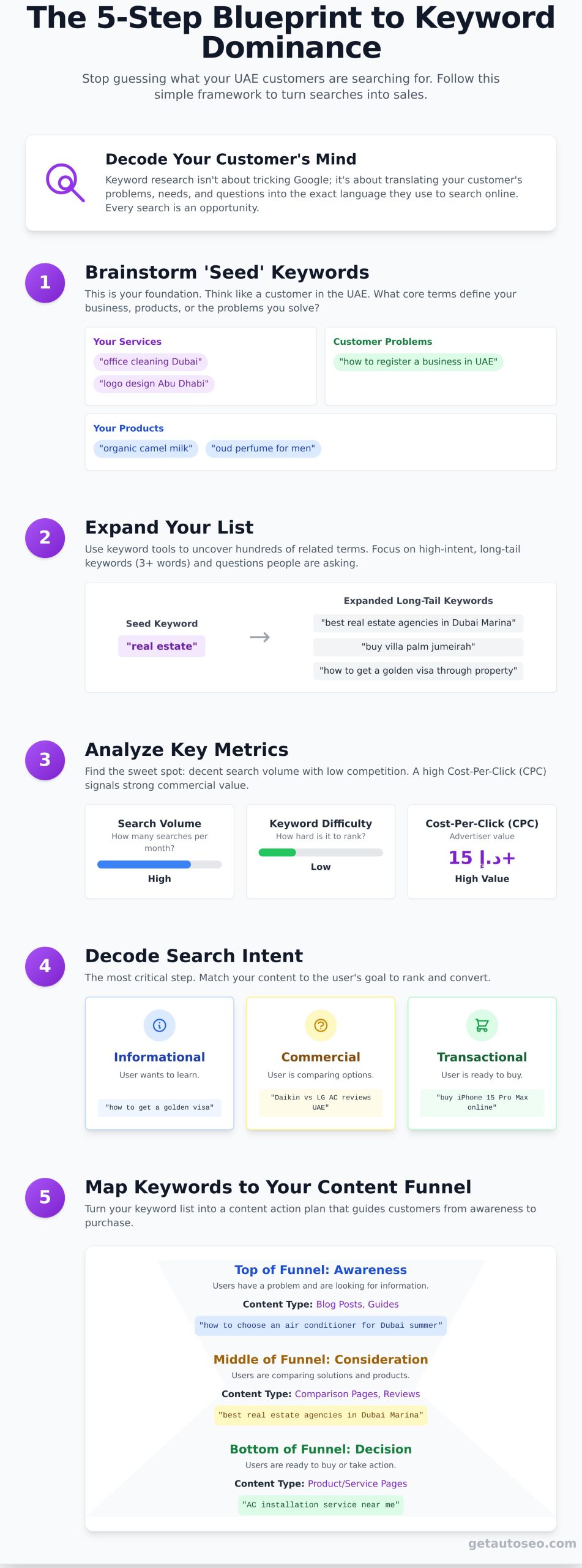
- Top of Funnel (Awareness): They have a problem. They search “how to choose an air conditioner for Dubai summer” or “what is the best visa for freelancers in UAE.”
- Middle of Funnel (Consideration): They’re comparing options. They search “Daikin vs LG AC reviews UAE” or “best real estate agencies in Dubai Marina.”
- Bottom of Funnel (Decision): They’re ready to act. They search “AC installation service near me” or “buy iPhone 15 Pro Max online UAE.”
The True Cost of Ignoring Keyword Research
Ignoring this process isn’t just a missed opportunity-it’s a financial drain. You’re creating content that gets zero traffic. You’re wasting thousands of Dirhams (د.إ) on Google Ads campaigns targeting terms that never convert. Every month, you’re letting thousands of potential customers find your competitors instead of you. They are becoming the authority in your industry while you remain invisible.
The 5-Step Keyword Research Process (The Manual Way)
Forget the slow, outdated methods that leave you guessing. While most guides on how to do keyword research are built for large teams with expensive tools, this is the lean, powerful framework you need to build a winning strategy from scratch. We’re showing you the manual way so you understand the engine behind traffic growth. Each step builds on the last, turning raw ideas into a high-value list that pinpoints exactly what your customers want and how to reach them.
Step 1: Brainstorm Your ‘Seed’ Keywords
This is your foundation. Don’t overthink it. Start by listing the core of your business. Think like a customer in Dubai or Abu Dhabi searching for a solution to their problem. What would they type into Google? Your initial list is the starting point for massive discovery.
- Your Services: “office cleaning Dubai,” “logo design Abu Dhabi”
- Customer Problems: “how to register a business in UAE”
- Your Products: “organic camel milk,” “oud perfume for men”
Step 2: Expand Your List with Keyword Tools
Your seed list is just the beginning. Now, you need to find the hidden opportunities your competitors are missing. Use free tools like Google Keyword Planner to uncover hundreds of related terms. Focus on long-tail keywords (3+ words) and the exact questions people are asking. These show high intent and are often easier to rank for.
Step 3: Analyze Key Metrics (Without Getting Overwhelmed)
Data drives results. But you only need to focus on the metrics that matter. Don’t get lost in spreadsheets. Look for the sweet spot: decent volume with low difficulty.
- Search Volume: How many people search for this term monthly?
- Keyword Difficulty: How hard is it to rank on page one?
- CPC (Cost-Per-Click): A high CPC, like د.إ 15, shows the term is valuable to advertisers-and likely to you, too.
Step 4: Decode Search Intent: The Most Critical Step
This is non-negotiable. If you misunderstand intent, you will never rank. Google’s entire goal is to give users what they want. Your goal is to create the content that satisfies their search. Every keyword falls into one of three main categories:
- Informational: The user wants to learn (“how to get a golden visa”).
- Commercial: The user is comparing options (“best real estate agent in Dubai”).
- Transactional: The user is ready to buy (“buy villa palm jumeirah”).
Step 5: Map Keywords to Your Content Funnel
Your final list isn’t just data-it’s an action plan. Group your keywords by intent and map them to a piece of content. Informational keywords are perfect for blog posts. Commercial and transactional keywords are for your service and product pages. This final step turns your keyword research into a content engine that drives traffic and sales on autopilot.
How to Choose the *Right* Keywords for Your Business
Stop building useless spreadsheets. A list of 10,000 keywords is a vanity metric, not a strategy. While your competitors are drowning in data, you need to be surgical. Your goal isn’t to collect keywords; it’s to find opportunities that generate revenue. Fast.
Forget casting a wide net. The new strategy is about dominating specific, high-value topics. It’s about thinking in ‘clusters’-groups of related keywords that signal to Google and AI search engines that you are the definitive authority. This is how you build a moat around your business that competitors can’t cross.
Prioritize by Relevance, Authority, and Volume
Every potential keyword must pass a simple, brutal test. Don’t waste a single Dirham creating content unless a keyword clears all three hurdles. Traditional keyword research often gets this backward, starting with volume. We start with what matters: money.
- Relevance: Does this searcher want to buy, or are they just browsing? “Best accounting software for SMEs in the UAE” has infinitely more business value than “what is accounting.”
- Authority: Can you realistically rank? A new startup can’t beat a global giant for a broad term. Be honest about your website’s current strength and pick fights you can win.
- Volume: Is the demand high enough? After confirming relevance and your ability to rank, check if enough people are searching to make it worth your time.
Target Low-Difficulty, High-Intent Keywords First
You need results now, not in 12 months. The fastest way to get traffic that converts is by targeting long-tail keywords your bigger, slower competitors are ignoring. These are your ‘quick wins’.
Focus on specific problems and questions. Instead of targeting a high-competition term like “property for sale,” you target “buy two-bedroom apartment near Dubai Metro.” These searchers are further down the buying funnel and ready to act. This targeted traffic is pure gold.
Spy on Your Competitors’ Winning Keywords
Why guess what works? Your competitors have already spent thousands of Dirhams and months of effort figuring out which keywords drive traffic and customers in the UAE market. Use that to your advantage.
Use tools to see exactly what they rank for. This isn’t just about copying them; it’s about finding their weaknesses. Identify the valuable keywords where their content is thin, outdated, or fails to answer the user’s question completely. That’s your opening to steal their traffic and dominate the conversation.
From Keywords to Content: Turning Research into Rankings
Let’s be blunt. A list of keywords is just data. It’s a useless spreadsheet that costs you time and delivers zero customers. Every day you sit on that data, your competitors in Dubai and Abu Dhabi are turning their own research into revenue. Your keyword research is a treasure map, but it’s worthless until you start digging. This is the step where potential explodes into profit.
Executing on your research is the only thing that matters. It’s how you stop planning and start dominating the search results that your customers are typing into Google.ae right now.
Mapping Keywords to Your Content Plan
Stop thinking in single keywords. Start building a content fortress. Group related search terms into “topic clusters.” For example, “best real estate agent in Dubai Marina,” “apartment prices Marina,” and “buy property Dubai Marina” all belong to one powerful pillar page. Each cluster becomes a target for a future article or landing page. This isn’t just a list; it’s a strategic battle plan for your content.
On-Page SEO: Where to Place Your Keywords
Once you have a target, you need to aim precisely. This isn’t creative writing; it’s a technical requirement for getting found. Don’t guess. Follow the formula that wins:
- Page Title & H1 Tag: Your primary keyword must be here. No exceptions.
- Subheadings (H2, H3): Weave in variations and related questions naturally.
- Body Text: Include your main keyword and related terms within the first 100 words and a few more times throughout.
- Meta Description: Write a compelling summary that includes the keyword to drive clicks from the search results page.
Write for Humans, Optimize for Search Engines
The old game of “keyword stuffing” is dead. Trying to trick Google will get you penalized, while your competitors fly past you. The new algorithm has one simple rule: the most helpful content wins. Your goal is to answer the user’s question so completely and with such expertise that they have no reason to click the back button. High-quality, expert-driven content isn’t just a ranking factor; it’s the ranking factor.
This entire process-from topic clustering to creating perfectly optimized, high-quality content-is what separates winning businesses from everyone else. It’s also the exact engine that platforms like AutoSEO put on complete autopilot, turning your growth strategy into a reality.
The Problem: Manual Keyword Research Is Obsolete
You’ve seen the old way. The spreadsheets, the tedious analysis, the endless guessing. It’s slow, it’s expensive, and frankly, it’s a relic of a bygone era. While you’re buried in data, your competitors in Dubai and Abu Dhabi are leveraging AI and automation to capture the market. Every day you wait, they get further ahead.
You are a business owner, not a full-time SEO analyst. You don’t have time to master complex tools and run endless reports. You need a system that works for you, not one that creates more work. It’s time to stop fighting a losing battle and start dominating search the smart way.
Why Manual Research Is a Full-Time Job
Effective SEO isn’t a one-time project; it’s a relentless campaign. Manually finding new opportunities, analyzing thousands of keyword variations in spreadsheets, and constantly tracking your rankings against competitors is more than a full-time job. It’s a massive resource drain that pulls you away from what you do best: running your business.
The High Cost of Professional SEO Tools
Enterprise-level tools like Ahrefs and Semrush are powerful, but they come with a staggering price tag-often exceeding 1,500 د.إ every single month. These platforms are built for large agencies, with a steep learning curve and dozens of features you’ll never touch. You’re paying a premium for complexity you don’t need, burning cash that could be invested in actual growth.
Solution: Put Your Entire SEO Strategy on Autopilot
Stop the manual grind. The AI revolution is here, and it’s changing the game. Instead of spending weeks on manual keyword research, our AI can analyze your business and build a complete, high-impact content plan in minutes. Our system doesn’t just plan-it executes.
- Instant Strategy: AI finds every valuable keyword your customers are searching for.
- Automated Content: Expert-level articles are created and published for you, daily.
- Unbeatable Value: Get the results of a full-time SEO team for a tiny fraction of the cost.
Don’t let your competitors leave you behind. It’s time to automate your growth and watch your traffic explode. Start your 5 د.إ trial and let AI handle your keyword research.
The Final Step: Put Your Keyword Research on Autopilot
You now have the blueprint. You know that effective keyword research is the non-negotiable engine for business growth, and you understand the manual steps to uncover what your customers in the UAE are searching for. But here’s the hard truth: the game has changed. While your competitors are leveraging automation to dominate search, the manual process keeps you buried in spreadsheets, slow to react, and vulnerable to being left behind.
It’s time to stop researching and start ranking. AutoSEO is your unfair advantage. Our AI-powered platform doesn’t just find keywords; it uncovers the hidden opportunities your competitors completely miss. Then, we turn that intelligence into action, writing and publishing daily, expert-level articles on your behalf. You get the traffic, the leads, and the growth-all on autopilot and at a 98% cost reduction compared to a traditional Dubai SEO agency.
Every day you wait, your competitors get further ahead. Don’t let them win. Stop Guessing. Start Growing. Automate Your SEO for just 4 د.إ today.
Frequently Asked Questions
What is a long-tail keyword and why is it important?
Long-tail keywords are your secret weapon. They are specific, multi-word phrases customers type when they’re ready to buy, like “best karak chai near Dubai Marina.” While your competitors fight over broad terms, you can dominate these high-intent searches. This is how you attract qualified traffic that converts into actual sales, not just empty clicks. Stop chasing vanity metrics and start capturing real customers who are ready to spend money.
How many keywords should I target per page?
Forget the old rule of “one keyword per page.” That thinking is slow and it’s costing you customers. Modern SEO is about covering a topic comprehensively. Your page must answer every question a customer has about a core problem, which naturally covers dozens of related keywords. Stop obsessing over single keywords and start creating value-packed content that dominates entire topics. This is how you get recommended by Google and AI search engines.
How long does it take to see results from keyword research and SEO?
Traditional agencies in the UAE will tell you 6-12 months because their process is outdated. With a modern, topic-focused strategy, you can see initial traffic gains in as little as 90 days. Every day you stick with old-school keyword research, your competitors are capturing market share that should be yours. The real question isn’t how long it takes-it’s how much longer you can afford to wait while your competition pulls further ahead.
What are the best free keyword research tools for beginners?
Stop getting trapped by “free” tools. They show you the same surface-level data your competitors already have. Instead, use tools that reveal customer problems. Browse Reddit, Quora, and local UAE industry forums to see the exact questions your audience is asking. This is a goldmine for content ideas that traditional tools will never show you. This strategy costs nothing and delivers ten times the value, getting you ahead of everyone else.
How often should I do keyword research?
You shouldn’t. “Doing keyword research” is a one-off task that leaves you vulnerable. Building a growth engine is a system. Instead of periodic research, you need an always-on system for understanding your customer’s problems and intent. This isn’t a project; it’s the core of your marketing engine. If you’re only checking in quarterly, you’re already falling behind. Put your customer research on autopilot and focus on dominating your market 24/7.