
Your website traffic is dropping. You feel it. Your old SEO playbook is officially dead. While you’re stuck wondering why, your competitors are being recommended by name in Google AI Overviews and ChatGPT answers. Every single day, they are stealing your customers, one AI-powered search at a time. Every day you wait, they get further ahead.
Stop the chaos. It’s time to fight back. The new battlefield is ai search engine optimization, and most businesses are completely unprepared-making them invisible to the AI engines that now control customer decisions. This isn’t another fluffy theory post. This is your definitive, step-by-step guide to dominate AI answers.
We are revealing the exact strategies to get your business cited by Google, ChatGPT, and Perplexity. You will get a clear, actionable plan to future-proof your online presence, stop being invisible, and finally start winning the customers that AI is sending directly to your competition. Let’s crush it.
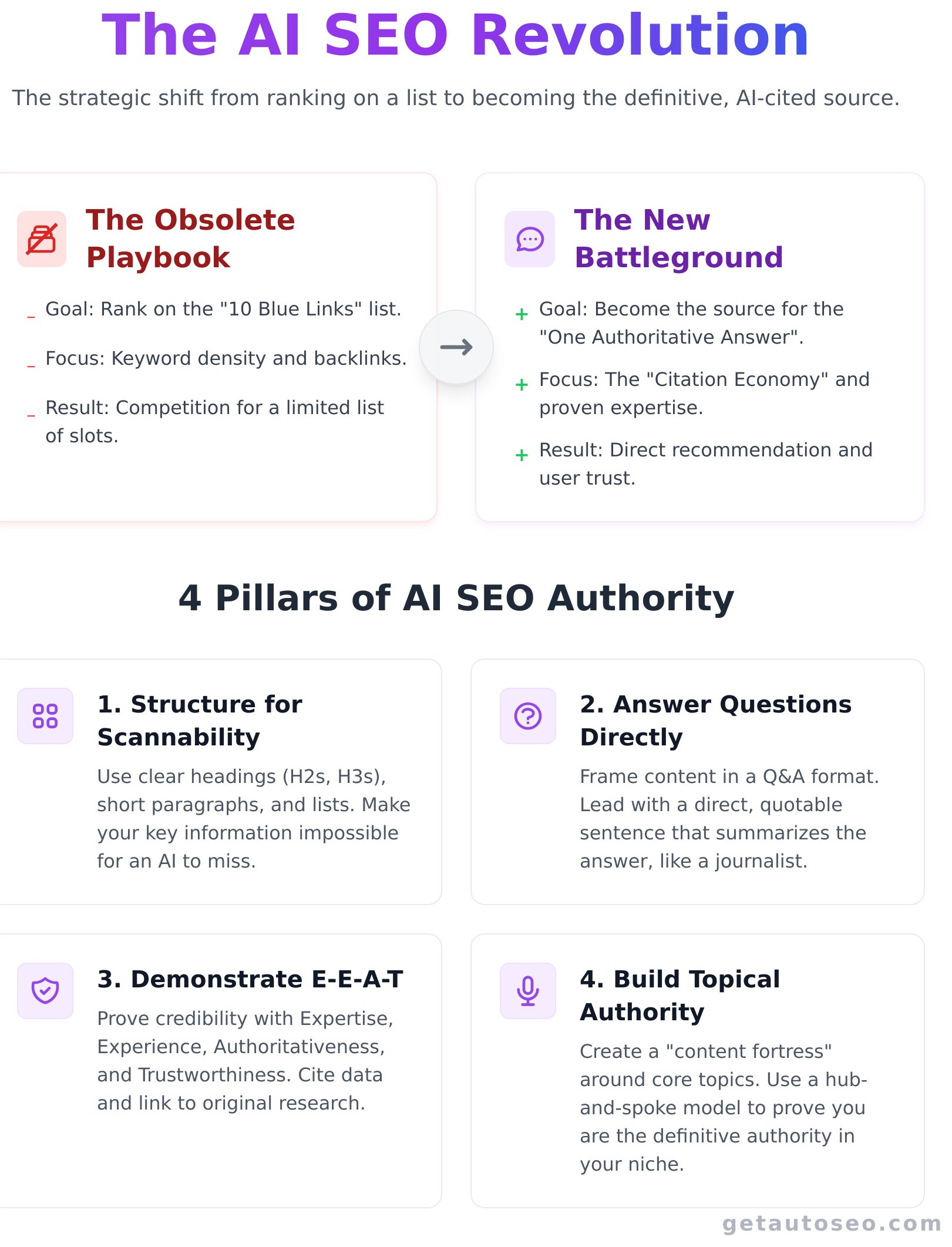
The New Reality: Why AI Search Makes Your Old SEO Obsolete
Stop what you’re doing. The SEO playbook you’ve spent years mastering is now a relic. While you were busy chasing backlinks and keyword density, the entire search landscape shifted from under your feet. This isn’t a slow change-it’s an avalanche, and your competitors are already using it to bury you.
This isn’t a future trend; it’s today’s reality. With ChatGPT handling billions of queries and Google rolling out AI Overviews to over a billion users, your customers are no longer getting a list of options. They’re getting a single, direct answer. The brutal truth? If that answer isn’t sourced from you, your business is completely invisible.
From 10 Blue Links to One Authoritative Answer
Remember the classic Google search results? A neat list of 10 blue links where you fought to be on top. That’s gone. Now, AI engines synthesize information from multiple sources to present one cohesive, conversational answer. The 10+ chances you had to get a click have been crushed down to one or two embedded citations. The visibility slots have vanished, and with them, your traffic.
[Visual: Side-by-side comparison of a traditional SERP vs. an AI Overview answer]
The ‘Citation Economy’: Why Being the Source is the New #1 Ranking
Forget ‘ranking.’ The new goal is to be cited. In the world of ai search engine optimization, authority isn’t just about links; it’s about being the definitive source of truth that the AI trusts. This new reality moves beyond the traditional tactics you might find in a foundational understanding of SEO and demands an obsessive focus on clarity, verifiable data, and expertise. It’s the difference between being listed in a phone book’s index and being quoted on the front page of a major newspaper. One is a listing. The other is a game-changing endorsement that drives real customers.
The AI SEO Playbook: 5 Pillars to Becoming an AI-Cited Authority
Stop guessing. The old SEO rules are obsolete. While your competitors are stuck optimizing for keywords, the winners are optimizing for answers. This is the battle plan to dominate the new landscape of ai search engine optimization. Follow these five pillars, and you won’t just rank-you’ll become the source AI models quote directly to millions of users.
Pillar 1: Structure for Scannability
Forget dense paragraphs. AI engines parse content like a human in a hurry-they scan for signposts. Use clear H2/H3 headings, short sentences, and bullet points to create an easy-to-follow roadmap. A clean structure allows AI to instantly identify and extract the most valuable information, making your content the fastest and most logical choice to cite.
Pillar 2: Answer Questions Directly & Concisely
People ask AI questions. Your job is to be the definitive answer. Frame your content in a Q&A format whenever possible. Start every answer with a direct, quotable sentence, then elaborate. Think like a journalist: the most critical information comes first. This makes your content the perfect, bite-sized snippet for an AI-generated summary.
Pillar 3: Demonstrate E-E-A-T
AI is allergic to anonymous, low-quality content. You must prove you’re a legitimate expert (Expertise, Experience, Authoritativeness, Trustworthiness). This means citing authoritative data, showcasing original research, and linking out to build a web of trust. Referencing credible sources, from academic studies to established government SEO best practices, signals to AI that your information is vetted and reliable. Back it up with clear author bios and company information.
Pillar 4: Build Overwhelming Topical Authority
One-off blog posts are a drop in the ocean. To win, you need to build a content fortress. Use the ‘hub and spoke’ model: create a central pillar page for your core service, then surround it with articles answering every possible related question. This strategy makes you the undeniable subject matter expert, leaving AI no choice but to cite you as the primary authority.
Pillar 5: Feed the Machine with Structured Data
Speak the AI’s native language: Schema markup. This is the technical cheat sheet that tells search engines exactly what your content is about-your business hours, location, customer reviews, and services. Implementing structured data is a critical part of a modern ai search engine optimization strategy because it removes all ambiguity, making your business the easiest, most reliable entity for AI to understand and recommend.
Content That Feeds the Machine: How to Write for AI & Humans
Theory is cheap. Results are everything. While your competitors are still debating keywords, the battle for AI visibility is being won with content structure. Effective ai search engine optimization isn’t about tricking the algorithm; it’s about feeding it exactly what it wants, in the format it understands best. This is where the real work begins-work that separates the winners from the businesses AI will forget.
The Art of the ‘Quotable Fact’
AI models are scavengers. They hunt for clean, self-contained facts to use in generated answers. You need to create this ammo for them. Instead of burying data in long paragraphs, pull it out and make it a standalone statement.
Before: “When you consider all the materials and labor, most homeowners will find that the total cost for replacing their roof can be quite high, often landing somewhere in the neighborhood of $8,500 on average.”
After: The average cost of a new roof is $8,500.
See the difference? The second version is a perfect, citable snippet. Your content should be packed with these.
Using Tables and Lists for Easy Digestion
Long paragraphs are poison for AI parsers. They create ambiguity. Structured data like tables and lists are a direct line to the machine’s brain. It’s the difference between a messy garage and a perfectly organized toolkit.
Before: “Asphalt shingles are the most affordable option but have a shorter lifespan of about 15-30 years, whereas metal roofing is more expensive upfront but can last 40-70 years. Slate is a premium, very durable choice that can last over 100 years, but it’s also the heaviest and most costly.”
After:
| Material | Cost | Lifespan |
|---|---|---|
| Asphalt Shingles | Low | 15-30 Years |
| Metal | High | 40-70 Years |
| Slate | Very High | 100+ Years |
Which one do you think an AI will understand faster? Your competitors are already formatting their data this way.
Leveraging Schema Markup to Spoon-Feed AI
Think of Schema markup as a set of secret labels only search engines can read. It removes all guesswork. You’re not just publishing an article; you’re telling Google, “This block of text is a question, and this block is the answer.” This is a non-negotiable part of modern ai search engine optimization.
Key types you must use:
- FAQ Schema: Explicitly marks questions and answers on your page.
- Article Schema: Identifies the headline, author, and publication date.
- LocalBusiness Schema: Feeds AI your address, hours, and phone number.
Implementing this code across your entire site is tedious, but skipping it makes you practically invisible. While you could learn to code it all by hand, platforms like AutoSEO build this in on autopilot, saving you hundreds of hours.
The Crossroads: The Manual Grind vs. The Autopilot Advantage
You understand the strategy. You see the massive opportunity. Now you’re at a fork in the road. One path is the manual grind-slow, expensive, and utterly exhausting for a busy business owner. The other is the autopilot advantage-fast, affordable, and built to win.
The True Cost of Manual AI SEO
Let’s be brutally honest about the manual grind. To execute this strategy yourself, you’re looking at a massive time and money sink for a single article:
- Topic & Keyword Research: 2-4 hours
- Expert Writing & Sourcing: 4-6 hours
- Editing & On-Page Optimization: 2-3 hours
- Schema & Technical Markup: 1-2 hours
That’s 9-15 hours per post. Don’t have the time? Hiring a decent freelancer costs $300-$500 per article. A traditional agency will happily charge you $3,000-$5,000+ per month for a handful of posts. The worst part? Manual effort is inconsistent. You get busy, and your content engine grinds to a halt while your competitors pull further ahead.
How an AI SEO Engine Puts Growth on Autopilot
Now, imagine a different reality. An automated system that executes this entire expert playbook for you, every single day. It researches what your customers are asking AI, writes hyper-relevant expert content, optimizes it with perfect schema, and publishes it directly to your blog. On autopilot.
This isn’t another complicated tool you have to learn. It’s your dedicated content and backlink engine, working 24/7 to establish your authority and drive qualified customers to your door. It’s the ultimate unfair advantage for effective ai search engine optimization.
Why Your Competitors Are Choosing Automation
Here’s the hard truth: your competitors aren’t waiting. They are already using automated systems to achieve the speed and scale needed to dominate this new landscape. While you spend a week trying to create one perfect article, they’ve published seven, capturing more territory and attracting more customers.
Every day you wait, the gap widens. The game has changed from slow and steady to fast and dominant. Don’t get left behind trying to do it all by hand. It’s time to put your growth on autopilot. See how an automated SEO engine works.
The Crossroads Are Here: Dominate or Be Ignored
The game has changed. Your old SEO playbook is officially obsolete, and waiting is no longer an option. The new battlefield is AI-generated answers, and victory requires becoming a cited authority by consistently feeding the machine with expert content. This is the harsh reality of modern ai search engine optimization. You’re facing a clear choice: continue the manual, soul-crushing grind with uncertain results, or seize the autopilot advantage and let your competitors choke on your dust.
Stop guessing. Stop falling behind. Join the 527+ businesses who have stopped the chaos and are seeing a 216% average traffic increase with automated daily content and backlinks. The engine is built. Your growth is waiting. The only question is whether you’ll act before your competition does.
Stop Being Invisible. Put Your SEO on Autopilot and Dominate AI Search.
Frequently Asked Questions
What is the difference between AI SEO and traditional SEO?
Traditional SEO is a slow, expensive guessing game. You pay agencies thousands to manually stuff keywords and build links, waiting months for maybe-results. AI SEO is a precision strike. It analyzes what AI models like ChatGPT and Google’s AI Overviews demand-clear, factual, expert content-and delivers it automatically. It’s about feeding AI the exact data it needs to recommend YOU, not your competitor, crushing the old-school playbook.
How long does it take to see results from AI search engine optimization?
Forget the 6-12 month waiting game. AI search models are constantly learning, and they index and trust new, authoritative information incredibly fast. Our clients often see their business appear in AI-generated answers and featured snippets within weeks, not months. Every day you wait is another day your competitor gets recommended first. The race is on, and speed is the only thing that matters to win more customers.
Do backlinks still matter for AI search engines like ChatGPT and Perplexity?
Backlinks were yesterday’s game. Today’s AI engines care less about who links to you and more about the raw quality and factual authority of your content. They prioritize verifiable facts and demonstrable expertise. Instead of chasing expensive links, a winning ai search engine optimization strategy focuses on creating a dense network of expert content on your site. This proves your authority directly to the AI, making you the most logical answer.
Can I do AI SEO myself, or do I need to hire an expert?
You could spend hundreds of hours trying to decode AI algorithms and manually pump out content. But why? Your competitors are already using automated engines to do it for them, on autopilot. Trying to do it all yourself is a recipe for burnout while you fall further behind. A dedicated AI SEO platform gives you the power of an expert team without the cost, letting you dominate search while you run your business.
How do I track if my content is being used in AI-generated answers?
Manually checking every AI platform is impossible. You’d have to run hundreds of queries on ChatGPT, Perplexity, and Google daily just to see if you’re visible. This is why a dedicated AI SEO dashboard is critical. We provide full transparency, tracking exactly when and where your business is cited in AI answers. You see the direct ROI and the customers you’re capturing-no more guessing if your marketing is working.
Is it too late to start optimizing for AI search?
Too late? You’re already behind, but the game is far from over. Most businesses are still stuck in the old world of keyword-stuffing, leaving a massive opportunity for you to leapfrog them and dominate the market. Acting now gives you a decisive, almost unfair, advantage. Waiting another month could be the difference between exploding your growth and becoming completely invisible to the next generation of customers.