
Stop the endless SEO grind. You know the routine: hours wasted on keyword research, mind-numbing backlink checks, and technical audits that never seem to end. You’re drowning in repetitive tasks while competitors with bigger teams and budgets dominate the SERPs. It’s slow, it’s expensive, and it’s holding your growth back. What if you could reclaim those hours and get better, faster results? The answer isn’t working harder-it’s working smarter with seo automation. This is the end of manual SEO as you know it.
In this guide, we cut through the noise and give you a direct blueprint. You will discover exactly how to leverage AI-powered systems to put your most critical SEO activities on autopilot. Prepare to save dozens of hours every month, achieve consistent growth without the daily effort, and build a predictable engine for driving organic traffic that works for you 24/7. It’s time to take control and let automation do the heavy lifting.
What is SEO Automation? (And Why It’s Your New Unfair Advantage)
Stop wasting time on manual checklists. SEO automation is the use of AI-powered software to execute repetitive tasks that bog down your strategy. Think of it as the ultimate upgrade for your marketing engine. The old way involved endless spreadsheets and manual checks to manage the complex discipline of Search engine optimization (SEO). The new way? Automated workflows that run 24/7, freeing you to focus on what actually matters: high-level strategy and creative execution.
This isn’t about replacing human experts. It’s about giving them superpowers. Automation acts as a force multiplier, handling the grunt work so your team can innovate, analyze, and dominate the SERPs.
The Problem: The Brutal Reality of Manual SEO
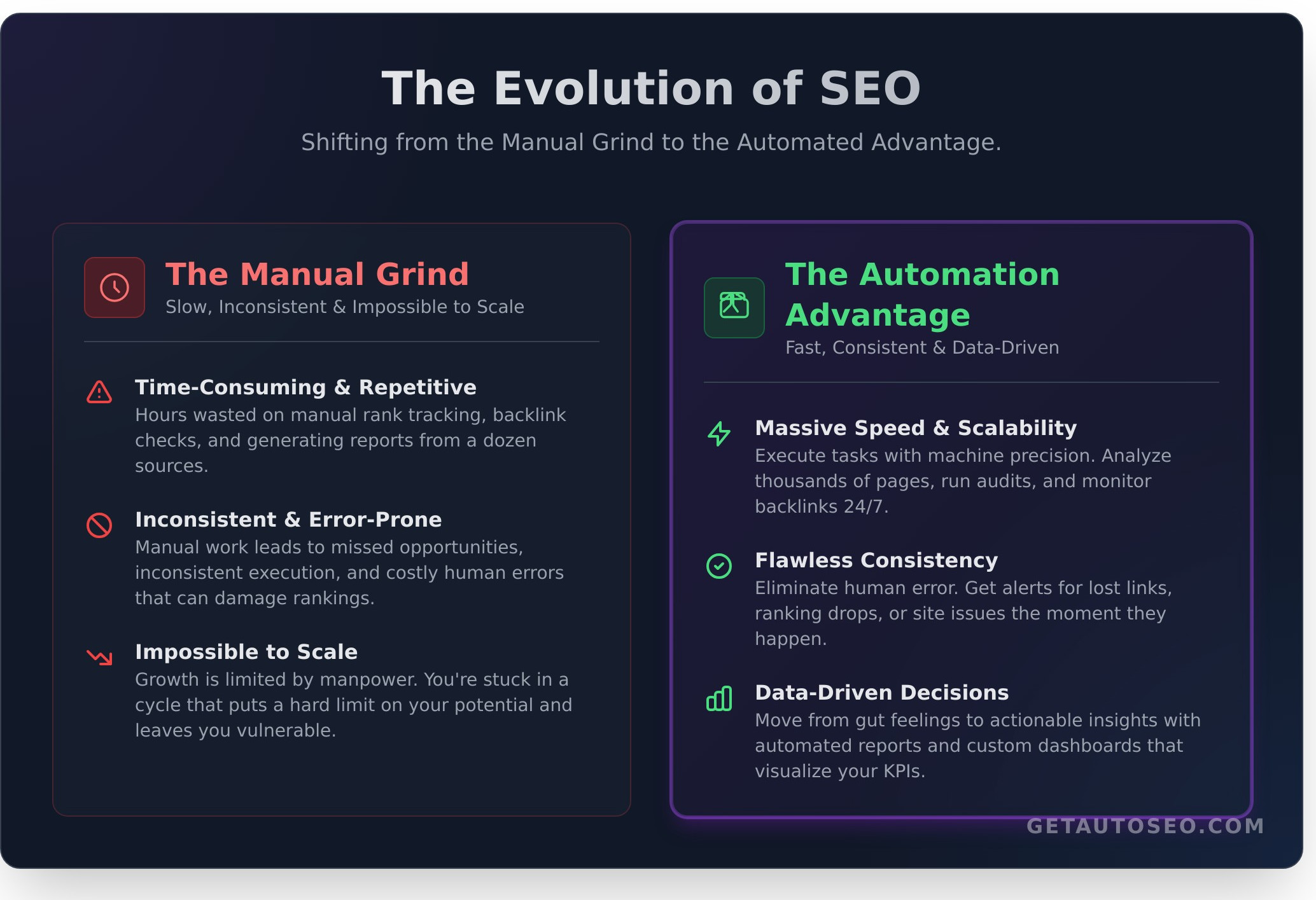
Tired of the SEO grind? Manual work is slow, inconsistent, and impossible to scale. You’re stuck in a cycle of tedious tasks that drain your most valuable resource: time. This manual approach puts a hard limit on your growth and leaves you vulnerable to costly mistakes.
- Endless Rank Tracking: Manually checking keyword positions across different locations and devices.
- Constant Backlink Monitoring: Hoping you catch a toxic or lost link before it hurts your rankings.
- Time-Sucking Reporting: Pulling data from a dozen sources just to build one monthly report.
The Solution: Putting Your SEO on Autopilot
The solution is simple: put your SEO on autopilot. By leveraging powerful software, you can execute tasks with machine-like precision and speed. True seo automation eliminates human error, ensures perfect consistency, and delivers clean, actionable data in minutes, not days. It’s how you move faster and make smarter decisions than the competition.
- Massive Speed & Scalability: Analyze thousands of pages or backlinks instantly.
- Flawless Consistency: Never miss a broken link or a ranking drop again.
- Data-Driven Decisions: Get accurate reports generated automatically, so you can act on insights, not gut feelings.
The Core Pillars of SEO Automation: What to Automate for Maximum Impact
Effective SEO automation isn’t about flipping a switch on random tasks. It’s about building a powerful, interconnected system that handles the repetitive work so you can focus on strategy. Stop wasting hours on manual checks and start dominating the SERPs. We break down the highest-impact tasks into three core pillars: Intelligence, Content, and Reporting.
Automated Intelligence & Research
This is your 24/7 command center, gathering critical data without you lifting a finger. Instead of reacting to changes, you’re always one step ahead. Put your market intelligence on autopilot with tools that:
- Track Ranks Daily: Get instant updates on keyword positions. No more manual spot-checks. Know immediately when you rise or fall.
- Monitor Backlinks Continuously: Receive alerts for new links gained or valuable links lost. Protect your link profile automatically.
- Run Scheduled Technical Audits: Catch site-breaking errors like 404s or slow page speed the moment they happen, not weeks later.
- Analyze Competitors Automatically: Instantly track their new content, keyword gains, and backlink strategies to find opportunities.
Automated Content & On-Page SEO
From creation to optimization, automation streamlines your entire content workflow. This pillar transforms a slow, manual process into a high-speed production line. AI can generate powerful content briefs and outlines, but it’s crucial to ensure the final output is high-quality and genuinely helpful for users. This focus on value aligns perfectly with Google’s spam policies for automation, which prioritize helpful content regardless of how it’s produced. Automate on-page SEO checks for every new post, get smart internal linking suggestions, and build workflows that move content from draft to live with one click.
Automated Reporting & Monitoring
Stop spending the first Monday of every month buried in spreadsheets. Automated reporting delivers the insights you need, when you need them, directly to your inbox. Integrate Google Analytics and Search Console data into a single, custom dashboard that visualizes your most important KPIs. Set up intelligent alerts that notify you of significant traffic drops or ranking changes, allowing you to act instantly. This is how you move from data entry to data-driven decisions. Tired of manual reports? See how AutoSEO automates everything.
Two Paths to Automation: Piecing Together Tools vs. Using a Platform
Once you understand what SEO automation is and the power it holds, you face a critical decision: how will you implement it? This isn’t just a technical choice; it’s a strategic one that will define your efficiency, costs, and ultimately, your results. You can either build a custom system from individual tools or leverage a powerful, all-in-one platform. Your choice will dictate whether you spend your time managing software or dominating the SERPs.
The DIY Approach: Pros and Cons of Using Multiple Tools
The DIY method involves stitching together multiple specialized tools using connectors like Zapier. You might use one tool for keyword tracking, another for content generation, and a spreadsheet for reporting. While this offers flexibility, it creates significant headaches.
- Pro: Ultimate Flexibility. You can hand-pick what you consider the ‘best-in-class’ tool for every single micro-task.
- Con: Massive Complexity. This approach creates a fragile system. When one tool updates its API, your entire workflow can break. You’re left managing multiple subscriptions, troubleshooting integration errors, and dealing with scattered data that never gives you the full picture.
The Platform Approach: The Power of an Integrated System
An SEO automation platform is the direct answer to DIY chaos. It’s a single, unified system where every feature is designed to work together seamlessly. Instead of juggling a dozen logins and troubleshooting broken connections, you have one dashboard that manages the entire workflow. Platforms like AutoSEO are built from the ground up to connect keyword analysis, content optimization, rank tracking, and reporting in one automated flow. This eliminates data silos and technical failures, putting your strategy on autopilot.
How to Choose: When a Platform is the Smarter Choice
Stop trying to be a systems integrator and start focusing on strategy. The choice becomes simple when you value speed and simplicity. A platform is the smarter, more efficient choice if you:
- Lack technical expertise or time to build and maintain a complex web of tools.
- Want a ‘done for you’ solution that gets to work in minutes, not weeks.
- Need to eliminate complexity and consolidate multiple software bills into one predictable cost.
If you’re ready to stop wasting time on manual tasks and broken integrations, a dedicated platform is your fastest path to results. See how an integrated system can transform your workflow at getautoseo.com.
The Dangers of Bad Automation (And How to Avoid Google Penalties)
Let’s be direct. The word “automation” triggers alarm bells for a reason. It brings to mind black-hat tactics and spammy bots that get sites de-indexed. But in 2026, confusing smart seo automation with spam is like confusing a race car with a wrecking ball. One is a precision tool for winning; the other causes mass destruction. The key is knowing the difference.
Bad automation promises impossible shortcuts and delivers guaranteed penalties. Smart automation, on the other hand, executes your expert strategy at a scale and speed that humans simply can’t match. Avoid the pitfalls by spotting these critical red flags.
Red Flag #1: Low-Quality, Spun AI Content
This isn’t about old-school article spinners that just swapped synonyms to create unreadable garbage. The new danger is mass-producing generic, soulless AI content that offers zero unique value. Google’s algorithms are built to reward expertise and helpfulness. Pumping out hundreds of bland, AI-generated articles is a clear signal that you’re trying to game the system, not help the user. The solution? Use AI as a co-pilot, not the pilot. It can draft outlines and analyze SERPs for ideas, but the final strategic polish, fact-checking, and unique insights must come from a human expert.
Red Flag #2: Spammy, Automated Link Schemes
If a service promises “5,000 backlinks in 24 hours,” it’s selling you a penalty, plain and simple. These are toxic links from irrelevant PBNs, hacked sites, and comment spam that will crater your domain authority. In 2026, link quality crushes quantity. One single, relevant backlink from an authoritative site is worth more than thousands of spam links. The correct way to automate link building is to streamline prospecting. Use tools to instantly find relevant sites and contact information, but leave the personalized outreach to a human.
The Golden Rule: Automate the Process, Not the Judgment
This is the core principle of effective seo automation. A machine should never make your strategic decisions. A human with market knowledge must set the goals, define the keyword strategy, and analyze the competitive landscape. The platform’s job is to execute those commands flawlessly and instantly.
Your strategy is the blueprint. The automation is the hyper-efficient construction crew that does the heavy lifting-rank tracking, technical audits, and data reporting-without getting tired. You handle the critical thinking; the software handles the tedious execution. This powerful synergy is what separates market leaders from everyone else.
Stop wasting time on manual tasks and start executing a smarter strategy. AutoSEO combines powerful AI with expert strategy. Start your $1 trial.
Stop Working. Start Dominating. The Future is Automated.
The age of manual SEO is over. As we’ve seen, smart seo automation is no longer just an option-it’s your new competitive edge. The right strategy automates the tedious work of content creation and link building to reclaim your time and drive real results. But the path you choose is critical. While a messy toolkit of different apps creates risk and complexity, a single, intelligent platform delivers unstoppable power and safety.
Why juggle dozens of tools and constantly worry about Google penalties? AutoSEO is the all-in-one platform built for busy business owners who demand results, not busywork. It’s your content engine, publishing daily AI-powered expert articles for you. It’s your growth machine, with automated backlink building to consistently boost your Domain Authority. It’s your entire SEO strategy, executed flawlessly.
Stop Wasting Time. Put Your SEO on Autopilot with AutoSEO.
Your competition won’t know what hit them.
Frequently Asked Questions
Can SEO be fully automated?
Not 100%-yet. High-level strategy, brand voice, and final creative decisions still require a human expert. However, the most time-consuming execution is ready for automation. Tasks like daily rank tracking, technical site audits, competitor analysis, and generating content briefs can now run on autopilot. This frees you from repetitive manual work to focus entirely on growth and strategy, where you create the most value.
Is using AI for SEO content safe from Google penalties?
Yes, when it’s done right. Google penalizes low-quality, unhelpful content, not AI-generated content. The key is to use AI as a powerful assistant to create a strong first draft that is then refined by a human editor. The final piece must be accurate, original, and provide real value to the reader. Focus on the quality of the output, not the tool used to create it.
How much does SEO automation cost?
The cost varies based on your needs, from under $100 per month for single-function tools to over $1,000 for all-in-one enterprise platforms. The true value isn’t the price but the return on investment. By automating hours of manual labor, you reclaim valuable time to focus on high-impact strategy. The right platform pays for itself instantly through massive gains in efficiency and speed.
What’s the difference between an SEO tool and an SEO automation platform?
An SEO tool performs one specific task when you tell it to. For example, you manually run a report to check keyword rankings. An seo automation platform integrates multiple tools into a system that runs without your input. It can automatically track your rankings, audit your site on a schedule, and alert you to new opportunities. A tool requires your constant action; a platform works for you.
How long does it take to see results from automated SEO?
Automation delivers immediate results in efficiency. You can execute tasks in minutes that once took hours. While major ranking improvements still follow Google’s timeline-typically 3-6 months depending on competition and your site’s authority-seo automation dramatically shortens your implementation cycle. You can find and fix errors faster, publish optimized content quicker, and get a critical head start on your competitors.
Can I use SEO automation for my small business website?
Absolutely. Small businesses often see the biggest benefits from automation. Without a dedicated SEO team, you need to make every minute count. Automation platforms handle the repetitive, technical tasks that consume your time, like site health monitoring and weekly rank reports. This allows you to compete with much larger brands by focusing your limited resources on what actually grows your business.