
Stop guessing about AI content. Will Google penalize your site? Is the quality good enough to represent your brand? The flood of new tools promises instant results but often delivers generic, robotic text. This is where mastering ai generated writing changes the game. It’s not about replacing your strategy; it’s about putting the tedious parts on autopilot. Forget the manual outlines and slow first drafts that kill your productivity.
This ultimate guide cuts through the noise. We will show you exactly how AI writers work, reveal Google’s official stance, and give you a proven framework to generate high-quality articles in minutes. Learn to leverage automation to scale your content production, boost your rankings, and finally get your time back. Let’s put your content creation to work.
What Is AI Generated Writing? A Look Under the Hood
Stop guessing. AI generated writing is content created instantly by sophisticated algorithms, not humans. At its core are Large Language Models (LLMs)-powerful engines trained on vast portions of the internet to understand language, context, and nuance. This isn’t the crude article spinning of the past. It’s a new technology designed to generate original content at scale.
Unlike analytical AI that just crunches numbers, this technology creates something new. Known as Generative artificial intelligence, its sole purpose is to produce original text, images, or code from the data it was trained on. The rapid evolution from basic predictive text to advanced systems like OpenAI’s GPT-4 and Google’s Gemini is what puts high-speed content creation directly into your hands.
How AI Text Generators Actually Work
Think of it as the world’s most advanced autocomplete. These models are trained on massive datasets of text and code. By analyzing trillions of connections between words, they learn to predict the most probable next word in any given sequence. When you give it a command, the AI isn’t “thinking”-it’s making a series of lightning-fast statistical calculations to assemble sentences that match your request.
Key Terminology You Need to Know
To master ai generated writing, you need to speak its language. These are the core concepts that put you in control:
- Prompting: This is your command. The quality of your instructions (your prompt) directly dictates the quality of the output. Vague prompts get vague results.
- Hallucinations: A critical flaw to watch for. This is when an AI confidently states false information as fact because it sounds statistically plausible. Always verify critical data.
- Tone and Style: You can command the AI to write in any voice-from a formal academic to a witty social media manager. You control its personality.
- Parameters: The technical settings, like “temperature,” that control the AI’s creativity. Higher settings mean more creative risk-taking; lower settings produce more focused, predictable text.
The Power and Peril: Pros and Cons of AI Writing
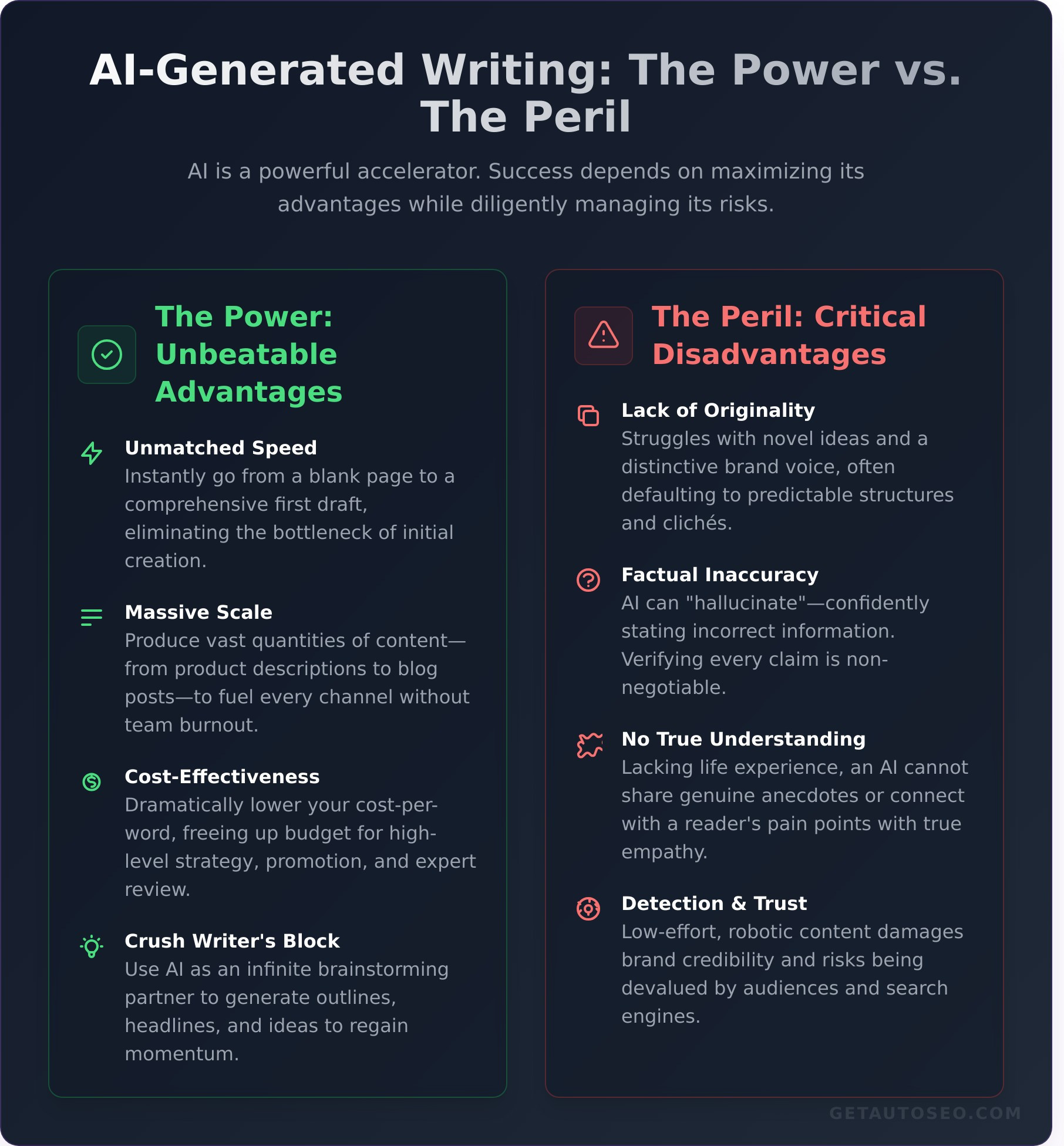
AI writing tools are not magic; they are powerful accelerators. Understanding their capabilities and limitations is the first step to dominating your content strategy. While it’s crucial to understand what AI-generated content is and how it works, the real question is how to leverage its power without falling into common pitfalls. The effectiveness of any ai generated writing tool depends entirely on the human guiding it.
The Unbeatable Advantages: Speed, Scale, and Cost
The core appeal of AI in content creation boils down to one thing: radical efficiency. Tasks that once took hours can now be completed in minutes. This is a fundamental shift in how content is produced, allowing you to operate at a scale previously unimaginable.
- Unmatched Speed: Go from idea to a comprehensive first draft instantly. Stop staring at a blank cursor and start refining a nearly complete article.
- Massive Scale: Need 50 product descriptions by tomorrow? A dozen blog post variations for A/B testing? AI makes it possible to fuel every channel without burning out your team.
- Cost-Effectiveness: Dramatically lower your cost-per-word. This frees up budget to invest in higher-level strategy, promotion, and expert review.
- Crush Writer’s Block: Use AI as an infinite brainstorming partner. Generate outlines, headlines, and opening paragraphs to get momentum when you’re stuck.
The Critical Disadvantages: Quality, Originality, and Risk
However, speed and scale come with significant risks. Treating ai generated writing as a “one-click” final product is a recipe for failure. The output reflects the data it was trained on-inheriting all the biases and inaccuracies of the open internet. These challenges are not deal-breakers, but they are critical guardrails you must enforce.
- Lack of Originality: AI can struggle to produce truly novel ideas or a distinctive brand voice, often defaulting to predictable structures and clichés.
- Factual Inaccuracy: AI models can “hallucinate”-confidently stating incorrect information as fact. Verifying every claim and statistic is non-negotiable.
- No True Understanding: An AI has no life experience or emotions. It cannot share a genuine anecdote or connect with a reader’s pain points with true empathy.
- Detection and Trust: Audiences and search engines are increasingly sophisticated. Low-effort, robotic content damages brand credibility and can be penalized.
| The Power (Pros) | The Peril (Cons) |
|---|---|
| Instant draft creation | Generic and uninspired tone |
| Massive content scalability | Risk of factual errors (“hallucinations”) |
| Significant cost savings | Lacks human empathy and experience |
| Overcomes writer’s block | Potential for audience and search engine distrust |
Think of AI not as an author, but as the world’s fastest assistant. The pros give you leverage, while the cons define your role as a strategist and editor. Success depends on maximizing the first while diligently managing the second.
AI Writing and SEO: What Google Really Thinks
Let’s cut to the chase. Your biggest fear is a Google penalty. You’re worried that using AI-generated content will tank your rankings overnight. The good news? It’s not that simple. Google’s stance has evolved, and it’s no longer about how content is made, but how helpful it is.
Google doesn’t care if you use a pen, a keyboard, or an AI to write. Its goal is to reward content that provides value to users. The focus is on quality, originality, and satisfying user intent. Spam is spam, whether it’s written by a human or a machine.
Decoding Google’s Helpful Content Guidelines
Google’s Helpful Content System is designed to reward content created for people, not just to manipulate search engine rankings. Think of AI as a powerful tool in your arsenal. The final output is what gets judged. Low-quality, unedited ai generated writing designed to game the system will be penalized. High-quality, human-reviewed content that solves a user’s problem will be rewarded. It’s that direct. Stop guessing what the algorithm wants and start creating what your audience needs. Let our AI write content Google loves, automatically.
E-E-A-T is Your North Star
To create content Google loves, you must demonstrate Experience, Expertise, Authoritativeness, and Trustworthiness (E-E-A-T). This is where human oversight becomes non-negotiable. An AI can’t fake firsthand experience or genuine expertise. Use AI to accelerate your process, but use your unique knowledge to elevate the final product.
- DO: Use AI to generate outlines, brainstorm ideas, and write first drafts instantly.
- DO: Inject your own experience, data, and unique insights to add value.
- DON’T: Publish raw AI output without rigorous fact-checking and editing.
- DON’T: Use AI to mass-produce low-value content on topics you know nothing about.
The Danger of AI Content Detectors
Forget trying to “beat” AI detectors. These third-party tools are notoriously unreliable, often producing false positives and flagging human-written text. They analyze patterns like sentence predictability (“perplexity”) and variation (“burstiness”), but they are not used by Google for ranking. As even academic resources like the University of Illinois Chicago’s guide to AI writing note, concerns about accuracy are significant. Your energy is better spent on creating valuable content, not on passing an arbitrary test. The best way to ensure your ai generated writing is high-quality is through smart, strategic human editing.
Best Practices: How to Create High-Quality AI Content
Stop getting mediocre results from your AI tools. The problem isn’t the technology-it’s the process. Generic prompts produce generic content. To dominate the SERPs, you must shift from simple generation to a strategic human-AI collaboration. This is how you transform AI from a simple writer into a powerful content co-pilot and overcome the common pitfalls of AI-generated content.
Follow this expert checklist to ensure your ai generated writing is sharp, accurate, and optimized for performance.
Mastering the Art of the Prompt
Quality output depends entirely on quality input. Don’t just ask for an article; direct the AI with the precision of a creative director. This is the fastest way to get 90% of the way to a finished product in minutes.
- Be Hyper-Specific: Provide the AI with your exact goal, target audience, desired tone of voice (e.g., “confident and professional”), and primary keyword.
- Assign a Role: Start your prompt with a command like, “Act as an expert SEO content strategist…” This primes the AI to access more relevant information and adopt the correct persona.
- Provide a Style Guide: Paste a short paragraph of text you like and instruct the AI to “write in a similar style.” This is the ultimate shortcut to matching your brand voice.
- Iterate and Refine: The first draft is never the final draft. Use follow-up commands like “make this more concise,” “expand on the second point,” or “rewrite this for a beginner audience.”
The Essential Human Touch: Editing and Fact-Checking
AI provides the draft; you provide the authority. This human oversight is non-negotiable for building trust with readers and search engines. Skip this step, and you risk publishing inaccurate, soulless content that fails to rank or convert.
- Fact-Check Relentlessly: AI models can “hallucinate” facts, statistics, and sources. Verify every single claim before you hit publish.
- Inject Your Expertise: Weave in your unique insights, personal anecdotes, or original data. This is what separates your content from everyone else’s and provides real value.
- Optimize for Flow: Break up long, dense paragraphs. Use subheadings, bold text, and bullet points to improve readability and user engagement.
Choosing the Right AI Writing Tool
Your workflow dictates your tool. While standalone writers like Jasper or integrated assistants in Notion are useful for hands-on tasks, they still require significant manual effort. For maximum efficiency, you need a system built for results.
Fully automated platforms are the definitive solution for serious content strategists. These end-to-end systems manage the entire workflow, from keyword analysis to generating a complete, SEO-optimized article. A solution like AutoSEO is designed to put your ai generated writing on autopilot, delivering tangible ranking improvements while saving you dozens of hours.
Full Automation: The Future of AI-Powered SEO
You’ve seen how high-quality ai generated writing can elevate your content. But let’s be honest-you’re still in the driver’s seat. You’re still prompting, editing, and publishing. Even with powerful tools, SEO remains a demanding, hands-on job that drains your time and resources.
What if you could take the final step and remove yourself from the process entirely? This is the critical shift from simply using AI tools to deploying a true AI system that runs your SEO for you. It’s about achieving results without the daily grind.
Beyond Generation: Automating the Entire Workflow
The typical content process is a multi-step marathon, even with AI assistance. You still have to:
- Perform tedious keyword research and plan a content strategy.
- Craft and test the perfect prompts for each article.
- Review and edit every piece for quality, accuracy, and brand voice.
- Format, optimize, and publish the content to your CMS.
- Build links to get your new content seen by search engines.
An automated SEO platform eliminates this entire chain of tasks. It’s designed to run independently, handling everything from keyword discovery and content clustering to generation, on-page optimization, and scheduled publishing. The most advanced systems even build backlinks automatically, ensuring your content doesn’t just exist-it ranks.
When to Choose an Automated SEO Platform
A fully automated solution isn’t a luxury; it’s a strategic necessity for those who need results without the manual labor. It’s the right move if:
- You’re a busy business owner who lacks the time or deep SEO expertise.
- You need to scale content production consistently to dominate your niche.
- You want one powerful platform to replace a dozen different, disconnected tools.
Stop juggling subscriptions and managing tedious workflows. It’s time to let a complete system handle your SEO from start to finish. Put your entire SEO on autopilot for $1. See how it works.
The Final Word: Put Your Content on Autopilot
The verdict is in: AI is not a threat to quality content; it’s the engine that will power the next generation of digital marketing. As we’ve explored, the key isn’t blind automation but strategic implementation. By understanding its capabilities and limitations, you can leverage ai generated writing to produce relevant, high-quality content at a scale your competitors can’t match. The manual, time-consuming methods of the past are officially obsolete.
But building this engine yourself is complex and slow. Why piece together tools when you can flip a switch? AutoSEO is the all-in-one solution designed for small businesses that demand results, not excuses. We put your growth on autopilot by publishing daily AI-powered expert articles directly to your site and building your authority with automated backlinking. It’s a complete system, built for one purpose: to make you win.
Stop Guessing. Start Ranking. Put Your SEO on Autopilot Now.
Frequently Asked Questions
Will using AI-generated writing hurt my website’s SEO?
No, it will not hurt your SEO if used correctly. Google rewards high-quality, helpful content, regardless of its origin. The danger lies in publishing unedited, low-value AI output at scale. Use AI as a powerful first-draft tool. Your job is to add unique expertise, fact-check, and ensure the content serves user intent. Combine AI efficiency with human oversight to create content that ranks and provides real value to your audience.
Can AI writing tools create factually accurate and up-to-date content?
Not always. AI models are trained on data up to a specific point in time and can generate outdated information or “hallucinations”-confidently stated falsehoods. For topics requiring current data or absolute accuracy, human verification is non-negotiable. Use AI to build the content structure instantly, but always fact-check statistics, dates, and critical claims yourself. This ensures your content is both authoritative and trustworthy.
What is the difference between free and paid AI writing generators?
The difference is power, quality, and features. Free tools often use older AI models, resulting in generic output and strict usage limits. Paid platforms provide access to the latest, most powerful models, delivering more nuanced and context-aware content. They also include critical features for marketers like plagiarism checkers, brand voice templates, and team collaboration tools. Investing in a paid tool is investing in superior, scalable content generation.
How can I make AI-generated content sound more human and less robotic?
Transform robotic text into engaging content with strategic human editing. Inject your brand’s unique voice, personal anecdotes, and opinions. Vary sentence length to create a better reading rhythm-mix short, punchy statements with more complex sentences. Rewrite passive voice into active voice for more direct impact. This final editing pass is what turns a machine-generated draft into a compelling article that connects with your readers.
Is AI-generated content considered plagiarism?
No, ai generated writing is not plagiarism. Plagiarism is the act of stealing someone else’s specific work. AI tools create new content by predicting word sequences based on patterns in their training data; they don’t copy and paste from existing sources. However, to guarantee originality, it is a critical best practice to run all final drafts through a reliable plagiarism checker before you publish. This simple step protects your site’s integrity.
What are the best AI writing tools for marketing and blogging?
The best tool depends on your specific needs. For comprehensive SEO content, tools like Jasper and Surfer SEO excel by integrating keyword optimization directly into the writing workflow. For generating high-converting ad copy, social media posts, and emails, platforms like Copy.ai and Rytr offer specialized templates that produce results in minutes. Analyze each platform’s features and integrations to find the one that best automates your content creation process.
How much human editing does AI-generated content typically require?
The editing time depends entirely on the quality of your prompt and the tool you use. A detailed prompt in a premium tool can produce a draft that is 80-90% complete, requiring only minor edits for tone, flow, and fact-checking. A vague prompt or a less advanced tool might only give you a 50% usable draft. Your goal is to use AI to eliminate the bulk of the writing time, freeing you up for high-impact strategic refinement.